Autonomous Omnichannel AI Sales Ecosystem for BrandVault360

Bhavy Shekhaliya


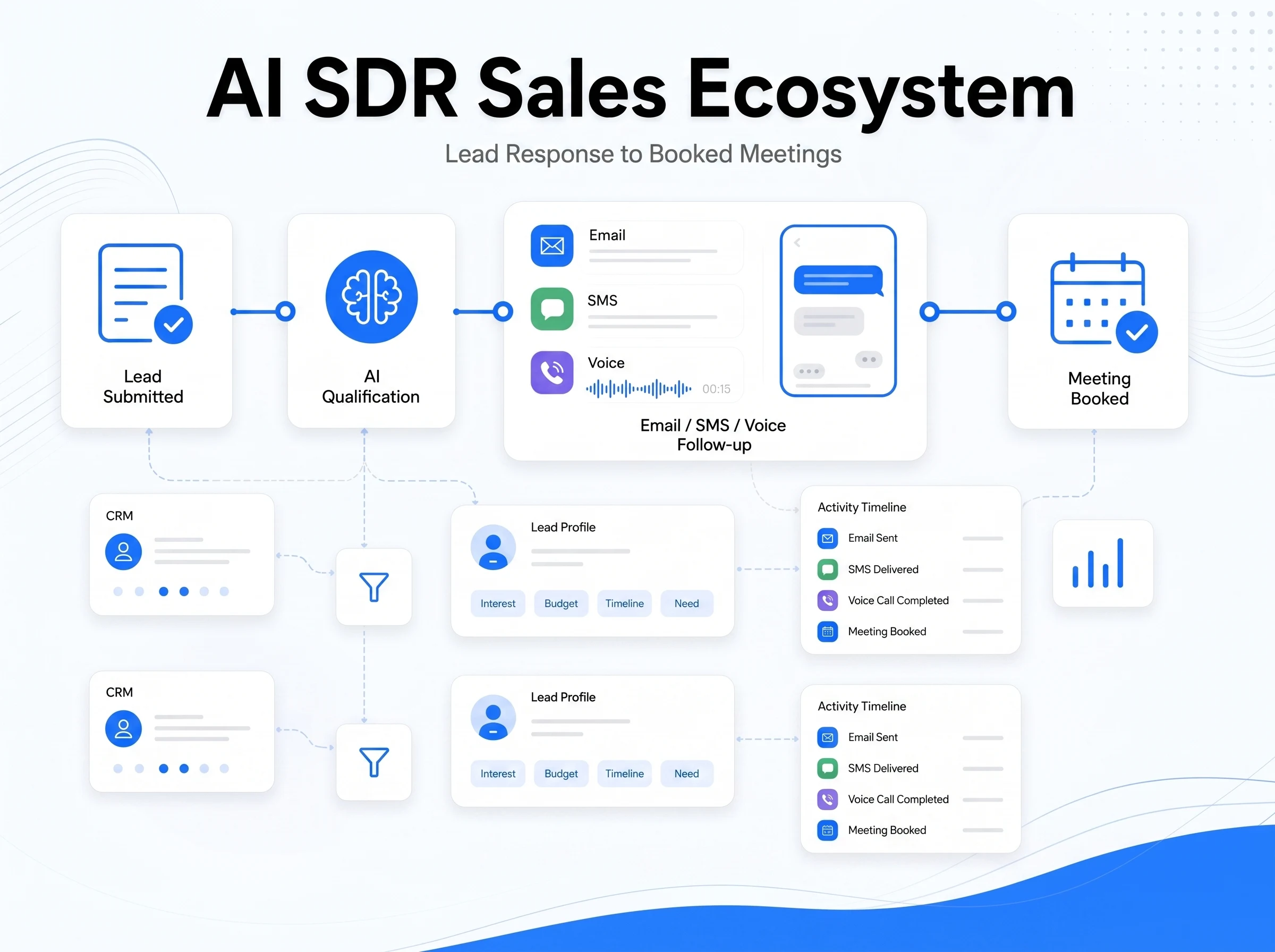
Leads were not the problem.
The agency was already generating them.
The real problem was what happened after the lead submitted a form.
For this project, I designed and deployed an autonomous omnichannel AI sales ecosystem for a US-based CPG branding agency.
The system acts like an AI SDR layer between lead generation and booked meetings.
It responds fast, follows up consistently, qualifies prospects, handles objections, and books meetings across email, SMS, voice, and calls.
The situation
The agency was generating leads from multiple sources:
Meta ads.
Website contact forms.
Campaign landing pages.
Leads were coming in from different places, but they did not enter one clean follow-up system.
Some landed in the team inbox.
Some needed a manual reply.
Some needed a follow-up later.
Some needed qualification before a meeting.
And some simply went cold because nobody responded fast enough.
The original process
Before automation, the workflow looked like this:
Lead submits a form.
Notification goes to the team inbox.
Someone checks the inbox when they remember.
Manual email reply is drafted.
Team waits for a response.
Follow-up happens sometimes.
Team tries to schedule a call through back-and-forth emails.
Meeting gets booked sometimes.
The process depended too much on human memory.
That made follow-up inconsistent.
Where leads were falling through
The main bottlenecks were clear:
Slow first response: leads went cold within hours.
Inconsistent follow-up: some leads received 3 follow-ups, some received zero.
No qualification step: the team spent time on unqualified leads.
Scheduling friction: 4-5 emails were needed just to find a meeting time.
No tracking: the team could not see which leads were stuck.
Channel fragmentation: leads from ads, forms, and pages landed in different places.
The agency was spending money to generate leads, then losing opportunities because the process after lead capture could not keep up.
What I built
I built an autonomous AI SDR ecosystem that handled the lead journey from submission to booked meeting.
This was not a basic email sequence.
It was a multi-agent sales workflow that could:
Respond to new leads in under 2 minutes.
Start follow-up automatically.
Personalize messages based on lead context.
Qualify leads through conversation.
Use email, SMS, voice, and calls.
Handle common objections.
Send the calendar link at the right moment.
Notify the team only when a qualified meeting was ready.
The goal was not to replace the sales team.
The goal was to remove the repetitive follow-up work so the team could focus on qualified conversations.
The redesigned lead journey
The new workflow:
Lead submits a form from any source.
Lead is captured inside the CRM.
The system sends an instant first response through email and SMS.
AI starts a smart follow-up sequence.
The lead receives timed follow-ups across email, SMS, voice notes, or calls.
AI asks qualification questions to understand fit.
If the lead is qualified, the system sends the calendar link.
Meeting is booked through one-click scheduling.
Confirmation and reminder sequences are sent.
The team receives a qualified lead brief before the call.
Human involvement changed from "every lead, every step" to "qualified meetings only."
End-to-end customer journey
Capture:
Lead submits from Meta ads, website forms, or landing pages.
Acknowledge:
Personalized response is sent within 2 minutes.
Channels: email and SMS.
Engage:
Follow-up sequence starts automatically.
Channels: email and SMS.
Qualify:
Conversational questions filter fit, urgency, and need.
Channels: email, SMS, and voice.
Schedule:
Calendar link is sent when the lead is qualified.
Channel: email.
Confirm:
Meeting confirmation and reminders are sent.
Channels: email and SMS.
Handoff:
Team receives the qualified lead brief before the call.
Channel: internal notification.
Multi-agent architecture
Unlike standard linear automations, this ecosystem used multiple agents for different parts of the sales process.
The system included:
Intake qualification agent: reviews the lead and filters basic fit.
Personalization agent: writes natural, non-robotic follow-up messages.
Channel agent: chooses the right channel based on lead stage and behavior.
Objection handling agent: responds to common hesitation or questions.
Booking agent: moves qualified leads toward a meeting.
CRM agent: updates GoHighLevel and keeps the pipeline clean.
This made the system more flexible than a fixed sequence.
If the lead was cold, it nurtured them.
If the lead showed intent, it moved faster.
If the lead had an objection, it responded with context.
If the lead was ready, it pushed toward booking.
Before vs after
First response time:
Before: 4-24 hours.
After: under 2 minutes.
Follow-up consistency:
Before: around 40% of leads.
After: 100% of leads.
Channels used:
Before: email only.
After: email, SMS, voice, and calls.
Qualification:
Before: manual qualification by the team.
After: automated qualification conversation.
Scheduling:
Before: back-and-forth emails.
After: one-click calendar booking.
Team involvement:
Before: every lead, every step.
After: qualified meetings only.
Tech stack
The system used:
n8n for automation orchestration.
GoHighLevel for CRM and pipeline management.
OpenAI and Claude for lead reasoning, personalization, qualification, and objection handling.
Twilio for SMS and communication routing.
Vapi for AI voice workflows.
ElevenLabs for natural voice generation.
Meta Ads as a lead source.
Email automation for nurture, confirmation, and reminders.
Each tool had a specific job.
The value came from connecting them into one operating system for lead response and meeting booking.
What this meant for the agency
The agency stopped losing leads to slow follow-up.
Every lead that came in, whether at 2pm or 2am, received an immediate and professional response.
The team stopped spending hours chasing unqualified prospects.
By the time a meeting appeared on the calendar, the lead had already been engaged, followed up with, qualified, and scheduled.
They spent the same amount on ads.
They got more meetings because the process between "lead submitted" and "meeting booked" became faster and more consistent.
What made this useful
The important part was not just adding AI.
The important part was redesigning the sales workflow.
Lead capture, response, follow-up, qualification, objection handling, booking, reminders, and CRM updates were connected into one system.
That removed the messy middle between ad spend and booked meetings.
The practical lesson
Most agencies do not only need more leads.
They need a better system for handling the leads they already generate.
When every lead gets a fast response, every prospect gets consistent follow-up, and every qualified lead gets pushed toward booking, the sales team can focus on real conversations instead of admin work.
That is where AI automation becomes useful.
Not as a gimmick.
As the operating layer between lead generation and revenue conversations.
If your agency is generating leads but still manually chasing, qualifying, and scheduling every prospect, this is the kind of AI SDR ecosystem I can help map and build.
#AIAutomation #SalesAutomation #WorkflowAutomation
Optional short Contra feed post:
I built an autonomous AI SDR ecosystem for a US-based CPG branding agency.
The agency was already generating leads from Meta ads, forms, and landing pages.
The problem was what happened after.
Before:
First response time: 4-24 hours.
Follow-up consistency: around 40%.
Scheduling: back-and-forth emails.
Team involvement: every lead, every step.
After:
First response: under 2 minutes.
Follow-up: 100% of leads.
Channels: email, SMS, voice, and calls.
Scheduling: one-click calendar booking.
Team involvement: qualified meetings only.
The stack:
n8n,
GoHighLevel
OpenAI
Claude
Twilio
Vapi
ElevenLabs
Meta Ads
email automation.
The lesson:
Most agencies do not only need more leads.
They need a better system between "lead submitted" and "meeting booked."
Like this project
Posted Jun 5, 2026
The system responds to leads in under 2 minutes, follows up across email, SMS, voice, and calls, qualifies prospects, and books meetings automatically.