MotivateAI - Personalized Study Planner Development

Amina S


Self-directed learning has a brutal dropout problem.
Most people start an online course with enthusiasm, but only a small percentage finish. Learning platforms give you endless videos. Habit trackers count your streaks. Neither understands why you're losing momentum or adapts your next study session accordingly.
That's the problem I wanted to solve with MotivateAI.
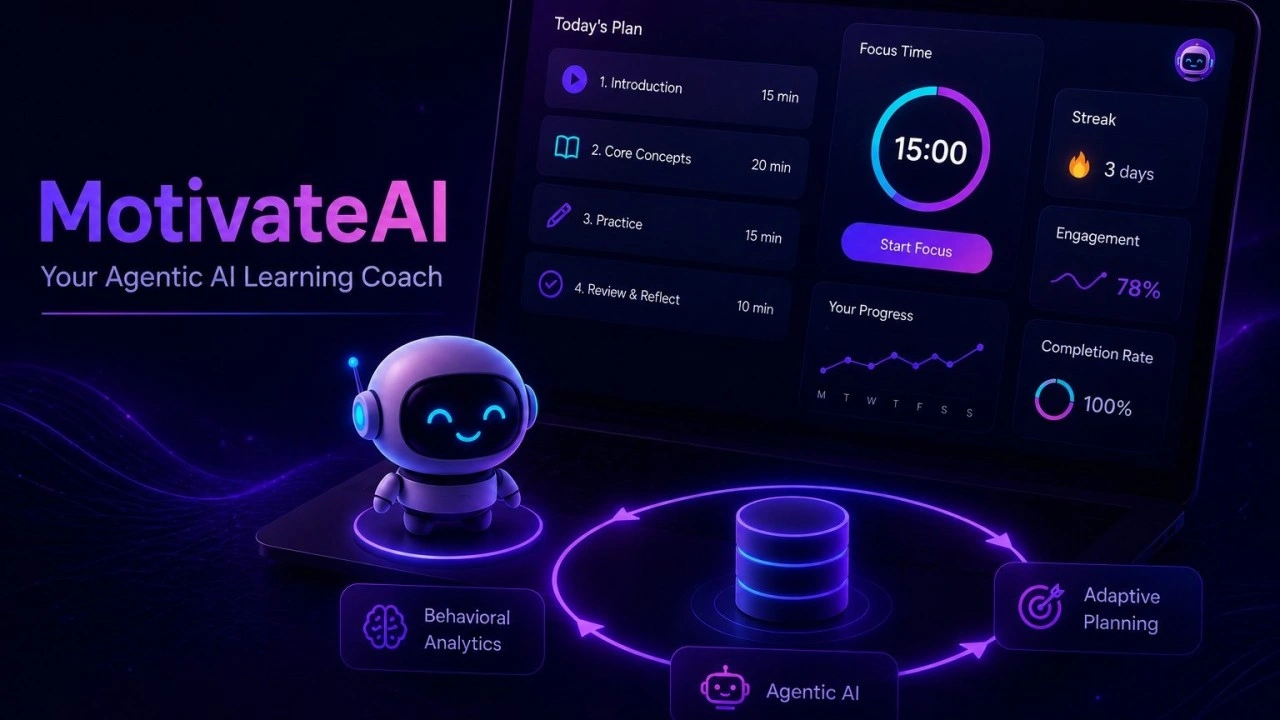
Instead of acting as another study planner, MotivateAI treats every study session as behavioral data. It analyzes how you learn, identifies patterns in your focus and consistency, and uses those insights to generate increasingly personalized study plans.
This article explores how the system works—from behavioral analytics and prompt engineering to Gemini 2.5, MCP tools, and the feedback loop that continuously improves future sessions.
Architecture Overview
MotivateAI is built as a full-stack Next.js application using:
The overall flow looks like this:
The user enters a learning goal.
Previous study sessions are loaded from MongoDB.
A behavioral analytics engine converts raw session history into structured learning signals.
Those signals become adaptive instructions inside Gemini's system prompt.
Gemini generates a structured JSON study plan.
Matching YouTube resources are automatically selected.
Session results are written back to MongoDB, improving future recommendations.
Every completed session makes the next recommendation smarter.
From Session Logs to Behavioral Intelligence
Rather than sending raw session history directly to the LLM, MotivateAI first converts historical data into deterministic behavioral signals.
The analytics engine calculates metrics such as:
Average task duration
Task duration variance
Completion rate
Break skip rate
Typical dropout point
Best study time
Consistency score
Current and longest learning streaks
These statistics are then transformed into meaningful behavioral signals like:
Prefers short study sessions
Frequently skips breaks
High variation in focus
High or low engagement
This separation is intentional.
The behavioral analysis remains deterministic, testable, and independent of the LLM, making personalization more reliable while reducing token usage.
Turning Analytics into Adaptive Prompts
Numbers alone don't create good coaching.
Break skip rate = 62%
MotivateAI translates that into an actionable instruction:
The user skips breaks frequently. Schedule an earlier break around 18 minutes instead of the default 25 minutes.
Likewise, if historical data shows users usually abandon sessions around minute 22, future sessions are shortened before that point.
The prompt also prioritizes:
Completion over content volume
User behavior over generic study advice
Early wins before deep work
The model receives clear constraints rather than raw statistics.
Reliable Structured Output
Each session plan contains:
Goal
Estimated duration
Break timing
Personalization notes
Task list
Difficulty
Learning resources
After generation, the application validates the response.
If anything is malformed—or Gemini fails entirely—the application falls back to a predefined study plan instead of breaking the user experience.
Beyond session planning, MotivateAI also supports an agent workflow powered by the Model Context Protocol (MCP).
When Gemini needs external information, it can call these tools through an iterative function-calling loop.
The workflow is straightforward:
User request
Gemini requests a tool
MCP executes it
Results return to Gemini
Gemini decides whether another tool is needed
This repeats until the task is complete or reaches the iteration limit.
If MCP becomes unavailable, the application gracefully falls back to Gemini's native reasoning instead of failing completely.
Continuous Optimization
One of my favorite parts of the system is the optimization engine.
Instead of looking at only recent sessions, it analyzes approximately 30 historical sessions to identify longer-term learning trends.
Gemini then suggests concrete improvements such as:
Better session length
Better break timing
Improved scheduling preferences
Expected improvement
User-friendly explanation
Technical reasoning
Accepted recommendations are immediately merged into the user's preferences, creating a continuous feedback loop where every accepted optimization influences future study plans.
Prompt Injection Protection
Because users provide free-text learning goals, the application includes multiple defensive layers.
The input is:
Limited to 100 characters
Sanitized using regex patterns for common prompt injection attempts
Separated from system instructions
Combined with strict schema validation
Regex-based filtering isn't a complete security solution, but layered together with system prompts and structured outputs, it significantly improves robustness.
Why This Architecture Matters
The most important design decision wasn't choosing Gemini or MongoDB.
It was separating deterministic behavioral analytics from probabilistic language generation.
The LLM never needs to interpret noisy session history.
Instead, it receives structured behavioral intelligence and focuses only on generating an adaptive study plan.
That separation makes the system:
Easier to test
Easier to debug
More token efficient
More predictable
Easier to extend
The MCP agent and optimization engine build on that same philosophy, creating an AI learning coach that becomes increasingly personalized over time instead of repeating the same generic advice.
If you're building AI products with LLMs, I'd love to hear how you're approaching personalization, agentic workflows, or behavioral analytics.
Tech Stack: Next.js • React 19 • Google Gemini 2.5 Flash • MongoDB • MCP • YouTube Data API
Like this project
Posted Jul 4, 2026
Developed an AI-driven study planner using behavioral analytics for personalization.
Likes
0
Views
2