Decentralized Crowdfunding Platform

Abolaji Adedeji


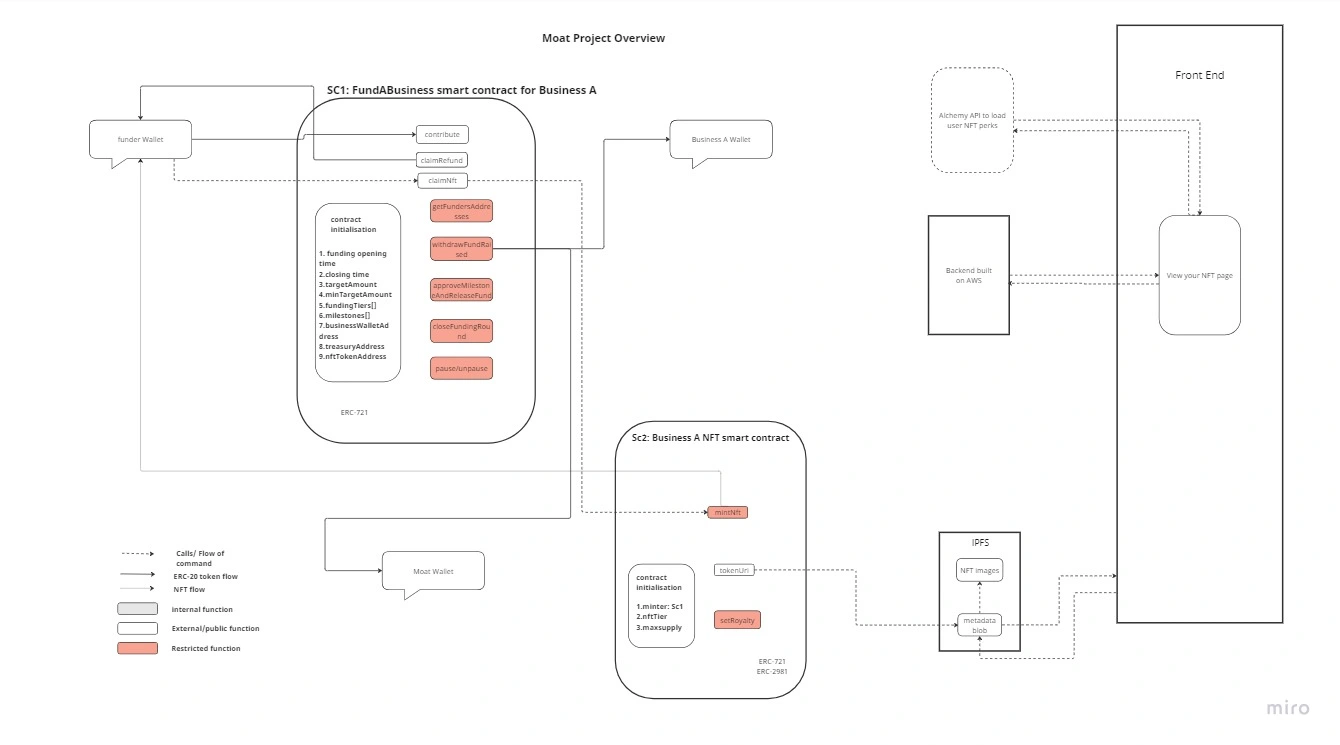
Project Moat Overview
Project moat is a decentralised crowd-funding platform that allows businesses to raise funds through crowd-funding. Contributors would be rewarded with nft of different perks based on how much the contributor contributed during the campaign period or funding round once the target amount is met.
Contributors would be able to contribute through fiat (banking system) and through cryptocurrency during the funding round. The nft perks given as the reward to the contributors will guarantee the contributor a special discount and vip access with the business. The contributor would also have the option of selling the nft perk on the secondary market to recover his/her investment anytime. The new buyer have to continuously patronise the business to claim the discounts and vip access attached to the nft perks. This way, the business customer-base keeps growing, the business itself keeps growing and the values of the nft perks also increase in the secondary market.
However, if the target amount is not met during the funding round and the campaign fails all the contributors or funders will be able to claim their refund or it may be sent to their wallets.
Benefits of Project Moat
Unlike the traditional crowd-funding space, the businesses do not have to promise unrealistic return on investment to the contributors. The contributors are not shareholders in the business. This gives sufficient time to the startup (business) to grow and expand carefully.
The contributors also become customers to the business as they can only use their NFT perks to claim discounts and VIP access with the business.
Anytime these NFT perks are sold in the secondary markets, the business gets royalties and gains a new customer. Royalties from the secondary markets give the business additional cash flow.
Contributors are able to see how and when funds-raised are released to the business according to the milestones defined in the contract as the approval and release of funds will be done on-chain. This guarantees transparency.
Since fiat contributions will be accepted, many more new users will be brought to the web3 space.
Project Moat will generate cash flow by taking fractions of the fund raised and the NFT royalties in the secondary market. Project Moat team plan to develop NFT marketplace as secondary market for the NFTs and hopes to eventually become a DAO. As a DAO, the project will be community-owned and the team can continue to effectively screen every business that comes to raise funds on the platform.
Background and Challenges We ran into
The Project Moat team first conceived the idea of a decentralised crowd-funding platform a few weeksbefore the Chainlink Hackathon started. Then we started writing the smart contracts.The FundAbusiness contract was initially developed to accept only stable coins.
However, a few days into the implementation, the USDC stable coin lost its peg. The first US bankcollapse this year happened. Then a few more banks also went under. Then, we realised that keepingstable coins on the contract for a long period of time is risky.
While we explore other options, Chainlink Hackathon started. We wanted to participate in the hackathon so we thought of ways to upgrade the project we are building. We decided to accept only ETH or native coins of the host blockchain. We used Chainlink DataFeed to fetch the real-time price of ETH and calculate the equivalent amount of every contribution. Then we proceeded to building the frontend and backend (including APIs)of the project.
Implementation
The Figure 1 below shows the overview implementation of the project. Two smart contracts were written; the FundABusiness.sol and the NFTperks.sol. The FundABusiness.sol contract manages the crowd-funding campaign. It has the minter-role of the NFTperks.sol contract and it would be able to mint NFTs to funders or contributors once the campaign is declared successful and the NFT contracts are set.
The Figure 2 below describes all the callable functions in the FundABusiness.sol. All the functions have a period of time when they are callable. For example, the contribute function is only available when the campaign period is open while claimRefund function can only be called when the campaign has failed. The Project Moat manager would be able to use the contributeOnBehalfOf function to deposit fiat contributions on behalf of the fiat contributors.
The figure above shows the overview of the architecture of the two APIs.
Tech-Stacks Used to build this Project
Hardhat framework for building smart contracts.
Chainlink Datafeed used for the "contribute" function in the FundABusiness contract to get the current price of ETH so that the value of the Tier Perks can be accurately calculated in ETH.
Next.js, Tailwind.css, Web3uikit and Moralis were used to build the frontend.
Smart contract tests, frontend and backend are written in Typescript.
Serverless framework was used to manage resources on AWS.
AWS Lambda, API Gateway and RDS Postgress were used to create the backend.
Alchemy API were used to fetch accounts Moat NFTs on the View Your NFTs page.
IPFS, NFTStorage + Filecoin used to host the NFT metadata and images.
View your NFT Page on the Frontend
On the View your NFT page on the frontend, the contributors will be able to generate a token or random string with their NFT perks. With this random string, a contributor (user) can go to the business and claim their perks. The business just needs to call the validate-otp API.
Here is how it works; once the user connects his/her wallet to the View Your NFT page, the Alchemy NFT API is called to load and display all the NFT perks in the user wallet. With any of the NFT, the user can generate the random string by clicking the NFT. In the background, the clicking action calls the generate-token API and it responds with the random string. The NFT data and the corresponding random string are stored in the AWS RDS database for the eventual validation API call.
It is expected that the user will go to the business with this random string to claim the NFT perks benefits. The business will make API call through the validate-otp API and an appropriate response will be received from the backend. The API call also updates the database with the random string status to "used".
This is a Next.js project bootstrapped with
create-next-app.Running this Project Locally
To run this project locally, this crowd-fund-frontend-backend-hackathon repo and the crowd-fund-hardhat-hackathon repo must be cloned.
To clone these repos, run the following command on your cli;
Then go into crowd-fund-hardhat-hackathon/utils/constants.ts, change the CAMPAIGN_PERIOD values.
CAMPAIGN_PERIOD = [unix start time, unix end time, time (in seconds) required to make a decision]
Convert a future time to unix time and enter it as the campaign to start. Similarly, convert a later time in the future to unix time and enter it as campaign end time. You can use the unix timestamp convert to do the conversion.
Ensure the frontEndContractsFile parameter in the crowd-fund-hardhat/utils/constants file is rooted to crowd-fund-frontend-backend-hackathon/constants/fundABizAddress.json and crowd-fund-frontend-backend-hackathon/constants/nftPerksAddresses.json location in the crowd-fund-frontend-backend-hackathon repo. Also, ensure frontEndAbiLocation parameter in the crowd-fund-hardhat/utils/constants file is rooted to crowd-fund-frontend-backend-hackathon/constants/ folder in the crowd-fund-frontend-backend-hackathon repo.
Finally, set the SET_NFT_PERKS and UPDATE_FRONT_END parameters in the .env file of crowd-fund-hardhat repo to true as shown in the .env.example file.
Then start the hardhat local blockchain by running this command in crowd-fund-hardhat-hackathon directory;
While the blockchain is running in the background, using another terminal, change directory to crowd-fund-frontend-backend-hackathon folder. Then, run the development server:
Also, get the API key from Alchemy to view your Moat nft on the testnet or mainnet. Enter this API key into the crowd-fund-frontend-backend-hackathon/.env file to set NEXT_PUBLIC_ALCHEMY_MUMBAI_API_KEY parameter as shown in the .env.example.
Open http://localhost:3000 with your browser to see the result.
You can interact with the frontend by connecting your wallet.
Note:
You can only contribute to the campaign when the campaign is open after the start-time entered above has passed.
View Your NFT page uses the Alchemy API to query and display all the users NFT perks and the API is only available on the testnet and mainnet. Therefore, the paige will only show "No NFT found" when on a local chain.
Like this project
Posted Sep 17, 2025
Developed a decentralized crowdfunding platform that rewards participants with NFTs. The NFTs are used to claim perks from the funded businesses in the future.