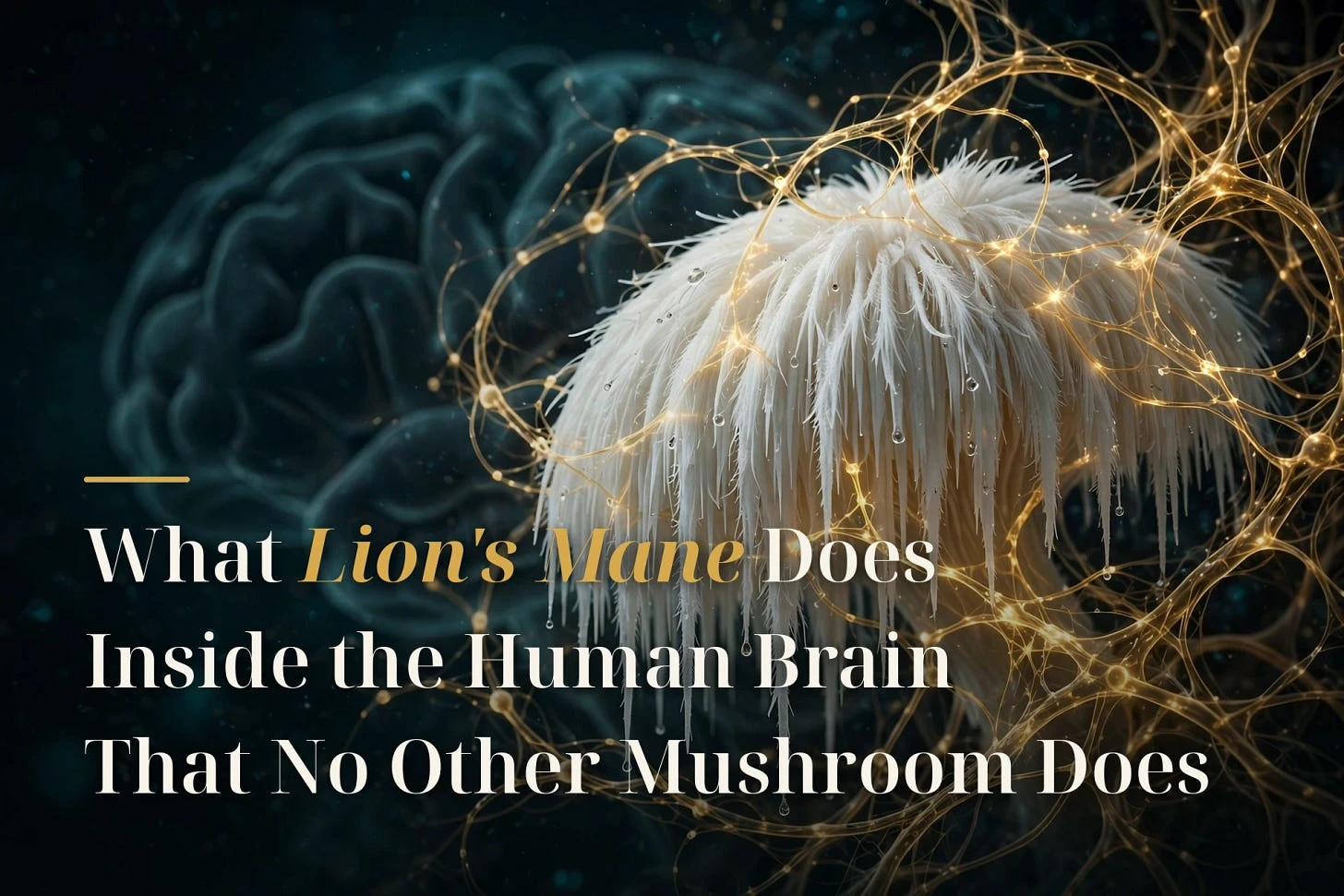
What Lion's Mane Does Inside the Human Brain

Zane Sampson

In a 2008 study by Mori and colleagues, published in the Biological and Pharmaceutical Bulletin, researchers looked for one specific effect: whether each mushroom could make human brain cells produce more nerve growth factor. Three of the four did nothing measurable. Only one triggered a clear increase. That one was lion’s mane, Hericium erinaceus.
Why does that matter? Because nerve growth factor, usually shortened to NGF, is the protein that tells neurons to grow, survive, and stay connected. It is one of the most important maintenance signals in the human brain. And here is the catch: you cannot just take NGF as a supplement. It is a protein, so swallowing it means it gets digested like any protein. It is also too large to cross the blood-brain barrier, the tight filter that decides what gets into your brain from your blood. So if more NGF is going to reach your brain cells, your brain has to make it itself.
That is what makes the compounds inside lion’s mane so unusual. They do not supply NGF. They appear to signal the brain to produce more of its own.
The proposed pathway: from mushroom compounds to more of the brain’s own nerve growth factor. Human brain delivery remains unproven.
Last month I wrote about what researchers have observed lion’s mane doing to nerve cells, the outward effects. This is the companion piece: how it happens inside the brain, step by step, and where the evidence stops. If you read both, you will have the complete picture. If you only read this one, you will still understand the mechanism that makes this mushroom different from every other functional mushroom I have studied.
What the comparative study actually found, and what “no other mushroom” really means
Let me be precise about the headline, because precision is the whole point of this article.
The finding comes from a 2008 study by Mori and colleagues, published in the Biological and Pharmaceutical Bulletin. They tested extracts of four edible mushrooms in human astrocytoma cells, a human brain cell line: lion’s mane (Hericium erinaceus), king oyster (Pleurotus eryngii), maitake (Grifola frondosa), and agaricus (Agaricus blazei). Only lion’s mane triggered nerve growth factor activity, and the effect grew stronger with higher concentrations. The same study fed lion’s mane powder to mice for seven days and found increased NGF activity in the hippocampus.
So when I say no other mushroom does this, I mean it in a specific, scoped sense: in a four-mushroom screen on human brain cells, lion’s mane was the only one that signaled NGF production. That is meaningful, because NGF signaling is rare and valuable, but it is not proof that lion’s mane is unique among every fungus on earth. Researchers have since found NGF-inducing compounds in a few other mushrooms, like Dictyophora indusiata and Sarcodon species. Nobody has tested every fungus. What we can say is that in this head-to-head screen of four well-studied edible mushrooms, lion’s mane stood alone.
That distinction matters because the supplement world loves to turn a lab finding into a universal claim. The finding here is already interesting enough without inflating it.
The two compounds behind the effect: hericenones and erinacines
The NGF signal does not come from the mushroom as a whole. It comes from two distinct families of compounds, and they live in two different parts of the mushroom. Understanding this split is the key to understanding the research, and it is also the key to reading a lion’s mane label intelligently.
Hericenones are found in the fruiting body, the white, shaggy, visible mushroom itself. Hericenones C, D, and E were isolated in 1991 and hericenones F, G, and H in 1992, and in lab studies they stimulated NGF synthesis in cultured mouse brain cells. Here is the honest wrinkle: when researchers later tested purified hericenones on human brain cells, they failed to trigger the same NGF effect, even though the whole mushroom extract still worked. That means the true NGF signal in the fruiting body may come from other compounds we have not fully identified yet. The mechanism is real and unresolved at the same time. Erinacines, by contrast, are found in the mycelium, the thread-like network that grows beneath the surface and functions as the mushroom’s root system. They were identified shortly after, and they showed the same core ability: prompting cells to produce more nerve growth factor.
Two parts of one mushroom. Two different compound families. One shared effect. That is the mechanism story in miniature: lion’s mane carries both halves of the NGF signal.
Fruiting body vs. mycelium: where each NGF-signaling compound family lives, and what the studies actually showed.
Why you cannot just take nerve growth factor as a supplement
This section might be the most important one in the article for anyone shopping for brain supplements.
NGF is a protein. When you eat a protein, your digestive system breaks it down into amino acids. The NGF molecule does not survive the trip. And even if it did, the blood-brain barrier would stop it. That barrier is extremely selective: it keeps large molecules, including most proteins, out of the brain to protect it. NGF is far too large to pass through.
This is why the lion’s mane research is a different category of finding from most supplement claims. Most brain supplements try to deliver something to the brain directly. Lion’s mane, if the research holds, works indirectly: its compounds are small enough to travel in the body, and they appear to tell the brain’s own cells to ramp up production of a signal the brain already knows how to make.
The blood-brain barrier question, and what erinacines did in living animals
For a compound to signal the brain, it has to reach the brain. Whether hericenones cross the blood-brain barrier in meaningful amounts is still an open question. The erinacine evidence goes one step further, and it comes from living animals rather than a dish: in a 2005 study, orally administered erinacine A raised nerve growth factor levels in the brains of rats, specifically in the locus coeruleus and the hippocampus, two regions involved in attention and memory. If a swallowed compound’s signal shows up inside the brain, the compound or its signal is reaching brain tissue in a living animal.
I want to flag this honestly as early evidence, not settled fact. It is animal work, and I could not find a published study directly demonstrating blood-brain barrier crossing by erinacines. But an orally administered compound raising NGF inside a rat’s brain is more than a lab-dish result. It is a promising mechanism, not a proven delivery system in humans.
What the human trials actually found
Here is the human evidence, all of it, stated plainly.
In 2009, Mori and colleagues ran a randomized, double-blind, placebo-controlled trial in Japan. Thirty adults between the ages of 50 and 80, all diagnosed with mild cognitive impairment, took either lion’s mane or a placebo daily for 16 weeks. The lion’s mane group showed improved scores on cognitive function tests compared with the placebo group. Then the researchers did something unusual and honest: they stopped the lion’s mane and watched for four more weeks. The cognitive improvements diminished after the supplementation ended.
That last detail is the one I trust most. A trial that reports its own fade-out is a trial worth taking seriously. The effect appeared while people were taking lion’s mane and faded when they stopped, which is consistent with a real, ongoing biological signal rather than a fluke.
Now the limitations, because they matter. Thirty people is a small study. All participants were older Japanese adults with mild cognitive impairment, so we cannot assume the same result in younger people or in people without cognitive complaints. And this remains essentially the entire human trial base for lion’s mane and cognition: one small, well-run trial that needs larger replication before anyone treats the effect as established.
So the honest summary of the human evidence is this: one small controlled trial found that lion’s mane improved cognitive test scores in older adults with mild cognitive impairment, and the benefit faded after stopping. That is encouraging. It is not proof.
What has only been shown in animals or cells so far
Everything beyond that one human trial lives in animal or cell studies, and I am labeling it clearly because none of it transfers directly to humans.
In animal models, researchers have reported that a 2011 study found rats with a crushed peroneal nerve recovered hindlimb function several days earlier when given an aqueous extract of fresh lion’s mane fruiting bodies, that oral erinacine A raised NGF in rat brain regions tied to attention and memory, and that lion’s mane extracts improved memory performance in healthy mice and showed protective effects in models of spinal cord injury and traumatic brain injury. In cell studies, lion’s mane stimulated neurite outgrowth in PC12 cells, a standard lab model for studying neuron-like growth, and an in vitro myelinating culture system showed induced myelination, the formation of the protective sheath that insulates nerve fibers and helps signals travel quickly.
The myelin finding deserves a pause, because it connects to something real about how brains age. Myelin sheaths thin over time, and signal speed matters for everything from reflexes to memory recall. A compound that promotes myelin production in a lab dish is genuinely interesting. But a lab dish is not a human brain, and a mouse is not a person. Every one of these findings is a reason to run more human trials, not a reason to claim a human benefit.
How this maps to real products, and what labels actually tell you
Now that you understand the mechanism, here is the part that affects your wallet.
The research studied specific compounds from specific parts of the mushroom: hericenones from the fruiting body, erinacines from the mycelium. Most lion’s mane products on the market do not tell you which parts they contain, how much of each compound is present, or whether the product is an extract standardized to anything at all. Many products sold as mushroom supplements are mostly mycelium grown on grain, which means a significant portion of what is in the capsule or scoop can be leftover growing medium rather than mushroom material. That is legal, but it is worth knowing when you compare products to the research.
This is the moment where it makes sense to examine how one real product maps to the research. Ascent Nutrition’s Lion’s Mane is a powder containing both mycelium and fruiting bodies, which mirrors the two-compound story in this article: hericenones come from the fruiting body, erinacines from the mycelium. It is grown in the USA, one serving is a single scoop of about 2 grams, and the label states plainly that daily value is not established. The other ingredient is organic myceliated brown rice, and the page does not claim any standardization or quantified compound levels, which I respect more than a label full of promises. The extract I kept coming back to while researching this piece is Ascent’s lion’s mane — that link is an affiliate link, which means I may earn a commission if you buy, at no extra cost to you.
What the research does not show
Clearing the underbrush, because the internet is full of claims the research never made.
Nothing in the published research shows that lion’s mane treats or prevents Alzheimer’s disease, multiple sclerosis, Parkinson’s disease, or any other named condition. The human trial measured cognitive test scores in people with mild cognitive impairment. That is not a disease-treatment trial, and it should never be described as one.
Nothing shows that lion’s mane regrows nerves in the human brain. Nerve regrowth has been studied in animal and cell models. It has not been demonstrated in people, and the gap between a petri dish and a human nervous system is enormous.
And nothing shows permanent structural change from supplementation. The one human trial found that benefits faded after stopping, which suggests an ongoing signal, not a lasting rewiring. Anyone selling you permanent brain change from a mushroom powder is selling you something the research does not contain.
What skeptical neuroscientists say
The sharpest objection to all of this comes from mainstream neuroscience, and it deserves a fair hearing.
The objection goes like this: the distance between mouse and human neurobiology is vast, the blood-brain barrier work is early, and the human trial base is a single small study from 2009 that nobody has replicated at scale. Until larger human trials exist, a careful neuroscientist will tell you this is an interesting hypothesis with a thin evidence base, not a finding.
They are right about the evidence base. Where I push back gently is on what thin means. A randomized, double-blind, placebo-controlled trial with an honest fade-out is not nothing. It is a real signal in a small sample, and it is exactly the kind of signal that justifies bigger trials. The skeptics are correct that we should not overclaim. They are also, in a sense, describing the normal early stage of every natural compound that eventually proved useful.
The intellectually honest position is the middle one: the mechanism is plausible and partially mapped, the human evidence is real but small, and the only way to know more is larger trials. That is not hype. That is science doing its job slowly. I explored this shifting scientific conversation in more depth here.
What I look for in a lion’s mane product
After years of reading labels and longer reading research papers, my standards are simple. I want both fruiting body and mycelium present, because the research story involves both halves. I want no hype claims on the label, because a product that promises what the research has not shown is telling you how it markets, not how it works. And I prefer USA-grown with a transparent ingredient list. Ascent’s Lion’s Mane meets those standards, which is why it is the option I recommend. If you try it, the code Zane10 takes 10 percent off.
Related reading
If this mechanism story grabbed you, these go deeper on the surrounding evidence:
There’s Only One Mushroom on Earth Known to Trigger New Nerve Growth in the Human Brain - the companion piece: what researchers observed lion’s mane doing to nerve cells, before we knew the full how.
Why Is Agarikon Mushroom Considered One of the Rarest Functional Mushrooms? - mushroom-adjacent: a different rare fungus, same evidence-first approach.
If your brain could make more of its own growth signal, what would you want it to help with first? Memory, focus, recovery, something else? Tell me in the comments. I read every one.
And if this kind of article, the mechanism, the honest limits, the label translation, is useful to you, subscribing is free and it is the single best way to make sure the next one reaches you.
Like this project
Posted Sep 20, 2026
SEO wellness article: fact-checked deep dive on lion's mane and brain health. Cited research, clean structure, reader-first explanations.
Likes
0
Views
2