AI Business Simulation Platform

Maxim Kushnir



An AI-driven business simulation platform built on a deterministic simulation kernel.
Decisions in, audited consequences out — every number reproducible, every AI contribution bounded.
1. Executive Summary
Ventute is a decision-simulation engine for business. A user founds and operates a company inside a
living economic world — setting prices, hiring, raising capital, managing supply chains, entering foreign
markets, and answering to stakeholders — and each turn resolves into a fully-audited financial and
operational outcome.
The hard problem in this space is trust. Most "AI business games" let a language model invent the
numbers: the revenue, the cash balance, the market reaction. That is entertaining and worthless — the
outputs are unreproducible, the accounting doesn't close, and there is nothing to learn from because the
"consequences" are improvisation.
Ventute is architected around the opposite principle:
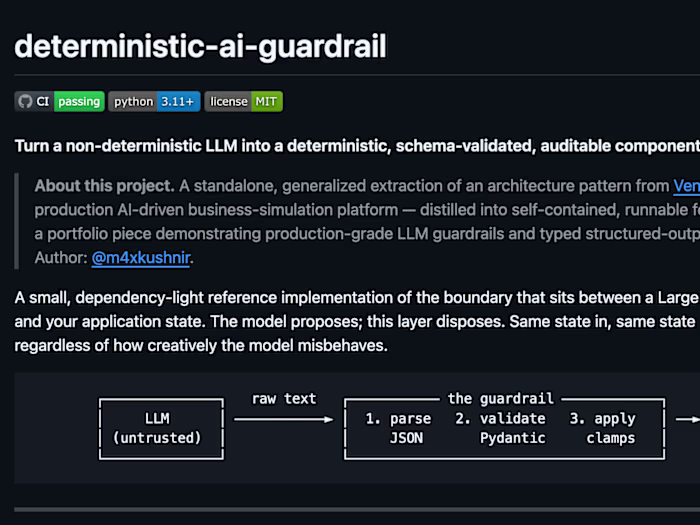
A deterministic kernel owns state, time, money, and legality. AI contributes only typed, capped,
seeded judgment coefficients and post-hoc narrative. Nothing AI-generated reaches state except through
a validated command or a range-capped judgment.
The result is a simulation that behaves like an institutional system of record: the accounting identity
holds every turn, share counts are conserved, cash is never conjured, and any historical turn can be
replayed bit-for-bit from its event log. AI makes the world feel alive and reactive — it never makes
the world lie.
The platform ships as a production web application with 26 localizations, a professional "cockpit" UI, a
business/education/enterprise entitlement model, LTI grade-sync for classrooms, and a full security,
privacy, and compliance surface.
2. Core Capabilities & Features
Simulation core
Deterministic kernel — the single writer-of-record for state, time, money, and legality. A command registry is the only door to state; an append-only event reducer is pure (takes no context), which is what makes replay bit-exact.
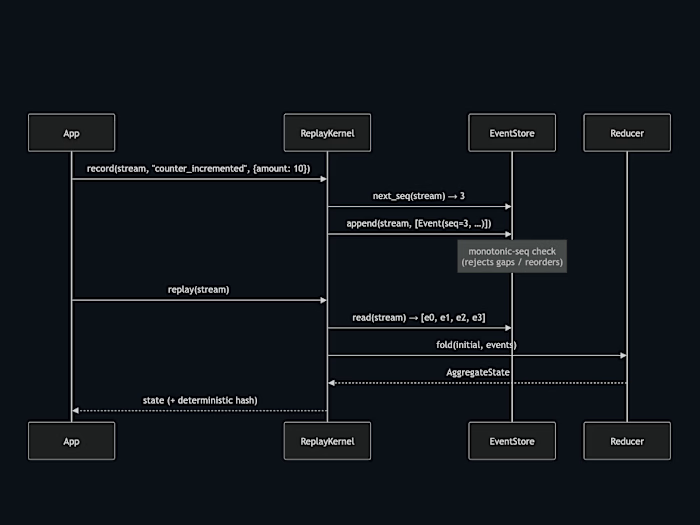
Event-sourced turns — nondeterminism (RNG, AI judgment, clock reads) happens once, at command resolution, and is captured into emitted events.
fold(events) reconstructs any state exactly.Bitemporal world model — a lazily-evaluated economic world with checkpoints, world events, policy regimes, and difficulty tuning that "catches up" state on demand rather than ticking every entity.
Invariants as law — double-entry accounting identity, share conservation, and value-range guards are enforced inside the turn, not asserted after it.
Business engines (24+, phase-ordered)
A breadth of independently-modelled disciplines, each a small unit that proposes typed deltas to the kernel:
Domain Engines Macro / International FX, inflation, tariffs, foreign tax, hedging, macro events, jurisdiction Market demand (constant-elasticity multi-product), microeconomics (segments + WTP), marketing funnel (9 channels, 4Ps, B2B pipeline), competitor reaction Operations 7 operating models, capacity that bites, quality, logistics, supply chain (suppliers, POs, inventory, COGS) Finance corporate finance (debt/equity/capital budgeting), payroll, tax, accounting ledger (double-entry) Org / People hiring & lifecycle, culture, change management, compliance, benefits Governance / Long-horizon ESG (7 stakeholders), ethics, entrepreneurship (lean BML, R&D, VC/board), strategy Business models SaaS metrics, marketplace, manufacturing, contract/services (PSA), franchise Reporting MIS/BI, forecasting, decision science, statistics lab
AI agents & the judgment boundary
Typed, capped, seeded judgments — AI returns coefficients within declared ranges with justifications; it never authors an amount. A stubbed/recorded judge is used in tests for zero live calls.
Tiered, privacy-aware provider routing — business simulations route only to "secured" official providers (Anthropic, OpenAI, Google, xAI, Mistral) that offer a DPA and do not train on API data.
Circuit-breaker failover across providers, per-request timeouts, and a hard block on restricted-origin models on every path (including BYOK).
AI personas, advisors, and boardroom counterparts — mentors, an advisory board, negotiation and board-meeting counterparts — all reading a projected view of state, never writing it.
AI governance suite — red-team harness, engine-version compare, nightly eval packs, and an AI quality dashboard.
Data generation & analytics
Projection / read layer — a single component builds every tab payload from state, so the UI and AI prompt read a consistent, contract-defined view.
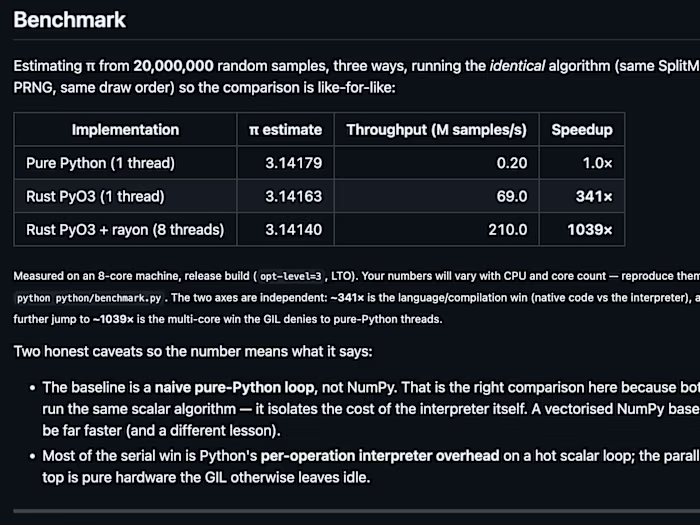
Native Monte-Carlo forecast engine — an optional Rust (PyO3 + rayon) extension runs parallel forward rollouts of the deterministic economy model for probabilistic forecasts.
Trust protocol — per-turn receipts, an evidence/provenance graph, a realism checker, and redaction before export.
User & institutional workflows
Solo, timed, and team (multiplayer-staged) turns; branch/counterfactual exploration.
Education & enterprise — cohorts, instructor groups, rubrics, grading exports, benchmark cohorts, LTI 1.3 grade sync, SSO, and an org console with audit logging.
Professional cockpit — two-level dashboard, exec briefing, risk register, operating plan, board pack, and a mobile-native bottom-nav layout.
Community, help center, methodology & status pages, GDPR self-service, and a demo mode that renders the real cockpit against scripted data.
3. Tech Stack & Architecture
Stack
Layer Technology Backend Python 3.11, FastAPI, Pydantic v2, async SQLAlchemy +
asyncpg, Alembic Database PostgreSQL (managed via Neon in production) Cache / counters Redis (rate-limit & captcha counters shared across workers) Native compute Rust (ventute_sim, PyO3 + rayon) — optional Monte-Carlo forecast extension Frontend React 18, Vite 6, Zustand, React Router 6, Recharts, Tailwind CSS i18n i18next — 26 locales with full coverage AI providers Anthropic, OpenAI, Google Gemini, xAI, Mistral (secured set) + OpenRouter (BYOK/free) Observability structlog (JSON), Sentry (opt-in), PostHog (opt-in), OpenTelemetry-ready Runtime uvicorn (multi-worker), slowapi rate limiting, GZipFootprint: ~104K LOC backend across 389 modules · 476 API endpoints · 41 Alembic migrations ·
179 backend test modules · ~46K LOC frontend across 40 routes · 26 test suites.
Request & turn data flow
The AI provider is called inside the judgment boundary and again for post-hoc narrative — it observes a
projected, redacted view of state and returns only bounded coefficients or prose. It is never a writer.
4. Design Philosophy & Code Consistency
The repository is governed by a small number of load-bearing rules, maintained in the internal
architecture documentation.
One writer of record. The kernel is the only path to state. Engines propose typed deltas; they do not mutate state directly. AI proposes coefficients; it does not touch numbers.
Determinism is a property, not a hope. All nondeterminism is injected (
Clock, seeded Random) and captured at resolution time. The reducer is pure. Replay re-folds recorded events with zero recomputation → identical state. A golden/determinism test suite guards this.Wiring is declared data, not call order. Engines declare
phase, the state slices they reads/owns, and their depends_on. Run order is derived by topological sort. Two whole classes of bug — dependency cycles and two engines writing the same slice — are caught at registration, not three phases later mid-turn.Decoupled services, module-per-concern. The service layer is split by domain (AI, game, world, memory, billing, enterprise, integrations, education, platform, accounts, admin). Integrations degrade to no-ops when their key/package is absent — the same optional-import pattern everywhere.
Progressive delivery via flags & kill switches. Product-affecting changes ship behind reversible feature flags; trust-critical paths are never flag-gated. Enrichment AI has a single kill switch that degrades to deterministic defaults under cost/incident pressure.
Strangler, not big-bang. The kernel was grown alongside the legacy turn loop and progressively adopts its responsibilities (pricing, payroll, supply, demand are already kernel-owned), each step golden-gated.
Contracts are versioned. Events, ledgers, judgments, and state are versioned Pydantic contracts; state carries a version and migrates forward.
6. Production, Security & Compliance
Deployment architecture
The production topology decouples the SPA, the API, and stateful backing services:
Component Production home Notes SPA (
ventute.com) Cloudflare Pages VITE_* build vars baked at build time API (api.ventute.com) Container host (Fly.io / Render) multi-worker uvicorn Database Neon (managed Postgres) pooled DATABASE_URL, TLS required, connection tuning per-worker Cache / counters Upstash / Fly Redis shared rate-limit & captcha state across workers Object storage AWS S3 / Cloudflare R2 pg_dump backups + presigned runtime artifacts Secrets AWS SSM Parameter Store (optional) SecureStrings hydrated into env at startup Edge Cloudflare WAF, Turnstile, origin lock-down headerContainerisation (documented capability)
The repository ships production-grade, portfolio-quality Docker profiles (
docs/docker.md). Whether or not a
given deployment uses them, they encode the standard the artifacts are held to:Multi-stage builds — the compiler/toolchain never ships to the runtime image (
Dockerfile.prod builder → runtime for the backend; node-build → nginx-serve for the frontend).Non-root runtime — backend runs as
appuser (uid 10001); the frontend serves via unprivileged nginx workers — shrinking the blast radius of a container escape.Static SPA on nginx — no Node runtime in the frontend image; SPA fallback, gzip, immutable-asset caching, and security headers.
Healthchecks so an orchestrator self-heals; small build contexts via
.dockerignore (no venv, node_modules, tests, .env, or .git in the image); secrets from the environment, never baked in.Managed DB, not a sidecar container — Postgres is Neon; the container only holds
DATABASE_URL.The prod Dockerfiles are exactly what a container host builds and runs, so the profile doubles as a local
prod rehearsal and the deploy artifact.
docker compose -f docker-compose.prod.yml up --build runs the full
prod-shaped stack locally.AWS integration
Two AWS seams are wired:
SSM Parameter Store (
SSM_ENABLED=true) — on startup, every SecureString under SSM_PREFIX is pulled into the process environment, so production secrets live in SSM (Standard tier) rather than in files or the platform env; only a handful of bootstrap keys remain in the platform. See docs/secrets_ssm.md.S3 object storage (
S3_BACKUP_BUCKET, ARTIFACT_BUCKET) — automated pg_dump backups are pushed to every configured destination, and GDPR/audit exports are served as presigned URLs. Credentials fall back to the shared AWS_* pair; an R2 endpoint can be substituted for S3. See docs/object_storage.md.Security posture
Security is treated as a layered discipline rather than a feature list. The summary below describes the
posture — the categories of control and the outcomes they guarantee. Exact mechanisms, thresholds,
header contracts, and configuration are deliberately kept out of this public document and live in
access-controlled internal runbooks.
Authentication & sessions — short-lived signed access tokens with rotating refresh, delivered over hardened httpOnly/
Secure cookies; modern memory-hard password hashing; optional federated sign-in and second-factor (TOTP) authentication.Abuse & bot resistance — managed edge challenge (Turnstile), distributed per-endpoint rate limiting, additional throttles on sensitive flows, and anomaly tracking on authentication attempts.
Ingress trust — the app treats client-supplied network metadata as untrusted and derives identity only from infrastructure it controls, with an optional edge-attestation layer so the origin cannot be reached around the perimeter. Request-shape limits guard against resource-exhaustion vectors.
Transport & headers — strict CORS, host allowlisting, and a full security-header policy across the API and the static SPA.
Secrets — provider and per-tenant credentials are encrypted at rest; startup refuses to boot on weak or placeholder critical secrets; production secrets are sourced from a managed secret store, never from the repository or images.
AI data governance — regulated (business) workloads route only to providers under a data-processing agreement that do not train on submitted data; models of restricted origin are refused on every path.
Responsible disclosure: security issues should be reported privately to the maintainers, not filed
as public issues. This README intentionally omits exploitable operational detail.
Compliance & data handling
GDPR self-service — dedicated data export and erasure endpoints, backed by a documented privacy review.
Consent-gated telemetry — Sentry and PostHog are opt-in and no-op without keys/consent; an in-DB funnel works without any third party.
Enterprise audit — org-scoped audit logging, rubrics, and benchmark cohorts (min k to prevent de-anonymization); LTI 1.3 grade sync for institutional integrity.
Clean legal & billing posture — legal/privacy/terms pages with honest disclosures (IP, indemnity, no monitoring, AI-Act notice). The platform is not built around a mandatory payment gateway: the free tier runs on the user's own key (BYOK) and a dedicated entitlement layer differentiates tiers without locking core function behind a checkout — extensible to any billing backend without redesign.
Ventute — consequences you can trust, because the machine, not the model, keeps the books.

Like this project
Posted Jul 31, 2026
Deterministic AI simulation platform: high-concurrency Async Python (FastAPI) backend, event-sourced architecture, and native Rust (PyO3) compute kernel.
Likes
1
Views
5
Timeline
Jan 1, 2025 - Ongoing