
A multi-project business operating environment
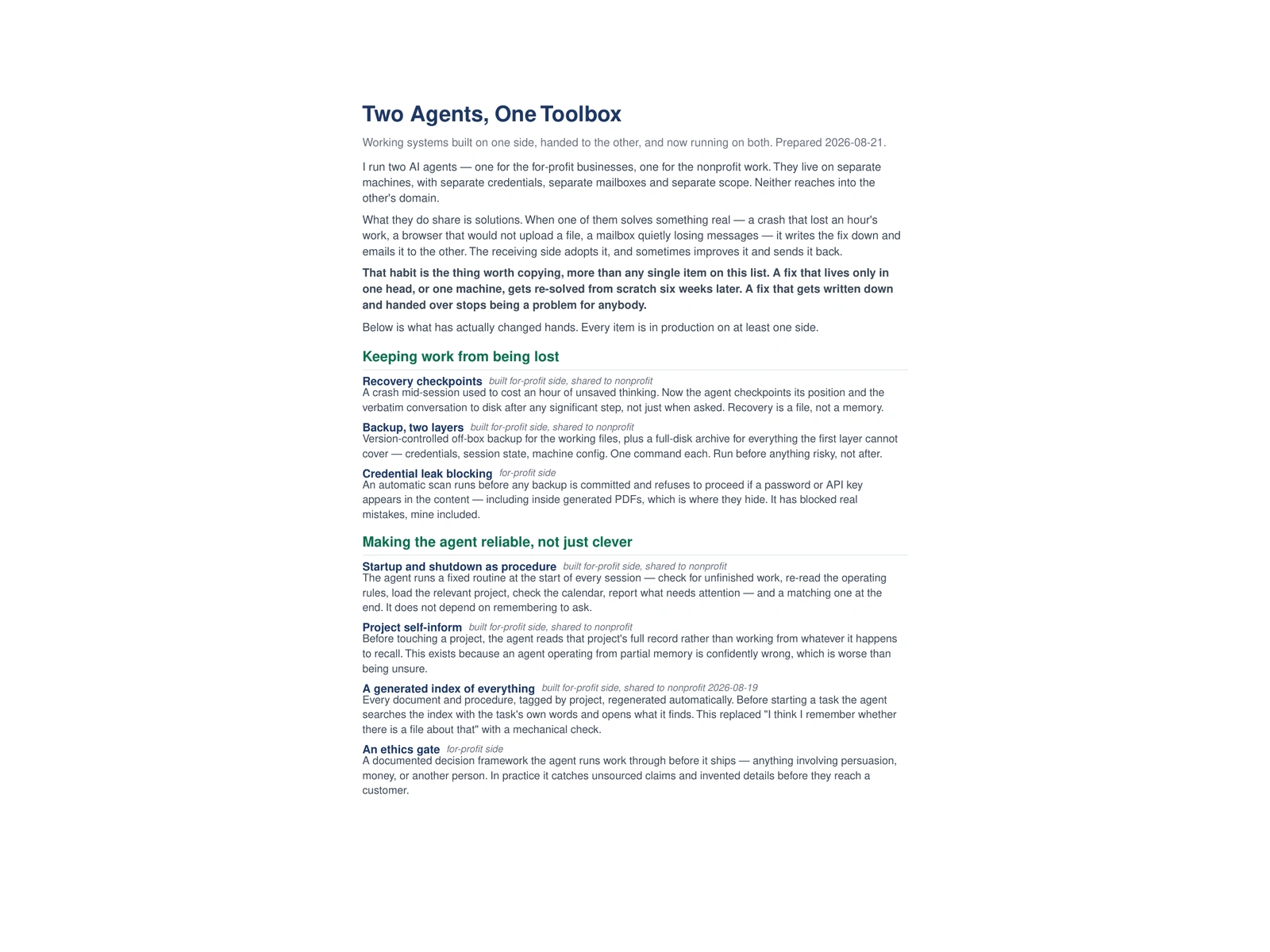
A dual-agent Claude system, running locally on separate machines, each scoped by its own credentials, workspace, mailbox and set of projects — and deliberately walled off from the other's workspace. Neither is an assistant waiting to be asked for something. Each is built to run as a project manager: it holds the task list, carries decisions between sessions so they don't get re-litigated, and pushes several projects forward every day without needing to be re-briefed on any of them.
The structure is the point. I built a many-agent version first and cut it back to two on purpose, because more agents meant more drift — separate working environments that quietly diverge until no two of them operate in a manner consistent with the owner's ethics, language style preferences and tool-selections. Two can easily stay synchronized. That's what lets one person carry a portfolio of unrelated projects, yet keep the feel, flow and process consistent for the human user.
Not a demo — it's the system my own businesses and philanthropic projects actually run on, daily.
What holds it together is procedure, not memory. Every task I repeat is written down as a skill the agent invokes on its own — how a daily outreach message is structured and paced, how a record gets logged, what has to be checked before anything reaches a customer, how a session opens and how it closes, with consistent report generation. Almost every one of those exists because of the tendency for AI to invent new ways to do the same reliable task, unintended shifts in protocol that come at a cost of time and tokens.
That is the real work, and it's the part nobody warns you about: capability + consistency = reliability. Left to itself, an AI will solve the same problem a new way every morning, and justify its perfectly reasonable initiative. The skill is catching that drift and turning it into a written rule that states, "no guesses, no initiative, no creativity unless it is either suggested with verification or asked for." Persistent corrections hold over time, with authoritative commands mixed with questions that allow the agent to find the best way to accomplish a task or improve the process.
In practice that has produced for me:
• A CRM build-out with pipelines, automated workflows, call routing and tagging — including an audit that traced and repaired a lead-follow-up workflow which had silently produced nothing since the day it was built.
• A B2B outreach system running against a 700-plus-record prospect tracker with a fixed message structure, pacing limits and compliance rules.
• Email deliverability end to end — SPF, DKIM, DMARC and a dedicated sending domain.
• A local call-transcription pipeline that turns recorded calls into fact-checked written summaries.
• An agent who acts like a seasoned employee, keeping me on-task and bringing skills to the table at a level that I could never afford.
What you will get from a session is that same discipline pointed at your work: the things you do over and over, captured as procedure so Claude does them your way every time — and the judgment to recognize when something needs to stop being a correction and become a rule. You are left with a working system, not just more AI education.
0 likes · 0 views · Nov 8, 2026
A multi-project business operating environment A dual-agent Claude system, running locally on separate machines, each scoped by its own credentials, workspac...


