Notebook AI Development

Pranit Patil


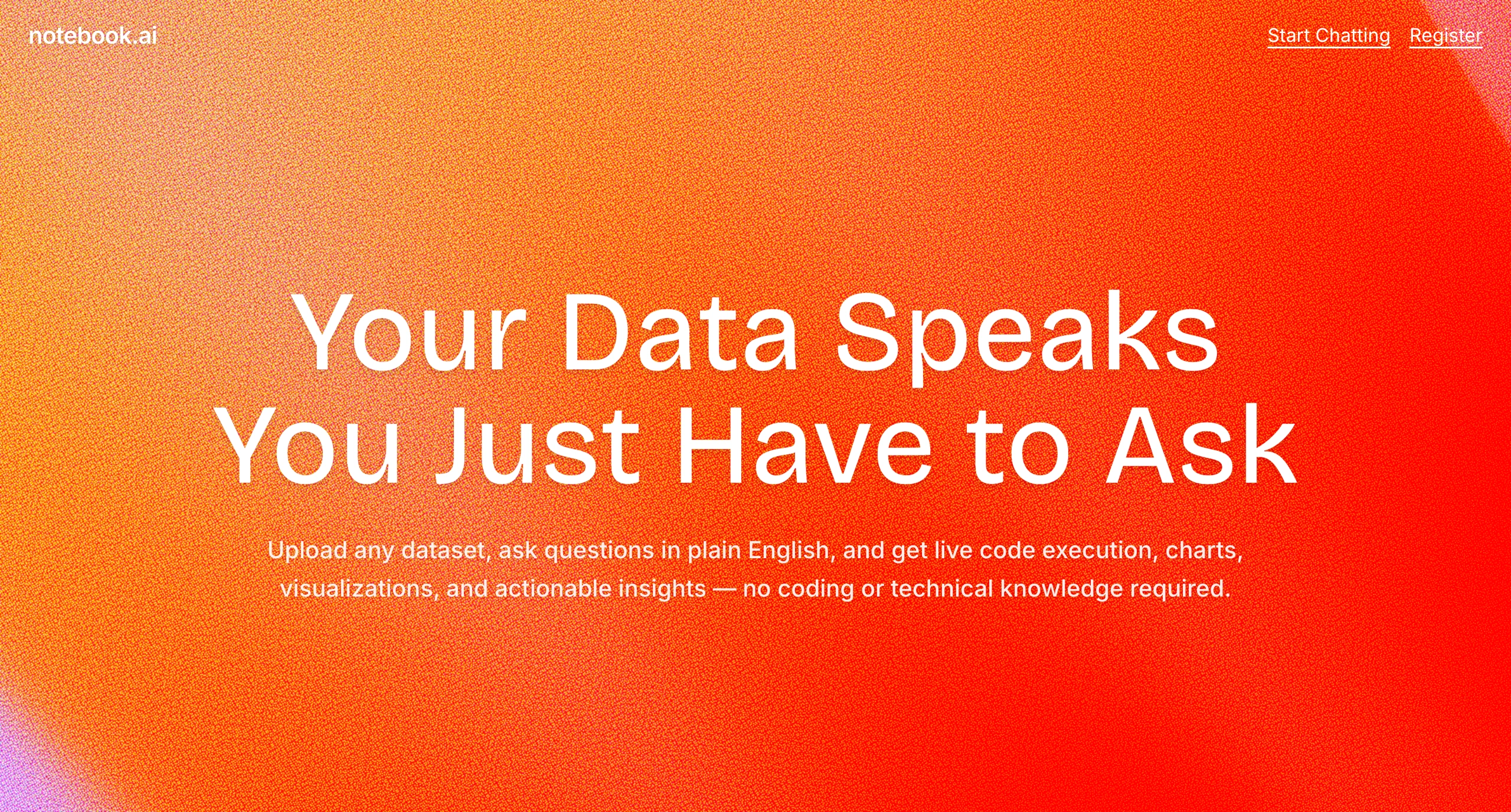
Notebook AI — AI Data Analysis Platfrom
A full-stack platform that combines chat, Jupyter notebooks, and file-based analysis into a single conversational interface.
Overview
Notebook AI is an AI-powered data science assistant that lets users upload datasets, ask questions in plain English, and receive real-time code execution, visualizations, and insights — without writing a single line of code. It bridges the gap between chatbots and notebooks by tightly integrating both into one seamless workflow.
The Problem
Data analysis today is fragmented across multiple tools — chatbots for Q&A, Jupyter notebooks for coding, and file explorers for data. This constant context switching slows analysis, increases cognitive load, and makes data science inaccessible to non-technical users.
Existing AI tools can explain concepts, but cannot reliably execute code on real datasets or preserve analytical state across a conversation.
Target Users
Founders & product managers exploring datasets without engineering support
Analysts & data scientists prototyping insights quickly
Non-technical users who want answers from data, not code
Developers who want an interactive AI + notebook workflow
How the Platform Works
1. Conversational Interface
Users chat with an AI model using real-time streaming responses — fast, natural, and familiar.
2. Automatic Notebook Mode
The system detects when a request involves data analysis (file upload or keywords like "analyze" or "plot") and switches to notebook mode automatically — no manual toggle required.
3. Jupyter Notebook in Chat
The AI generates Python code, executes it inside a secure cloud sandbox, and streams outputs — tables, charts, and errors — inline in the chat as notebook cells.
4. Persistent Analytical State
Variables and datasets persist across messages within a conversation, enabling multi-step analysis just like a real notebook.
5. Artifacts & Documents
The AI creates rich artifacts — documents, code files, notebooks, sheets, and images , that open in a side panel for deeper editing and exploration.
6. Side Chat for Quick Follow-ups
Users can select any output or text and ask a follow-up question in an ephemeral mini-chat without disrupting the main conversation.
Architecture & Core Components
Notebook AI uses a Next.js fullstack architecture with AI streaming, sandboxed code execution, and persistent notebook state. AI reasoning is fully decoupled from code execution, keeping the system fast, secure, and scalable.
Client (Next.js App Router)
Streaming UI with a chat interface, notebook viewer, and artifact side panel — all
updating in real time.
AI Layer (Claude via Vercel AI SDK)
Handles streaming responses, tool calling, and multi-step reasoning using Claude Sonnet 4 and Haiku 4.5.
Execution Layer (E2B Sandboxes)
User code runs exclusively inside isolated E2B cloud containers — never on the server. Supports pandas, numpy, matplotlib, seaborn, plotly, and scikit-learn.
Storage Layer
PostgreSQL (Neon) for chats, messages, notebooks, and artifacts. Vercel Blob for file uploads and dataset storage.
Auth & Security
JWT-based authentication with guest and registered sessions, rate limiting per user type, and Zod validation on all API inputs.
Tech Stack
Frontend
Framework: Next.js 16 (App Router + Turbopack)
UI: React 19, TypeScript, Tailwind CSS, shadcn/ui
Animations: Framer Motion
Editors: CodeMirror (code), ProseMirror (documents)
Backend
API: Next.js API Routes
AI SDK: Vercel AI SDK (streaming + tool calling)
Auth: NextAuth (Auth.js)
ORM: Drizzle ORM
Database: PostgreSQL (Neon)
File Storage: Vercel Blob
AI & Execution
Models: Claude Sonnet 4 / Haiku 4.5 (Anthropic)
Sandbox: E2B Code Interpreter
Libraries: pandas, numpy, matplotlib, seaborn, plotly, scikit-learn
Infrastructure
Deployment: Vercel
Monitoring: OpenTelemetry
Testing: Playwright (E2E)
My Role — End-to-End Ownership
Built entirely as a solo engineer, with full ownership across every layer:
Designed the system architecture and data models from scratch
Built real-time streaming chat with AI tool orchestration
Implemented a Jupyter-style notebook engine with sandboxed cloud execution
Designed cell versioning and persistent notebook state across conversations
Built the artifact system — documents, code files, sheets, notebooks, and images
Implemented auth, rate limiting, file uploads, and storage
Built the complete frontend — chat UI, notebook viewer, and artifact panel
Deployed and productionized the full platform on Vercel
Outcome
Notebook AI delivers a unique chat-plus-notebook experience that lets users analyze real datasets conversationally. It makes data science faster, more accessible, and more interactive — for both technical and non-technical users — without requiring any prior coding knowledge.
Like this project
Posted Feb 19, 2026
Developed Notebook AI, merging chatbots and notebooks for seamless data analysis.
Likes
1
Views
8