
HireMeAI
A recruiter-facing chatbot that answers questions about me — grounded only in my resume.
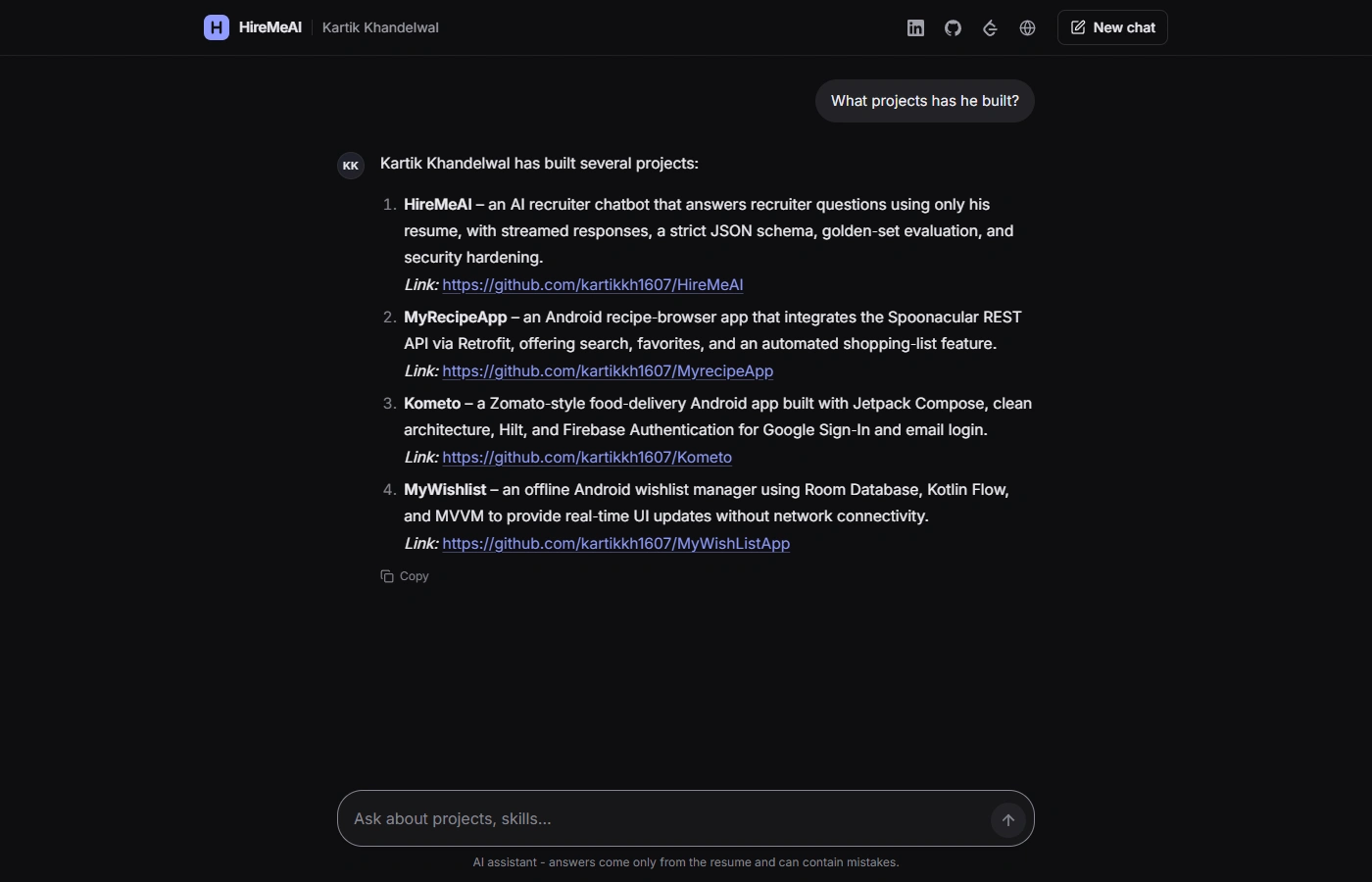
Recruiters can ask things like "What has he built?", "Has he done any hackathons?" or "Does he know Kubernetes?" and get short, honest answers with links — streamed in real time. If something is not in the resume, the bot says so instead of making it up.
Live demo: https://hiremeai-kartik.onrender.com
Features
Resume → structured data with strict JSON-schema output (Pydantic + Groq structured outputs)
Parse once, ship the result — the resume is parsed locally and the validated result is committed as a cache (data/resume_cache.json), so production startup makes zero LLM calls. The cache key covers the file, prompt and model; parser code changes still need a manual PARSER_VERSION bump in app/resume.py
Streaming chat with multi-turn memory (sliding window of the last 10 messages)
Grounded answers — no invented skills, no exaggerated skill levels, honest "not in the resume" replies
Privacy by design — the phone number is parsed but never sent to the chat model
Prompt-injection & XSS defenses on both the backend and frontend
Abuse limits — per-IP rate limiting, history size caps and a per-answer token cap (see Security & limits)
Golden-set eval for the resume parser (eval_resume.py)
ChatGPT-style React + Vite UI served by FastAPI
Architecture
Loading
flowchart TD B[Recruiter's browser<br/>React + Vite UI] -->|POST /chat - stream| M[app/main.py<br/>FastAPI] M -->|every question| C[app/chat.py<br/>prompt + history + stream] M -->|once at startup| R[app/resume.py<br/>read PDF, parse, cache] C --> CFG[app/config.py<br/>Groq client, model] R --> L[app/llm.py<br/>strict JSON + retries] L --> CFG CFG --> G[(Groq API<br/>gpt-oss-120b)] R <--> D[(data/<br/>resume + cache)]
Two flows:
Startup (once): if the committed cache matches the current resume, prompt and model, load it instantly; otherwise read PDF → extract text + hidden hyperlinks → LLM parses into a strict Resume schema → post-process → cache to disk.
Every question: system prompt (resume JSON, phone removed) + last 10 messages + question → streamed answer.
The expensive work (parsing) happens once; each question is a single cheap chat call.
File
Responsibility
app/config.py
Env vars, Groq client, model name
app/schemas.py
Pydantic models — the shape of all data
app/llm.py
Reusable strict-JSON LLM call with retry policy
app/resume.py
PDF/DOCX reading, link extraction, parsing, caching
app/chat.py
System prompt + streaming answers
app/main.py
FastAPI: startup, validation, endpoints
frontend/
React + TypeScript + Tailwind chat UI (built into static/)
tests/
pytest suite (FastAPI TestClient, Groq mocked)
scripts/
Manual try_*.py experiments that call Groq
Engineering decisions (and the bugs that led to them)
Most of the design came from things that broke during testing:
Hidden hyperlinks. pypdf.extract_text() only returns visible text ("GitHub", "View Project →"), not the URLs behind them. Links are pulled from PDF annotations and appended to the text, so project repos are now captured.
Silent data loss from schema gaps. In strict mode, the model can only fill fields that exist. The "Achievements" section and coursework silently disappeared until they were added to the schema.
Ambiguous fields cause regressions. A single description field sometimes got the subtitle and sometimes the bullet points. Splitting it into description + highlights made output stable.
Code over prompts. The model kept listing certifications as skills even when told not to (the resume itself lists them under skills). A deterministic post-processing filter fixed it — and the first version of that filter was itself brittle, which a stronger eval caught.
Cache keys must include everything that changes output — file bytes, prompt, model and a manual parser version.
Hide data and tell the model. Removing the phone number made the bot claim "the resume has no phone number" — technically a lie. The prompt now states it is intentionally withheld.
Retry only transient errors. 429 / 5xx / network / invalid JSON are retried with exponential backoff; auth errors, bad requests and truncated output are not.
Production startup must not depend on an LLM. After a resume update, a redeploy on Render failed while the same code had just started fine. gpt-oss is a reasoning model, its thinking tokens count toward the output limit, and on a longer run the JSON got cut off. In strict mode Groq reports this as a 400 json_validate_failed, not finish_reason == "length", so the truncation check never fired. Fix: an explicit max_completion_tokens (8192) for structured calls in app/llm.py, and the parsed resume is committed so the server starts in milliseconds without calling Groq.
Stateless server. Chat history lives in the browser and is sent with each request, so the backend needs no database or sessions.
Evaluation
eval_resume.py checks the parser against a golden set built by reading the resume by hand (links, project repos, bullet points, achievements, coursework, certification formatting, no certifications in skills). The checks are intentionally independent of the parser's own logic, so a bug in the filter can't also hide in the test.
7/7 checks passed
The chat was red-teamed manually: follow-up questions, missing skills (Kubernetes), exaggeration ("is he an expert in Python?"), privacy (phone number), off-topic and injection prompts.
Tech stack
Backend: Python 3.11, FastAPI, Pydantic v2, Groq (openai/gpt-oss-120b), tenacity, pypdf, python-docx, uv
Frontend: React, TypeScript, Vite, Tailwind CSS, react-markdown
Testing & deploy: pytest, Render
Run locally
Requirements: Python 3.11+, uv , Node 20.19+ (only to rebuild the UI), a free Groq API key .
git clone https://github.com/kartikkh1607/HireMeAI.git cd HireMeAI uv sync # 1. Create a .env file in the project root with one line: # GROQ_API_KEY=your_key_here # (On Windows, create it in your editor - PowerShell's echo writes UTF-16) # 2. (Optional) Use your own resume # replace data/my_resume.pdf, then run # uv run python eval_resume.py # to re-parse it and refresh data/resume_cache.json # (and update the golden values in eval_resume.py for that resume) # Note: the chat prompt (app/chat.py) and some UI copy are written for my # resume (e.g. he/his, card subtitles) - edit them when reusing it. # 3. Run uv run uvicorn app.main:app --reload # open http://127.0.0.1:8000
Frontend development (hot reload):
cd frontend npm install npm run dev # http://localhost:5173 (proxies API calls to :8000) npm run build # outputs to ../static, served by FastAPI
Useful scripts:
uv run pytest # tests - no Groq calls, runs in ~1s uv run python eval_resume.py # parser golden-set eval (uses the cached parse) uv run python -m scripts.try_chat # chat in the terminal (real Groq calls)
scripts/try_*.py are manual experiments that call Groq for real; run them from the project root with python -m so app is importable. They are not part of the test suite.
Production notes:
ENV=production turns off /docs, /redoc and /openapi.json # --proxy-headers makes the rate limiter see the real client IP behind a proxy (e.g. Render) ENV=production uv run uvicorn app.main:app --host 0.0.0.0 --port $PORT --proxy-headers --forwarded-allow-ips="*"
Security & limits
Protection
How
Rate limit (per IP)
POST /chat: 10 requests/minute and 100/day per IP → 429 with a JSON detail and Retry-After header. Best-effort only (see below)
Rate limit (global)
30 requests/minute and 300/day across all clients, regardless of IP → 429 "The assistant is busy right now". This is the cap that actually protects the Groq quota. Requests blocked by the per-IP limit don't count against it
Only valid requests count
Rate limits are checked after the request body is validated, so invalid requests (422) never use up the per-IP or global budget
Request size
Question 1–1000 chars; history max 20 messages, each max 4000 chars (the UI sends only the last 10)
Token cap
max_completion_tokens=1500 per answer (includes the reasoning tokens of gpt-oss); truncated answers end with (answer truncated)
Privacy
The phone number is parsed but never sent to the chat model or returned by /profile
Role injection
History roles are limited to user / assistant — a system message is rejected with 422
Prompt injection
Resume and questions are treated as data, not instructions (system prompt rules)
XSS
The UI renders answers with react-markdown (no raw HTML), allows only http(s) links and never loads images
Errors
Upstream failures before the first token return 503; mid-stream failures end with a sentinel the UI turns into an error with Retry
API docs
Disabled when ENV=production
Known limitations
Per-IP limits can be bypassed. Behind a proxy, uvicorn must run with --proxy-headers --forwarded-allow-ips="", otherwise every visitor shares the proxy's IP. But with "" uvicorn trusts the left-most X-Forwarded-For value, which the client controls, so a client can send a fake IP on every request and never hit the per-IP limit. The per-IP limit is therefore a fairness measure for normal users. The global limit is the real protection: spoofing can at most use up the global budget (making the bot "busy" for others until the window resets), never more Groq calls than that.
The rate limiters are in-memory and per process: counts reset on restart and are not shared across multiple instances or workers (fine for a single instance; use Redis to scale out).
The server is stateless, so it trusts the history the browser sends. A client can fabricate earlier "assistant" turns — but that only affects their own conversation, never other users. Low risk by design.
API
Method
Path
Description
GET
/health
Liveness check
GET
/profile
Parsed resume (phone removed)
POST
/chat
{ "question": str, "history": [{role, content}] } → streamed text/plain (422 invalid input, 429 rate limited, 503 AI service unavailable)
Roadmap
Deploy with a public demo link
LLM-as-judge eval for chat answers (groundedness, no exaggeration)
Job-description matching: paste a JD, get a grounded fit summary
Credits
The idea comes from the HireMeAI exercise in Padho with Pratyush — AI Engineer course . This version was rebuilt from scratch with a modular architecture, strict structured outputs, caching, evals, privacy and security hardening, streaming and a new UI.
About
Recruiter chatbot that answers questions about me using only my resume. FastAPI + Groq (gpt-oss-120b) with strict structured outputs, streaming, evals, rate limiting and a React UI.
0 likes · 0 views · Nov 24, 2026
Solo-built recruiter chatbot that answers only from my resume, never makes things up, and streams replies. FastAPI + Groq + React.


