
Developed an AI-driven heart health monitoring platform integrating IoMT hardware, real-time ECG acquisition, mobile application development, cloud infrastructure, physiological signal processing, and LLM-based health insights.
The system captures ECG signals through an AD8232 sensor connected to an ESP32 microcontroller, sampling data at 360 Hz. The acquired signals are transmitted over Bluetooth Low Energy (BLE) using a custom binary communication protocol to a cross-platform Flutter mobile application, where users can visualize their ECG waveform in real time.
The mobile application synchronizes buffered data with a cloud-hosted PostgreSQL database, where a Python-based background processing service performs physiological feature extraction, including R-peak detection, heart rate calculation, and heart rate variability (HRV) analysis.
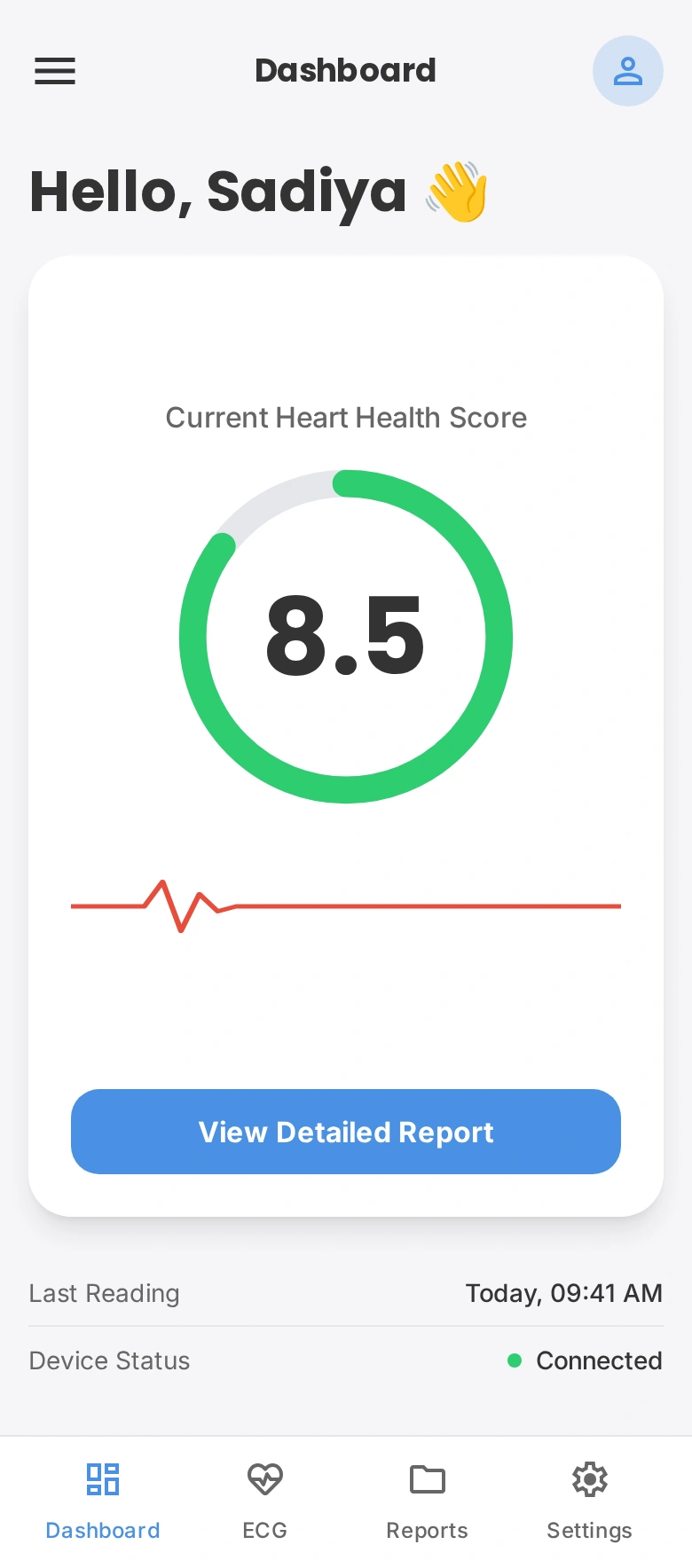
An integrated Model Context Protocol (MCP) server connects the processed physiological data to a dual-prompt LLM framework, which generates a cardiovascular health score on a 0–10 scale along with a detailed, patient-friendly interpretation of the extracted metrics.
System capabilities
Real-time single-lead ECG signal acquisition
AD8232 ECG sensor integration with ESP32
ECG sampling at 360 Hz
Bluetooth Low Energy communication using a custom binary protocol
Cross-platform mobile application built with Flutter
Live ECG waveform visualization
Cloud synchronization and PostgreSQL data storage
Automated Python-based physiological signal processing
R-peak detection, heart rate and HRV feature extraction
MCP server integration with a dual-prompt LLM framework
AI-generated health score and understandable health summaries
Technical architecture
The platform connects hardware-level ECG acquisition, mobile data visualization, cloud data storage, automated signal processing, and AI-driven interpretation into a unified pipeline.
By separating signal acquisition and mobile visualization from computationally intensive processing and AI analysis, the system is designed to maintain responsiveness while enabling more accessible interpretation of physiological data.
The measured end-to-end packet processing latency was approximately 33 ms, demonstrating an efficient data transmission and processing pipeline.
The project explores how IoMT and AI can work together to make continuous heart monitoring more accessible, understandable, and user-centered.
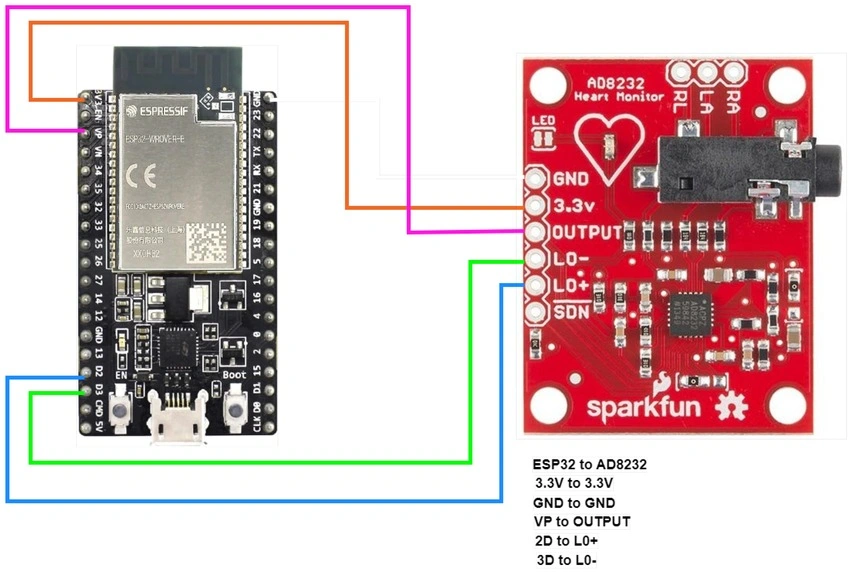
Hardware connections
0 likes · 0 views · Nov 25, 2026


