
From Fragmented Documentation to Enterprise Knowledge Management
Transforming disconnected operational knowledge into a centralized, governed, and widely adopted enterprise resource.
Industry: Financial Services
Project Scope: Enterprise-wide
Services: Knowledge Management Strategy · Process Improvement · Information Architecture · Content Governance · Change Management
The Challenge
A U.S. financial institution relied on an intranet and departmental shared drives to store and distribute operational documentation.
Information was scattered across multiple locations, with inconsistent organization, duplicate documents, and conflicting versions. Employees couldn't always determine whether the information they found was current or accurate.
The organization needed more than a new document repository. It needed a comprehensive knowledge management strategy that would establish a reliable source for operational information while introducing sustainable standards for content creation, ownership, approval, and maintenance.
My Role: From Concept to Enterprise Implementation
I independently identified the opportunity to transform the organization's approach to knowledge management and proposed the initiative to executive leadership.
After securing leadership support, I led the development and implementation of the enterprise knowledge management program.
My responsibilities spanned strategy, platform planning and implementation, information architecture, documentation transformation, governance design, stakeholder engagement, employee training, and ongoing program management.
Rather than simply transferring existing documentation into a new system, I designed the operational framework needed to make the program sustainable.
The Solution
1. Enterprise Knowledge Management Strategy
Developed the foundational strategy for a centralized knowledge management program, including content organization, governance requirements, stakeholder responsibilities, and implementation priorities.
Established an approach designed to address fragmented information, inconsistent documentation practices, and the absence of a reliable, governed knowledge environment.
2. Information Architecture & Content Transformation
Designed the organizational structure of the new knowledge platform, including departmental content organization, boards, groups, and curated content series.
In March 2026, I personally migrated approximately 600 existing documents into the centralized platform.
Following implementation, the knowledge library expanded to more than 1,000 content records through continued documentation development and maintenance.
I also created task-oriented content collections to help employees locate related operational resources, such as required forms and materials for branch security binders.
3. Content Governance & Quality Standards
Developed a comprehensive content governance framework encompassing:
Standardized documentation templates and style guidelines
Defined content ownership and accountability
Review, approval, and publishing workflows
Content quality controls
Automated annual review scheduling
Ongoing maintenance and update procedures
Each document receives a review date one year after its most recent update, establishing a recurring content maintenance cycle.
The first full annual review cycle is scheduled to begin in 2027.
4. Proactive Process Improvement
Recognized that applying the same moderation and approval requirements to every content type could create unnecessary operational friction.
Building on existing feedback about the standard publishing process, I proactively designed an alternative workflow for rate sheets, allowing these resources to bypass routine moderation requirements.
This approach accommodated different operational publishing needs without requiring every content type to follow an identical process.
5. Change Management & Adoption
Developed and delivered training for content contributors and end users, coordinated pilot groups, and established communication processes to support the transition to the new platform.
Following launch, I continued managing content quality, documentation requests, knowledge organization, and ongoing improvements to support adoption and long-term sustainability.
Measurable Results
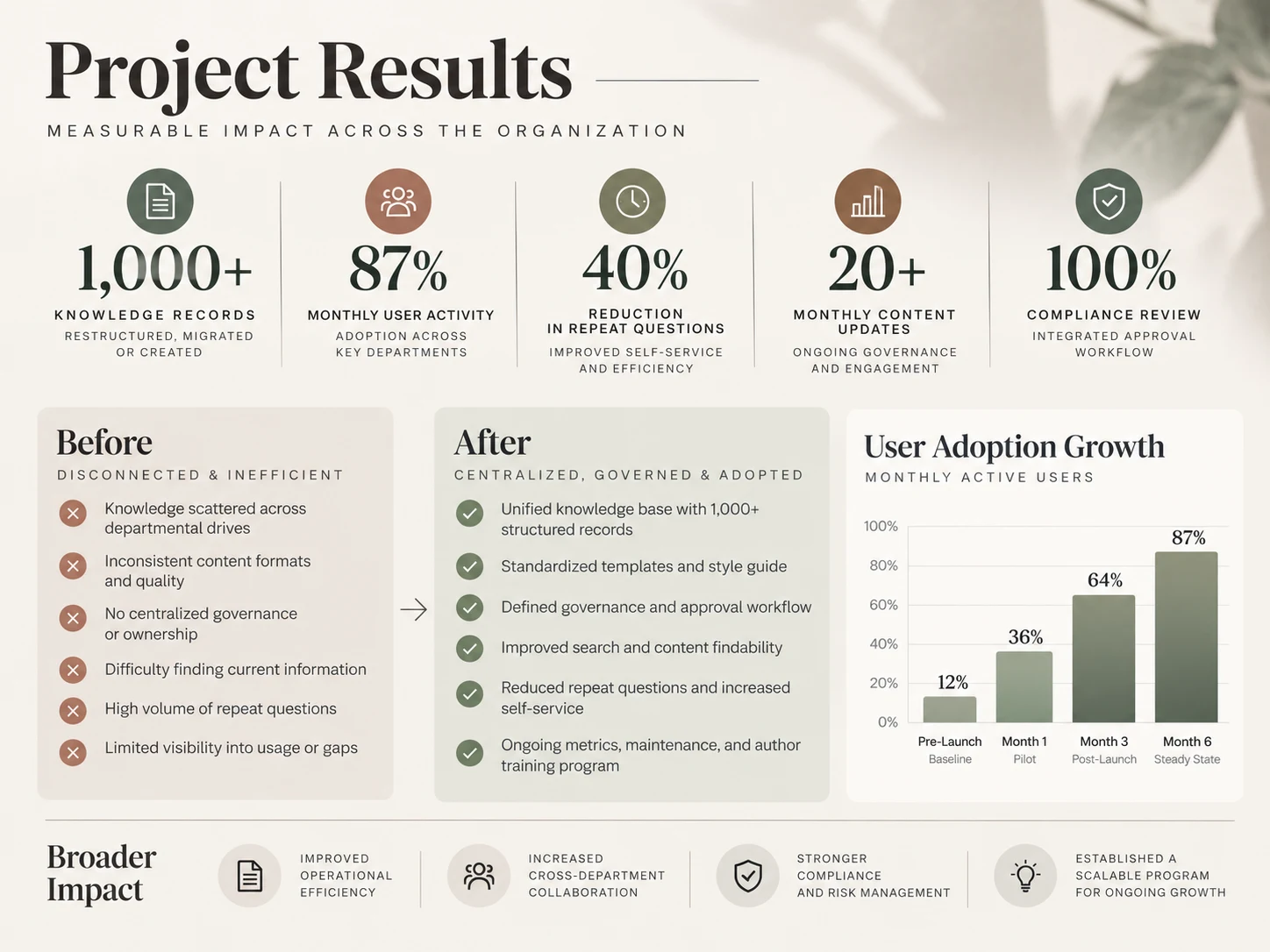
The program established a centralized knowledge environment with broad employee participation and consistent information retrieval activity.
Platform performance — Rolling 30 Day Period:
Registered account activation | 100% had logged in at least once
Active users in the last 30 days | 131 of 151 accounts (87%)
Users browsing published content | 130 of 151 accounts (86%)
Traditional searches | 2,503
Searches resulting in a result click | 1,731 (69%)
AI-powered knowledge queries | 823
Total content inventory | 1,000+ records
Published content | 838 records
The search-result click-through rate measures interaction with search results, not a verified answer-success rate. The user percentages are based on registered accounts, which may include inactive employee accounts.
Business Impact
The transformation established a centralized, governed approach to operational knowledge management, replacing fragmented storage practices with a structured enterprise resource.
Key accomplishments included:
Establishing a central location for governed operational documentation
Introducing consistent documentation standards and ownership practices
Creating structured review and approval workflows
Implementing an automated annual content review cycle
Supporting organization-wide platform adoption through training and communication
Developing flexible publishing processes tailored to operational requirements
Establishing an ongoing program capable of supporting new documentation and changing business needs
The resulting program supports continued knowledge development, content maintenance, and operational improvement beyond the initial implementation.
The Takeaway
Successful knowledge management transformation requires more than selecting a platform and migrating documents.
It requires understanding how an organization operates, identifying where existing processes create friction, designing practical solutions, and establishing the governance necessary to sustain those improvements.
This engagement demonstrates my ability to take an enterprise initiative from initial concept through implementation, adoption, and ongoing program management, combining strategic thinking with hands-on execution and measurable results.
0 likes · 1 view · Oct 29, 2026
Led an enterprise-wide knowledge management transformation, centralizing 1,000+ records and achieving 87% monthly user activity across a financial institution.
Timeline
Dec 1, 2023 - Ongoing

