Samkhya (Thesis Project)

Avi Parmar


Concept
Samkhya utilises mindfulness mechanics for level progression. The meditation mechanic has been carefully designed after thorough research, implementing scaffolding mechanics to suit the needs of professionals and beginners, and 3 unique meditation tracks based on the upcoming level unlocked by meditation.
What is 'Samkhya' ?
Sāṃkhya is an ancient indian school of philosophy. It stands at the fountainhead systematic Indian reflection, and has a ubiquitous influence in south asian cultural life.
Samkhya is a dualistic philosophy with two realities:
Prakriti — The source of the material world. It is dynamic and active, and thought of to be nature and matter.
Purusha — Pure Consciousness. It is the silent witness, unchanging and passive.
Narrative Design
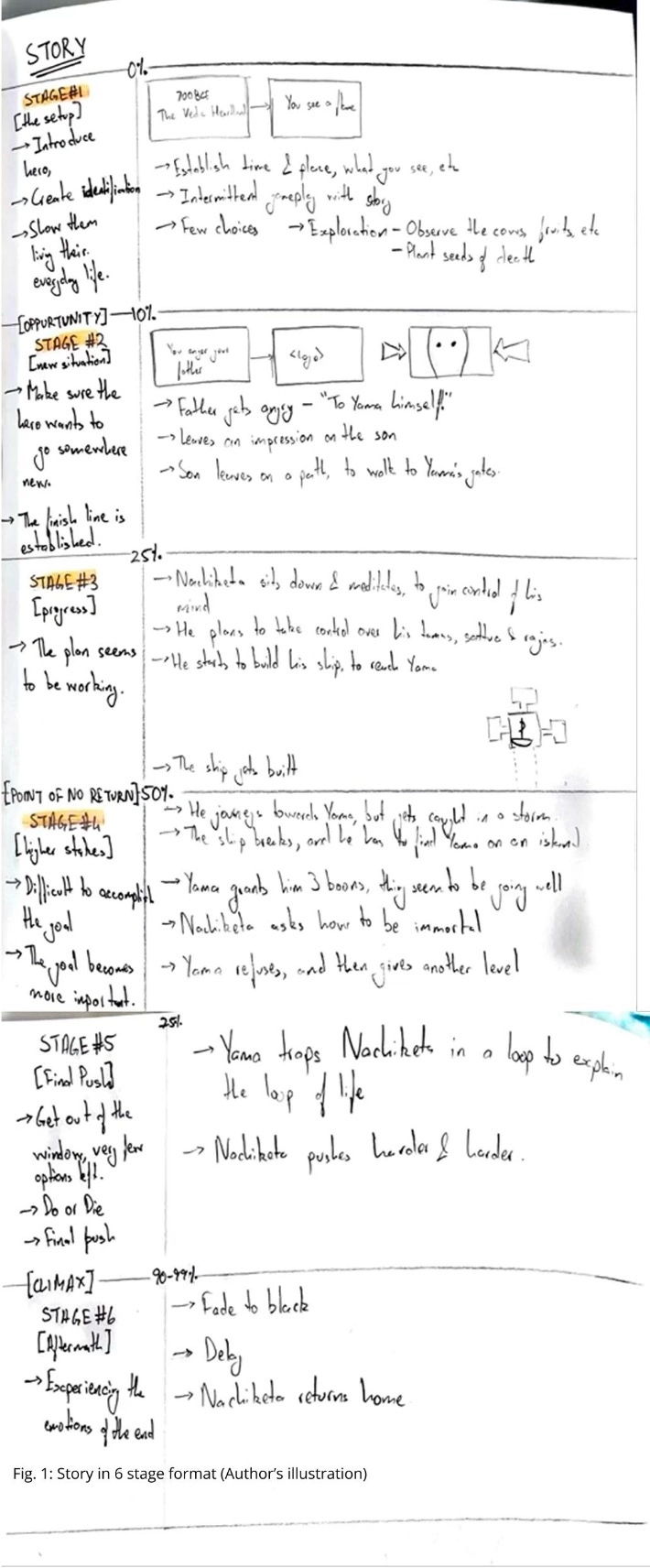
Adapted on the story of Nachiketa and Yama, the story is of a young boy named Nachiketa.
He was the son of a sage. Once the sage was doing a ritual of giving away all o f his possessions. Nachiketa observed that his father was only giving away his old and useless cows.
Wanting his fathers act to be truly selfless, he asks his father “to whom will you give me?”, angered by his persistence, his father replies “To Yama (the god of death I give you”
Nachiketa takes his father’s words seriously, and travels to Yamas abode.
After three days of waiting, Yama is impressed with Nachiketa’s patience and faith, and offers him 3 boons.
For the first wish, Nachiketa asks that his father’s anger be calmed. For the
second wish, Nachiketa asks for knowledge of the sacred fire sacrifice.
For his third wish, Nachiketa asks Yama, “Does the soul exist after death?”.
Yama tested him, by offering him wealth, long life, pleasures and power
instead of the answer. Nachiketa refuses, saying all worldly things are
temporary.
Impressed, Yama reveals the truth: the self (soul) is eternal, beyond birth and death. It is unchanging, and identical with brahman (ultimate reality). Realising this frees one from the cycle of life and death.
Game Design
Level Design Framework
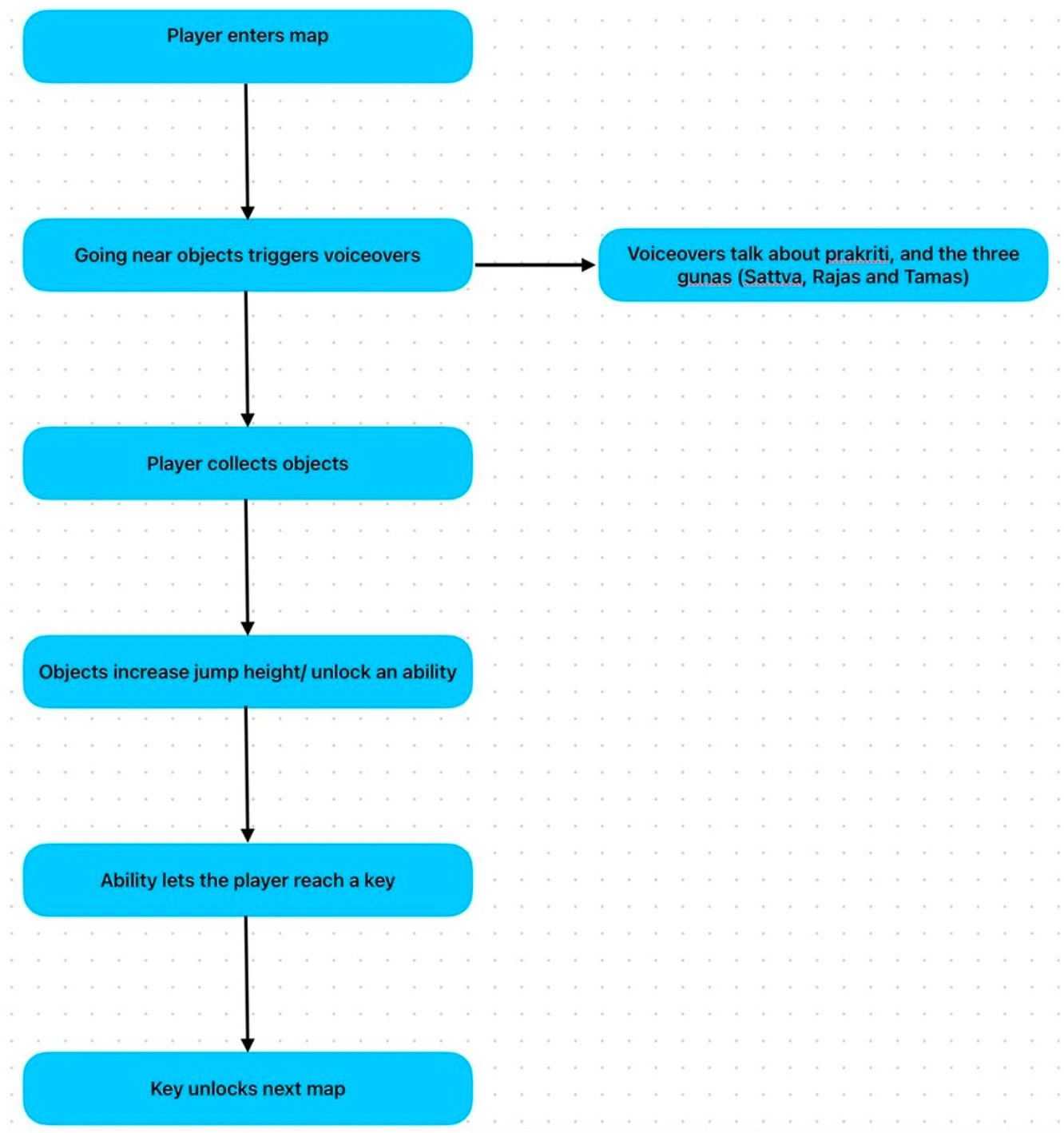
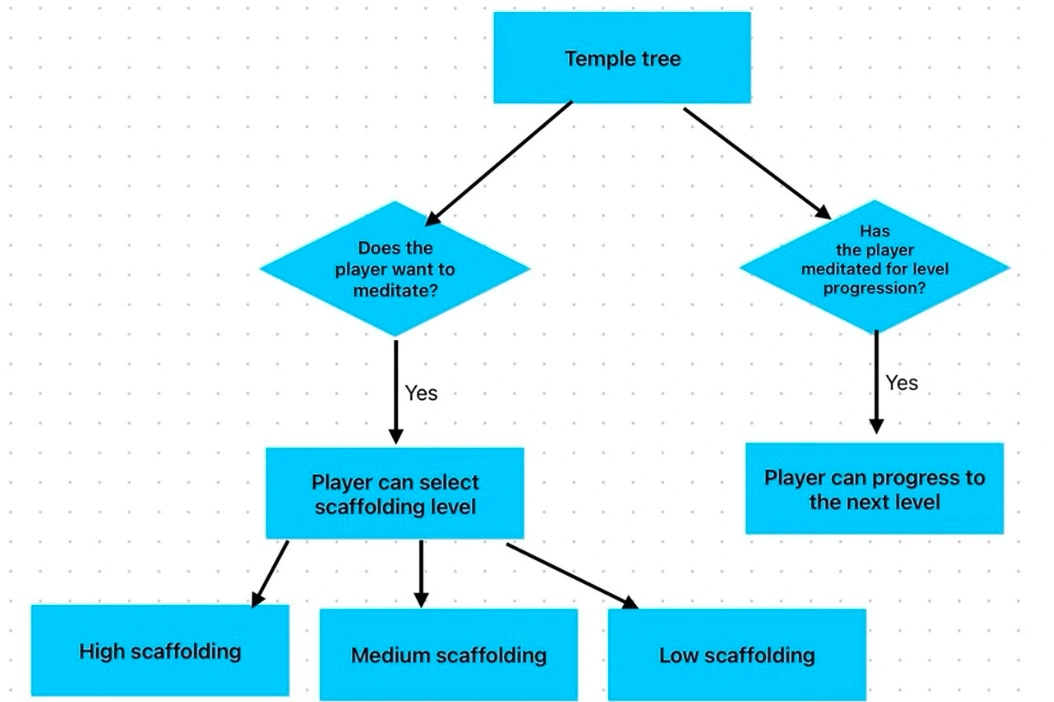
Taking inspiration from The First Tree, I made a simple framework for the mechanics of the levels of the game
Meditation Mechanics
Using the knowledge gained from the research done, I knew that the meditation mechanics had to have scaffolding mechanics, shouldn’t feel too forced, and has to be short and simple, to keep the user’s attention.
The meditation window would be prompted in the hub, when the user goes to the temple and sits under the tree.
The user would be given two options – meditate with scaffolding, or meditate for level progression.
Through the game, the user would have to meditate only 3 times to progress through the game. But if they wish, they can meditate more using the scaffolding
Overarching Design
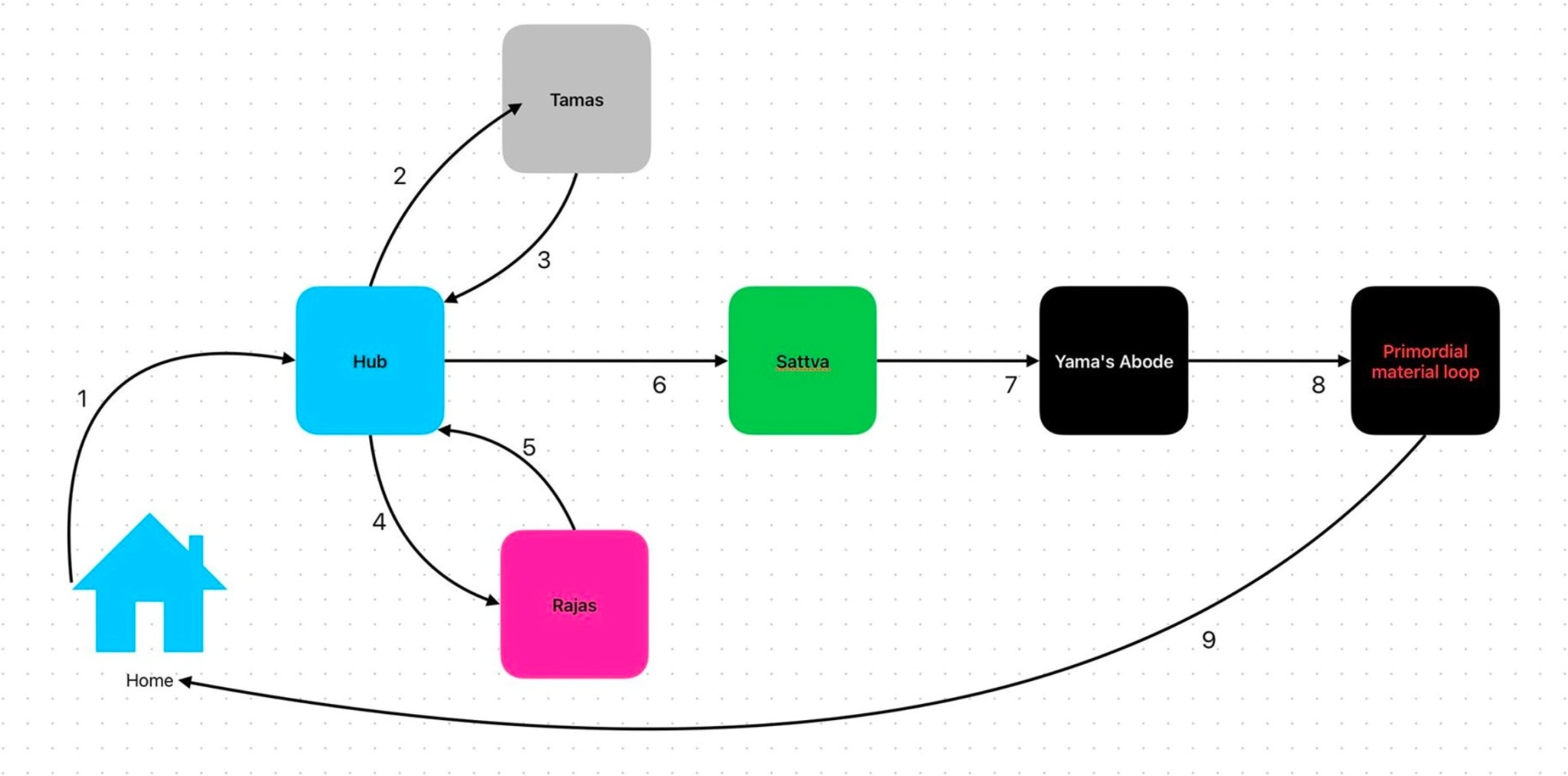
The overarching design was going to be a hub and spoke design, with influence from Super Mario Odyssey.
I was quite heavily influenced by Super Mario’s hub being a ship who’s sails need to be built with each passing level.
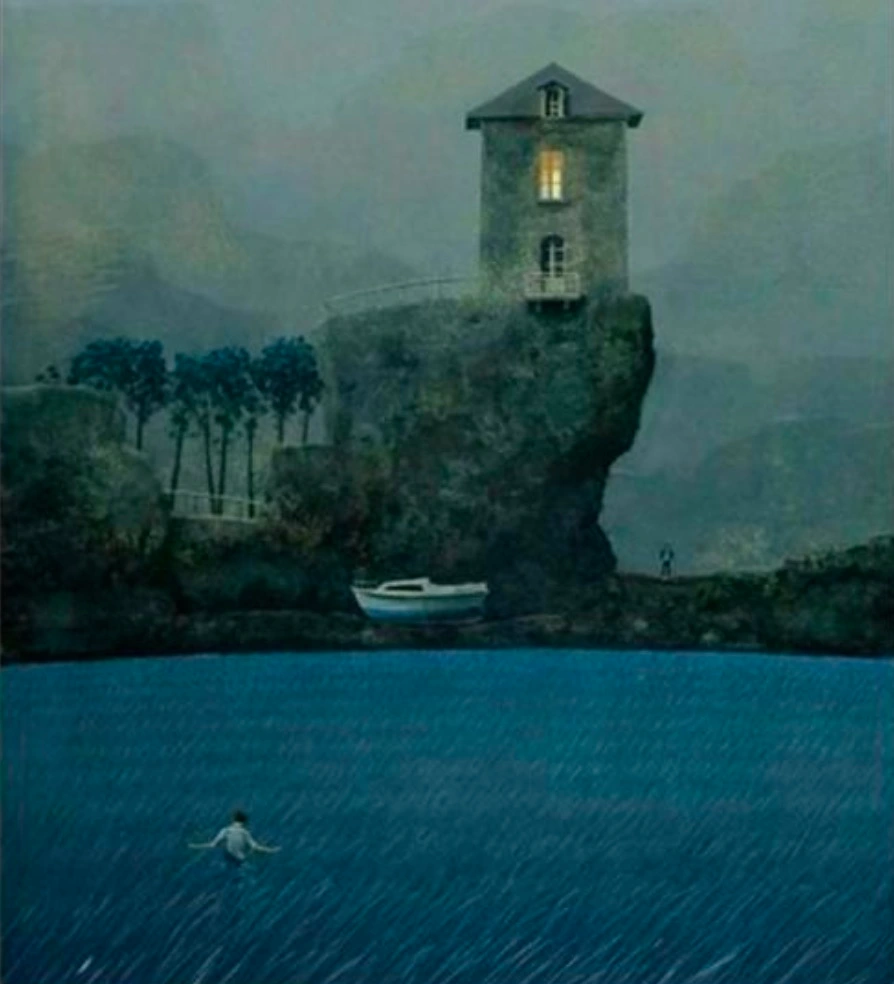
My game’s hub was going to be a dry landscape with a boat. The player would have to navigate through the various levels to be able to build the ship to travel to Yama (god of Death).
Level 1 - Tamas
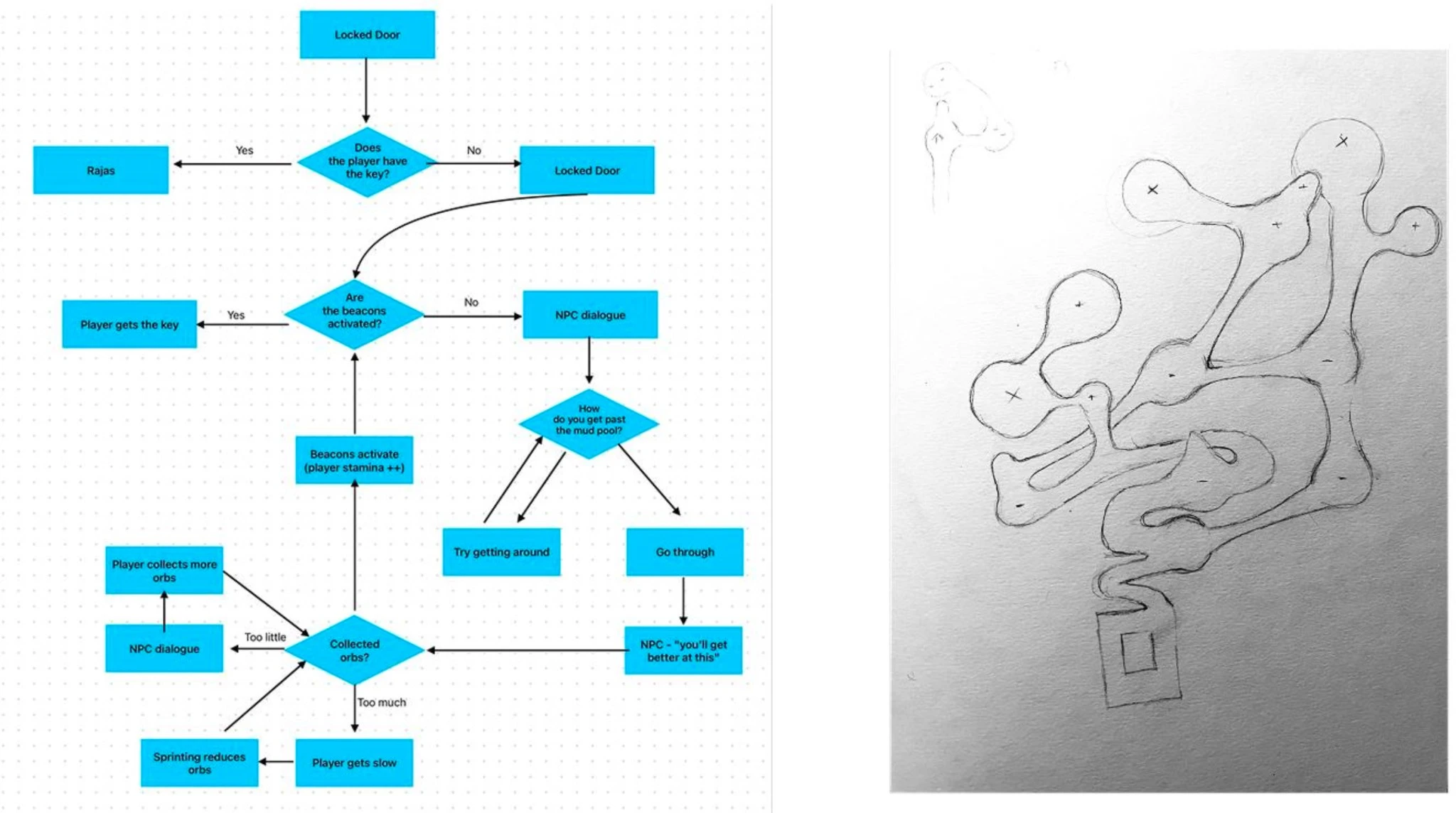
Tamas gives the feeling of inertia, darkness and Ignorance.
The following mechanics were implemented to reinforce that feeling:
Player can only walk, no sprinting
Mud slows the player down
Heavy silences, unsettling sounds
Player has to collect orbs – not too many, but not too little
Player could have a sprint timer, like in breath of the wild
Player would have to activate beacons – each beacon increases the player’s sprint ability
Level 2 - Rajas
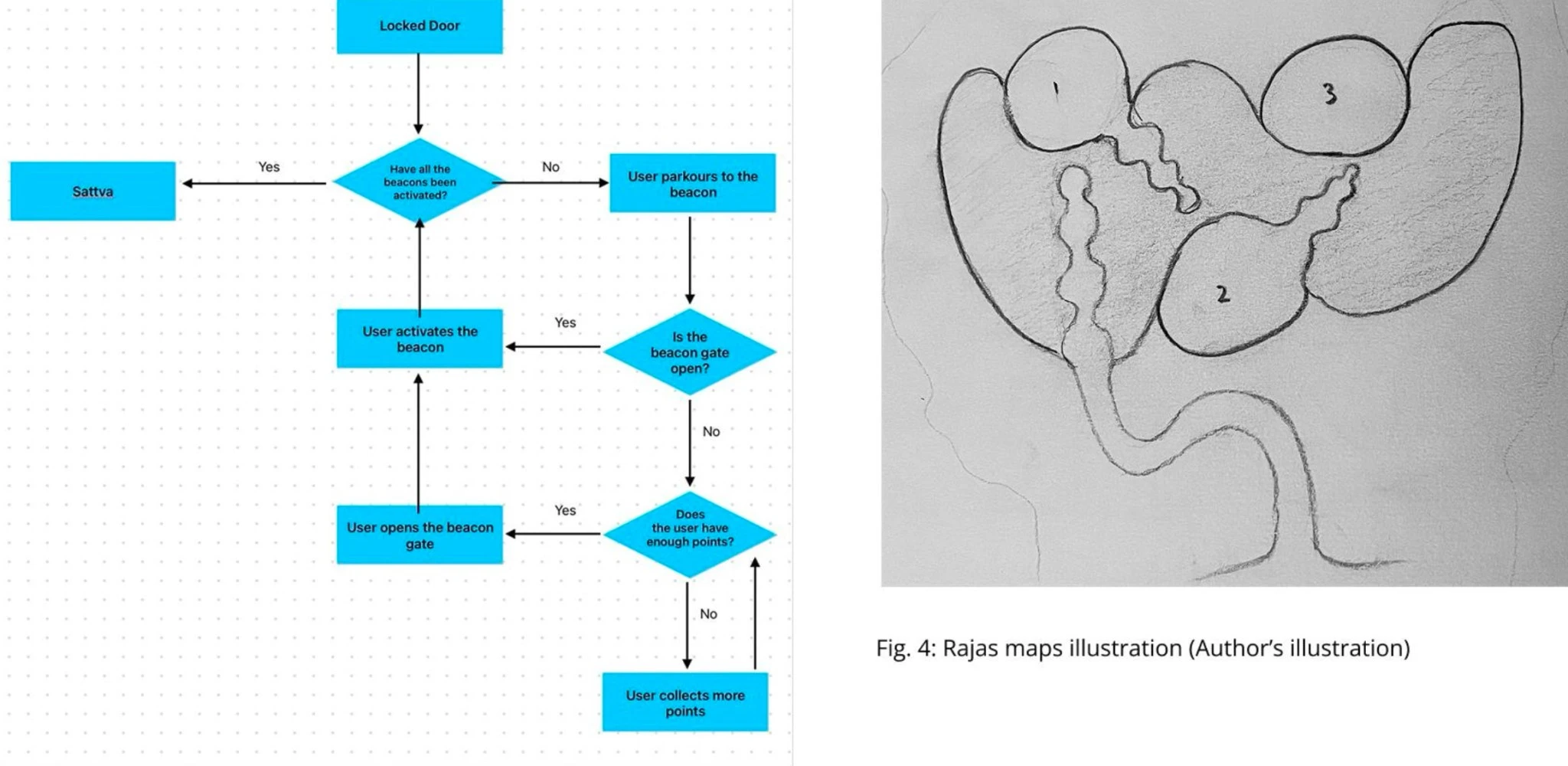
The level design for Rajas was going to have to include fast movement, parkour elements a n d solid goals to reinforce the feeling of growth, energy and restlessness.
The following mechanics were implemented to reinforce that feeling:
Arrangement based puzzles (creates frustration, and satisfaction on achieving a goal)
Parkour based platforming
Linear level design
Level 3 - Sattva
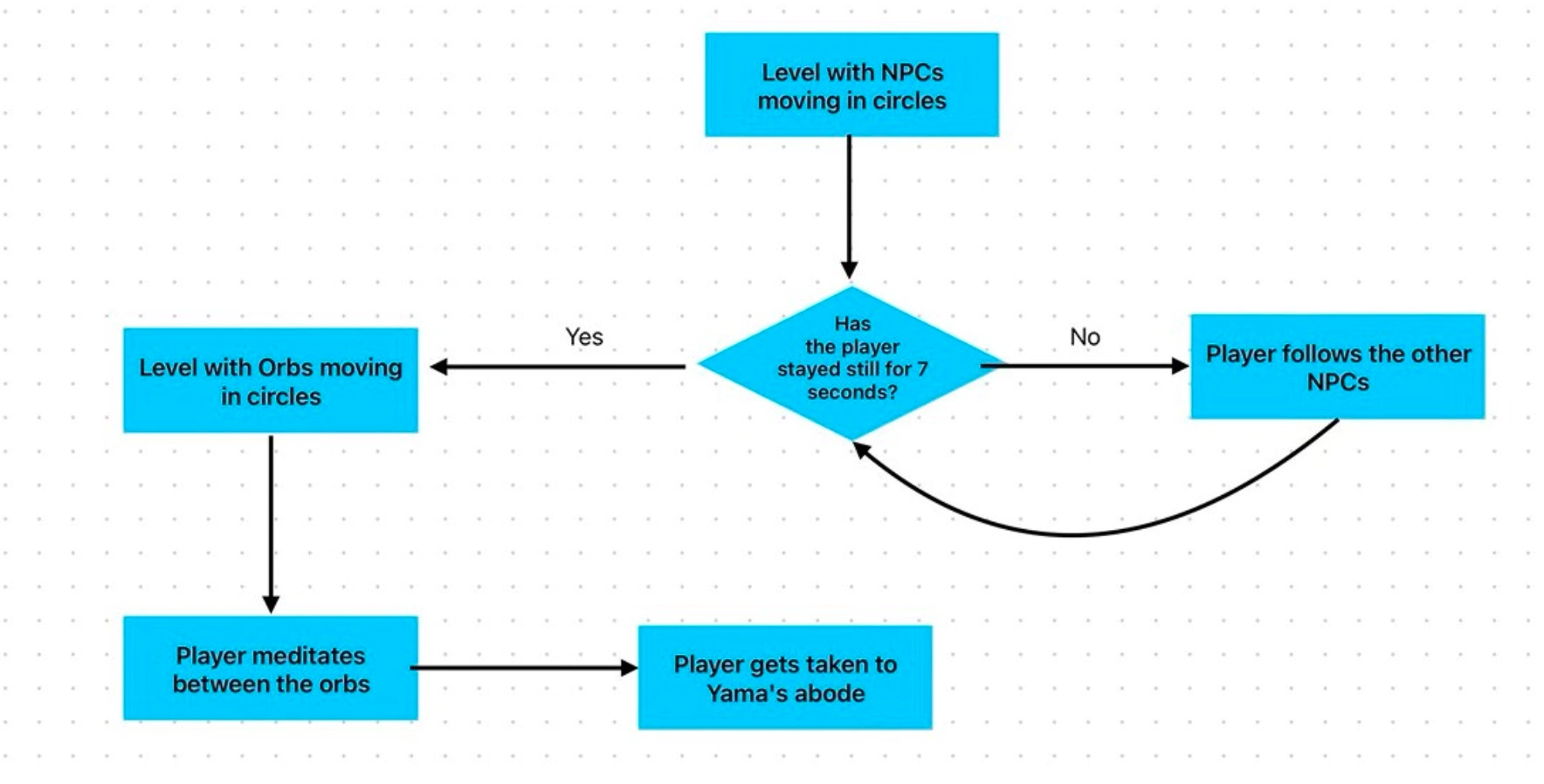
Sattva breaks the loop of the last two levels. Sattva is meant to be different, since it is the closest to moksha (liberation) player would have to walk in a loop following other NPCs.
The only way to stop the loop is for the player to step away from their computer. If the player steps away for about 7 seconds, the level changes to one that shows just their souls moving around in a loop, with the player in the centre.
To exit this level, the player would have to meditate, and after meditation, they would be transferred to the ship that takes them to Yama’s abode.
Level 4 - Primordial Matter
This is the conclusion of the game. Nachiketa mysteriously wakes up on Yama’s abode, his ship broken.
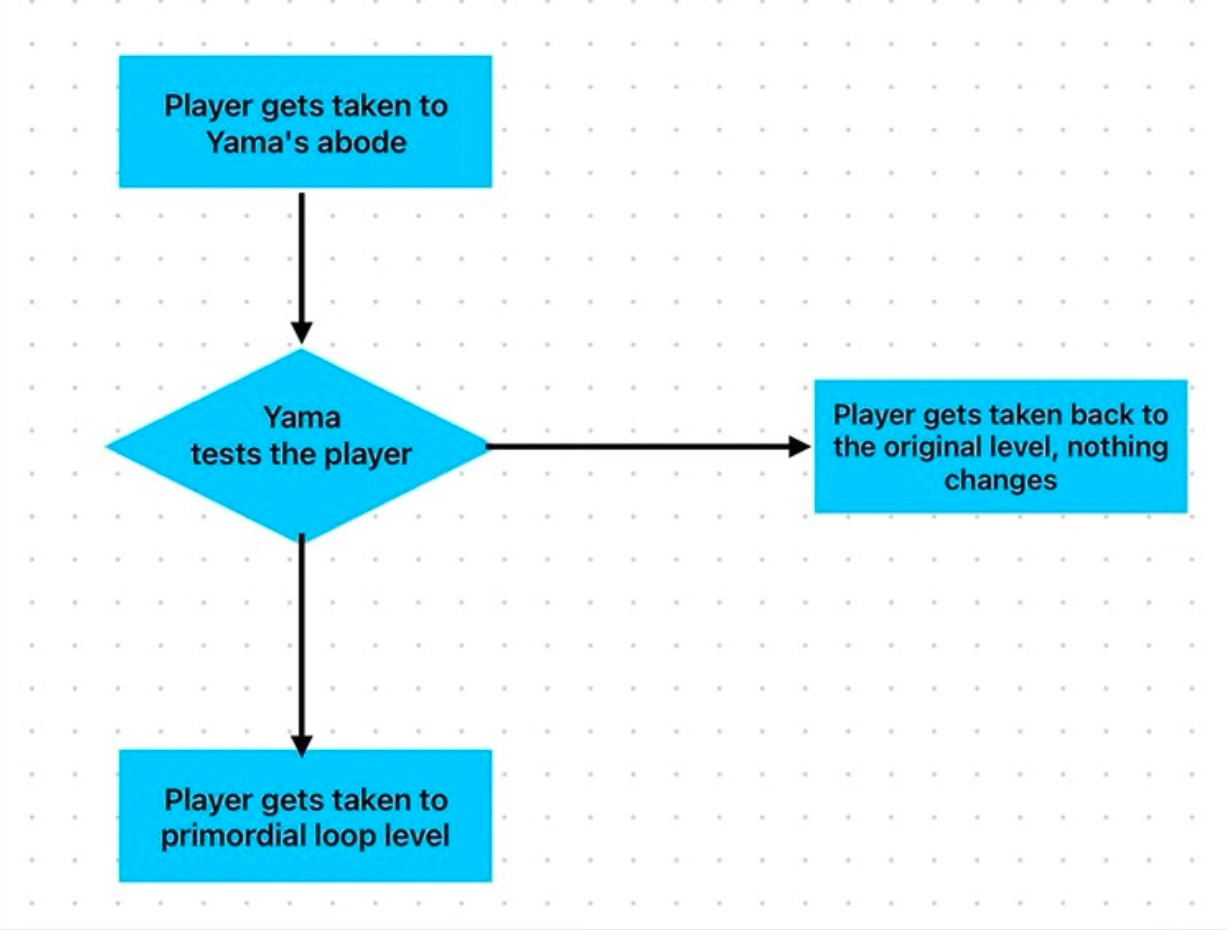
Upon meeting Yama, a dialogue scene is triggered where Yama tests the user after Nachiketa asks him “what happens to the soul after death?”.
If the user passes the test, the player is transported to a primordial material loop level.
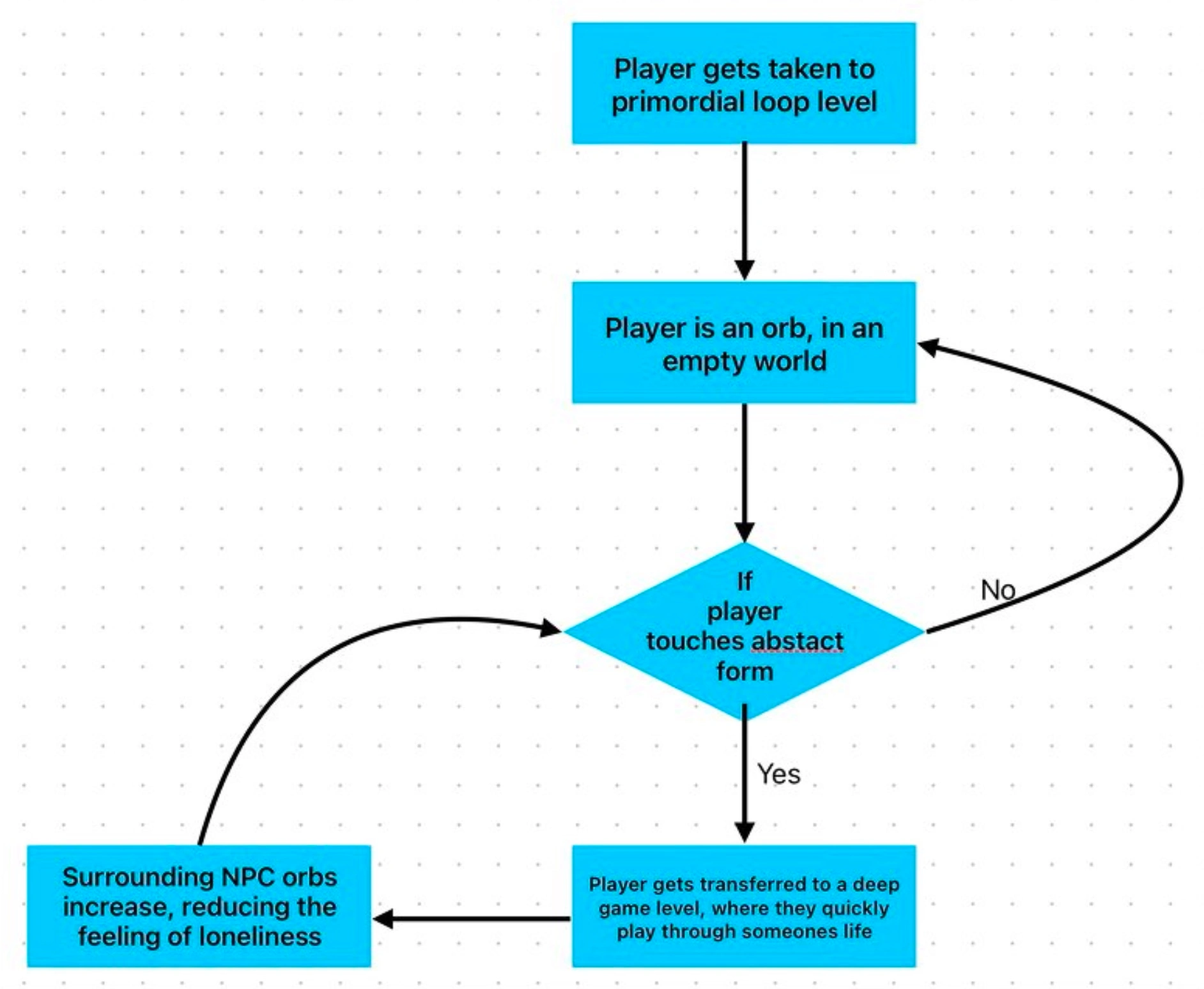
In the distance is an abstract form, upon going near, they are given
a body, and shown a life. This represents the line from samkhya,
“The universe begins when primordial material comes into proximity
with nature”Here, the user is an orb in a dark environment, representing a soul, searching for anything, any trace of anything.
Like this project
Posted Feb 10, 2026
Developed a game integrating meditation mechanics with ancient Indian philosophy.