The Battle for Goma: M23 Rebels and Rwanda's Role

Christoff Aucamp

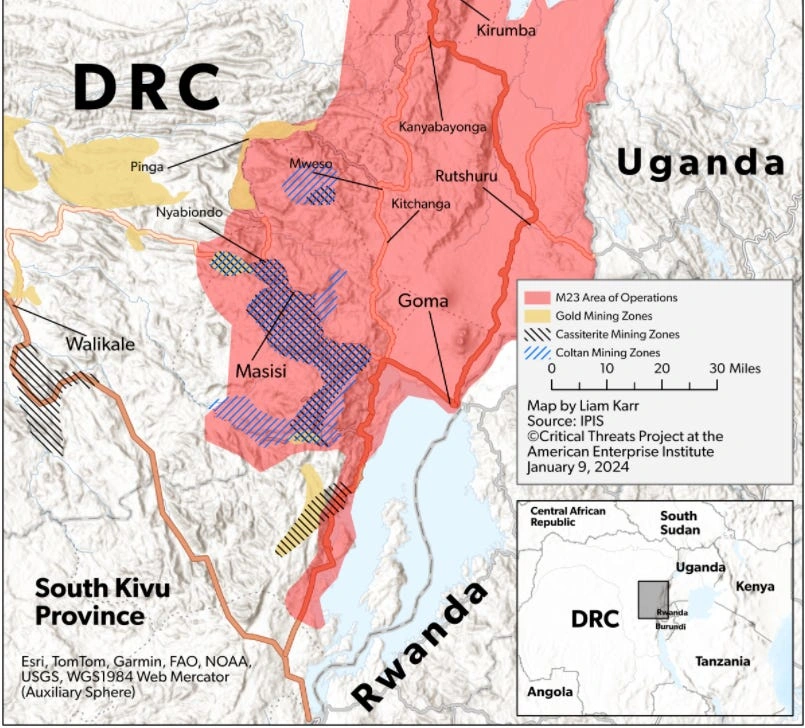
The Democratic Republic of Congo (DRC) has long been a battleground for armed groups, resource exploitation, and foreign interference. The latest chapter in this ongoing crisis unfolded in early 2025, as the M23 rebels, heavily backed by Rwanda, launched a major offensive against the Congolese army (FARDC) and its allies.
The fall of Goma, a city of over one million people, was a decisive victory for the rebels. But this was no ordinary insurgent attack—it was a well-planned military operation involving Rwandan special forces, modern weaponry, and strategic manoeuvres that left the Congolese army in complete disarray. The battle also exposed the struggles of South African and SADC peacekeepers, who fought bravely but were ultimately outmatched.
Thanks for reading! Subscribe for free to receive new posts and support my work.
M23 and Rwanda’s Role
The M23 rebel group consists of Tutsi fighters who claim to be defending their people in eastern Congo. However, evidence suggests that Rwandan soldiers were not just supporting M23—they were actively leading the fight. Reports estimate that between 3,000 and 7,000 Rwandan troops crossed into the DRC, providing superior tactics, firepower, and discipline to M23.
Rwanda’s President Paul Kagame has long denied involvement, but captured footage, satellite imagery, and intercepted communications suggest otherwise. Rwanda has been accused of backing M23 to secure access to Congo’s vast mineral wealth, particularly coltan, which is essential for electronic devices.
The Congolese Army (FARDC)
In contrast, FARDC was plagued by corruption, low morale, and logistical failures. Many soldiers were underfed, poorly equipped, and some even fought barefoot without body armour. Commanders were accused of selling food rations for personal profit, leaving troops demoralised and unfit for combat.
To compensate for these weaknesses, the Congolese government hired Romanian mercenaries, many of them former French Foreign Legion soldiers, to provide training and frontline support.
SADC Peacekeepers
The Southern African Development Community (SADC) deployed a 1,300-strong force, including 750 South African soldiers, alongside Tanzanian and Malawian troops. These forces established fortified positions west of Sake and around Goma’s airport, preparing to hold back the M23 advance.
The Battle
Phase 1: M23’s Strategic Expansion
By mid-2024, M23 had already seized key territories in North Kivu province, expanding their control over mineral-rich regions. They captured the town of Rubaya, generating an estimated $800 million in mining revenues between April and December. This influx of cash allowed them to bribe Congolese commanders, weakening the government’s ability to resist.
Phase 2: The Encirclement of Sake and Goma
As M23 advanced, they built extensive trench networks on the hills surrounding Sake, effectively cutting off the city from reinforcements. South African and Romanian forces held defensive lines, but the sheer scale of the attack put them under immense pressure.
Phase 3: The Fall of Goma
On January 24, 2025, M23 launched a surprise amphibious assault across Lake Kivu, flanking Congolese and South African forces. Simultaneously, Rwandan special forces entered the city from the north, overwhelming FARDC positions.
Despite heroic resistance, South African troops ran out of ammunition and were forced to negotiate a ceasefire. By January 27, thousands of Congolese soldiers surrendered or fled, abandoning Goma to the rebels.
Aftermath: What Happens Next?
With Goma under their control, M23 and Rwandan troops seized vast amounts of military equipment, including weapons, vehicles, and ammunition.
The fall of Goma also triggered a humanitarian crisis, with tens of thousands of civilians fleeing in fear of violence. Meanwhile, Burundi entered the war, sending 7,500 soldiers to counter Rwanda’s growing influence in the region.
Rwanda, despite denying involvement, has dug 600 new graves for fallen soldiers, raising questions about how long it can sustain this war.
Conclusion
The battle for Goma was not just another rebel uprising—it was a carefully planned military operation that exposed the weaknesses of the Congolese army, the strength of Rwandan-backed M23, and the limitations of South African peacekeepers.
While a temporary ceasefire was declared in early February, M23 has continued its push south towards Bukavu, suggesting that the war is far from over.
For the people of eastern Congo, peace remains an elusive dream, trapped between corrupt leadership, foreign interference, and the never-ending battle for resources.
This war is a stark reminder of how global demand for minerals, ethnic tensions, and international politics continue to fuel conflicts in Africa. With the stakes higher than ever, the world must ask itself: how long will this cycle of war and exploitation continue before real change happens
?
Thanks for reading! Subscribe for free to receive new posts and support my work.
Like this project
Posted Jun 7, 2025
Article on M23 rebels' offensive in DRC and Rwanda's involvement.
Likes
0
Views
5
Timeline
Apr 6, 2025 - Apr 7, 2025