K-8 Institutional Turnaround — Resilience Framework

Nicholas Primm


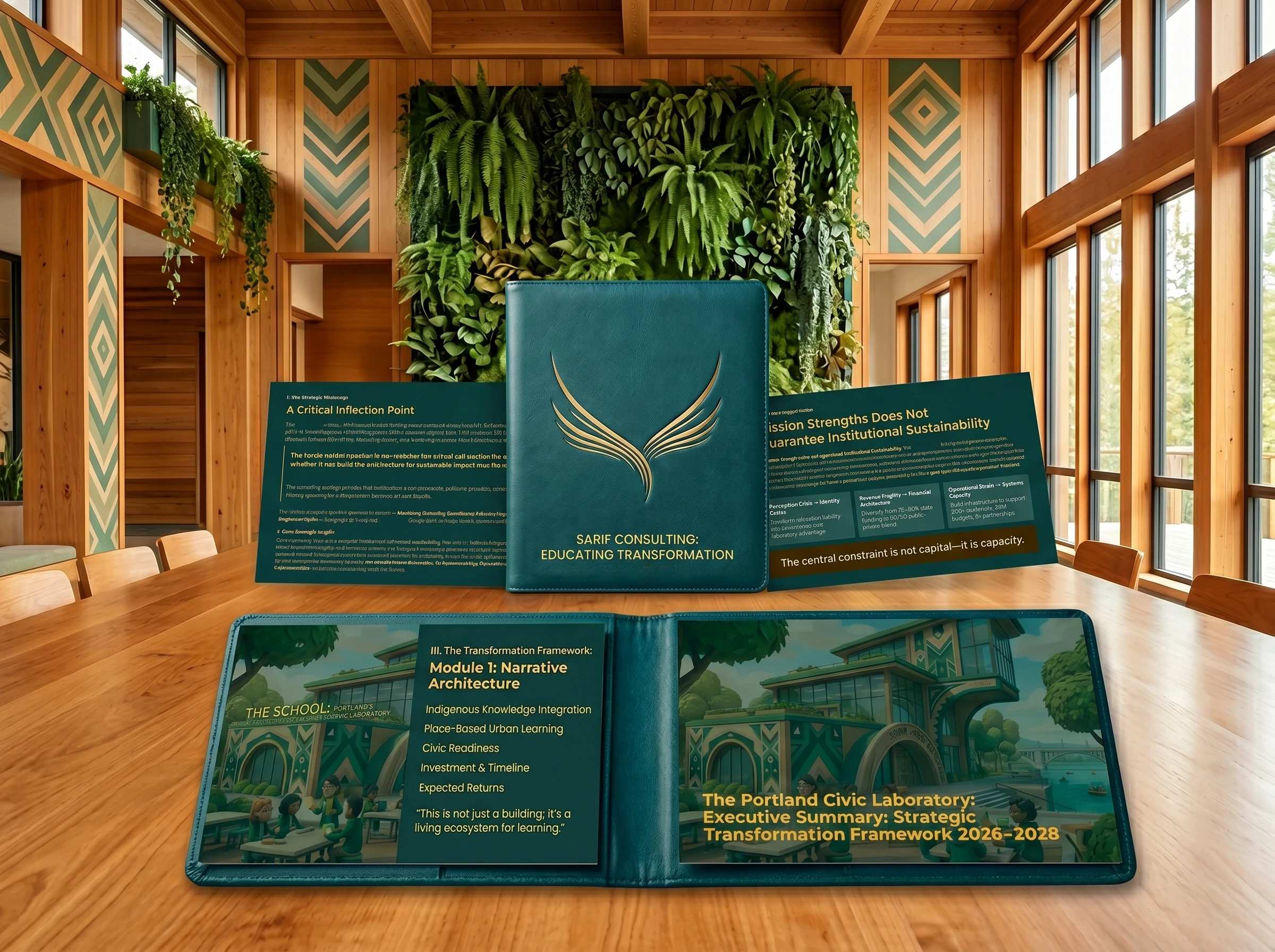
The Situation
A K-8 institution facing declining enrollment and a public perception crisis. The leadership team had options but no coherent framework for evaluating them. Strategic conversations were reactive, fragmented across departments, and disconnected from the institution's actual market position.
They needed someone to step back, diagnose the structural problem, and deliver something they could act on.
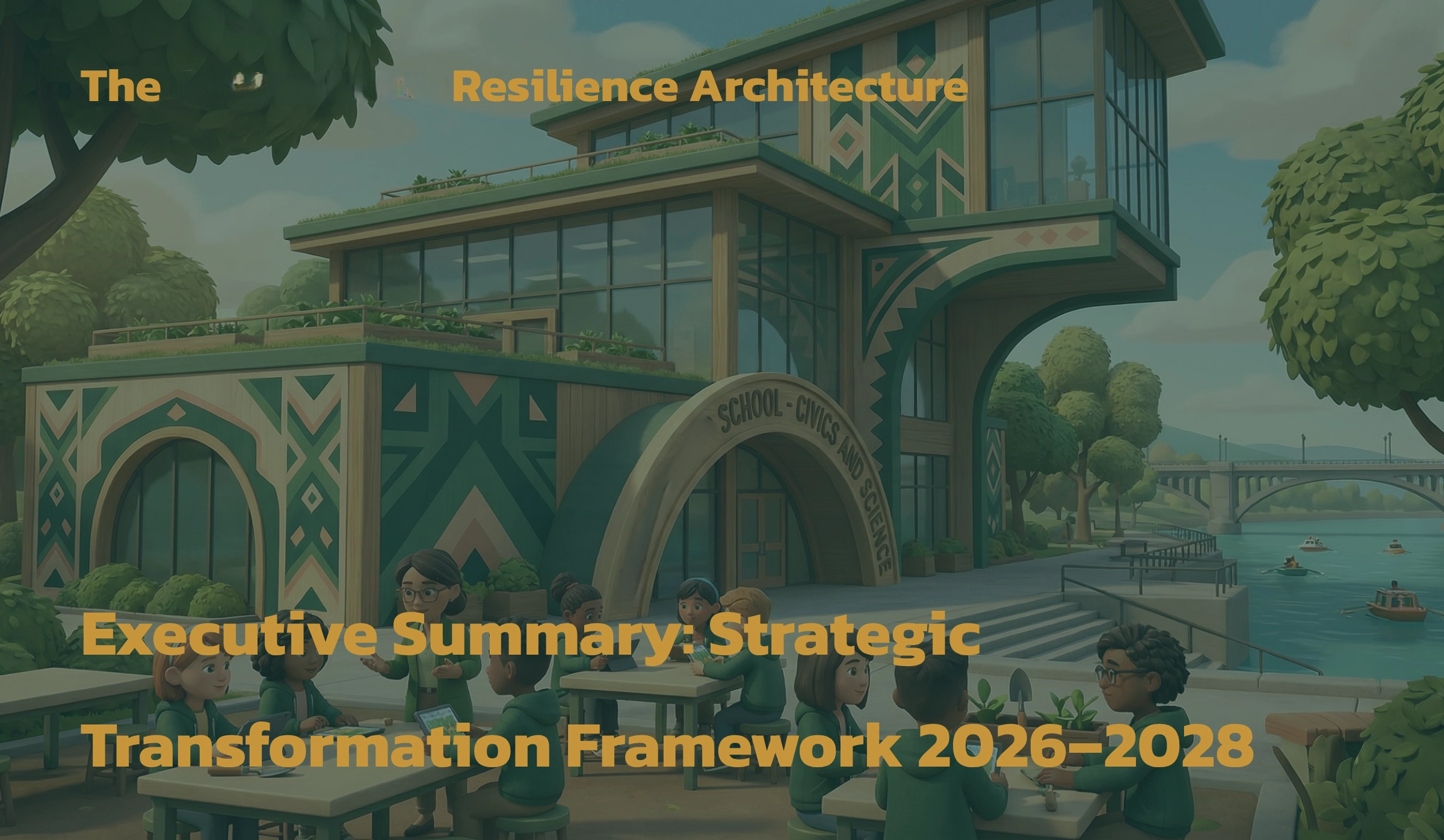
Executive Summary — Strategic Overview
The Diagnostic Reframe
The engagement started with a 20-minute conversation with a member of the admin team. That single conversation surfaced enough signal to identify the structural problem.
The core issue wasn't operational. It was perceptual. The institution was treating a positioning problem as an enrollment problem, which meant every intervention was downstream of the real failure point.
The diagnostic reframe was structural: convert a perception crisis into a defensible market position. That meant repositioning the narrative before touching enrollment tactics, financial planning, or partnership strategy. Everything else had to follow from that reframe or it would compound the original problem.
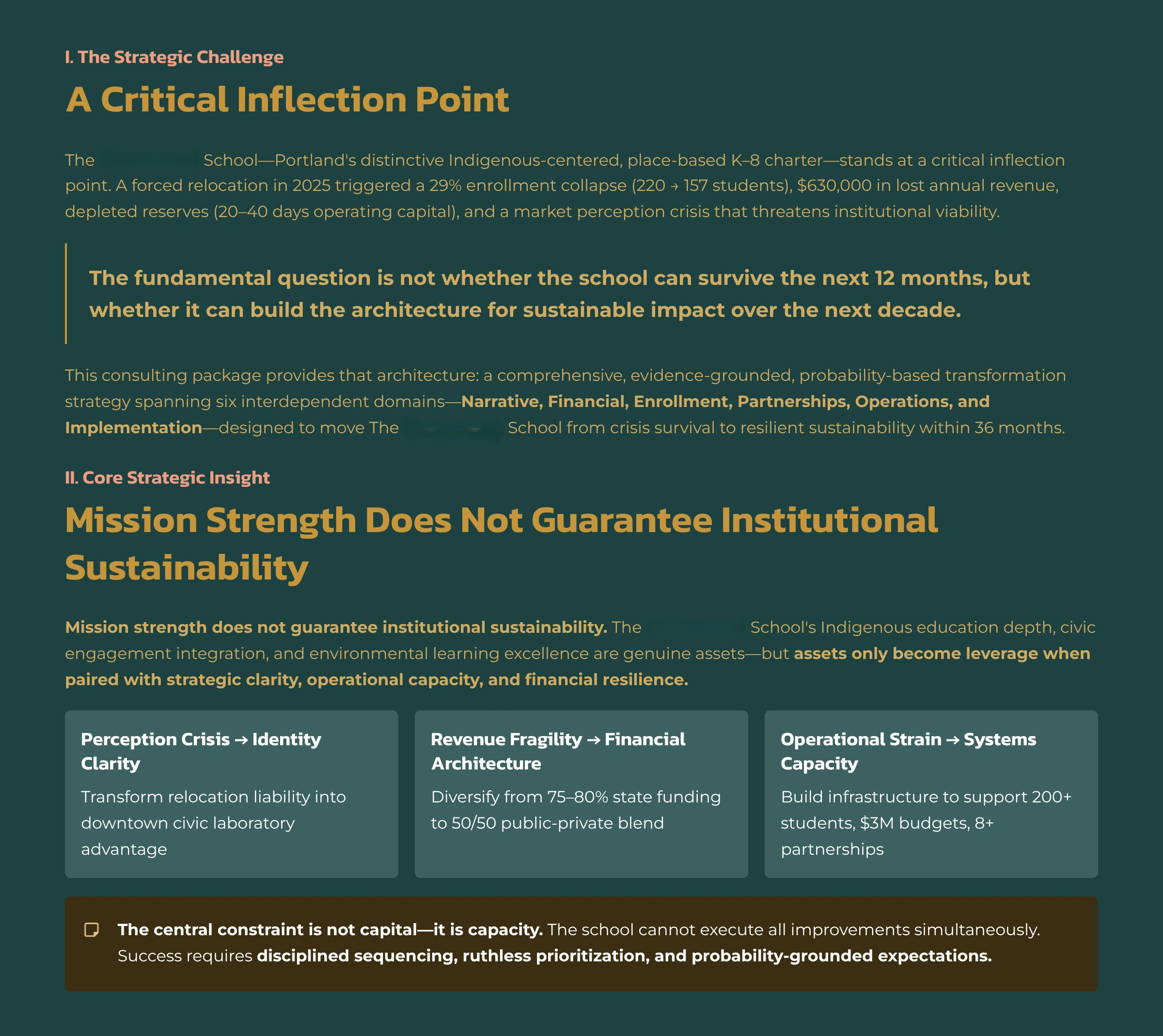
The Strategic Challenge
What I Built
A seven-module strategic transformation framework covering:
Narrative Repositioning — Reframing the institution's story from crisis to strategic transition
Financial Architecture — Restructuring the financial model to support the new positioning
Enrollment Recovery — Targeted recovery strategy built on the repositioned narrative
Partnership Development — Identifying and structuring external partnerships aligned with the new direction
Operations — Operational changes required to deliver on the repositioned promise
Implementation Sequencing — Phased rollout designed so each module compounds the others
Risk Management — Scenario planning and contingency architecture
The full package consists of eight cross-referencing documents. Every module was designed to function independently and compound collectively. Delivered as a complete decision-ready system.
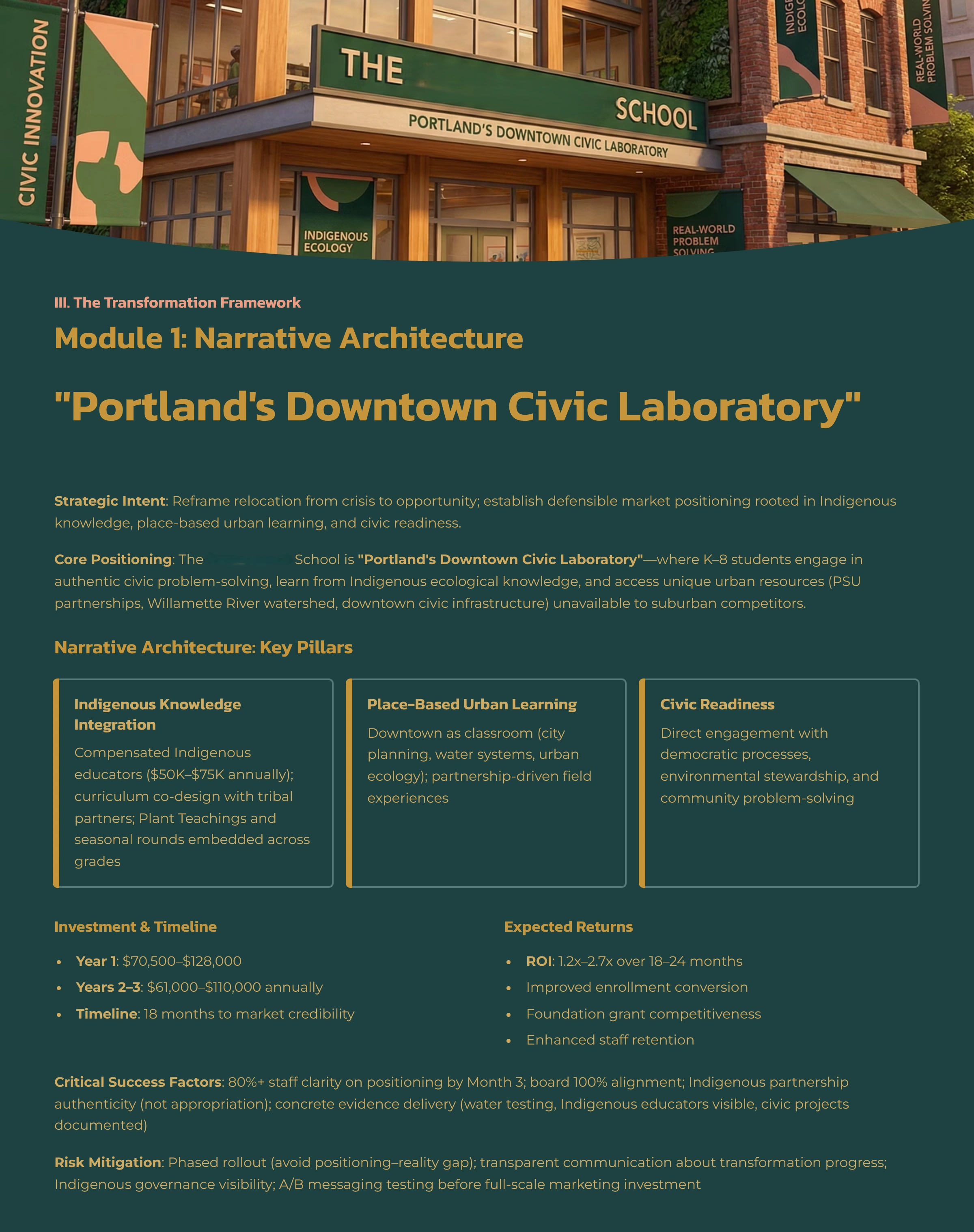
Portland's Downtown Civic Laboratory
How It Was Built
One 20-minute conversation. 36 working hours. Eight documents.
This engagement was AI-augmented across the entire production stack. Claude (Opus) for strategic reasoning, framework development, and deep analytical writing. Genspark.AI for research synthesis, competitive analysis, and strategic intelligence gathering. Gamma for document design and presentation architecture.
The AI layer compressed what would typically be weeks of consulting firm output into a focused, high-density deliverable. Each tool served a distinct function in the production pipeline: Claude handled the thinking, Genspark handled the research, Gamma handled the presentation.
This was a pro bono engagement, part of pressure-testing a methodology I'd been developing for institutional diagnostics. The institution provided a real problem with real stakes, which made it a genuine test of the framework under operational conditions.
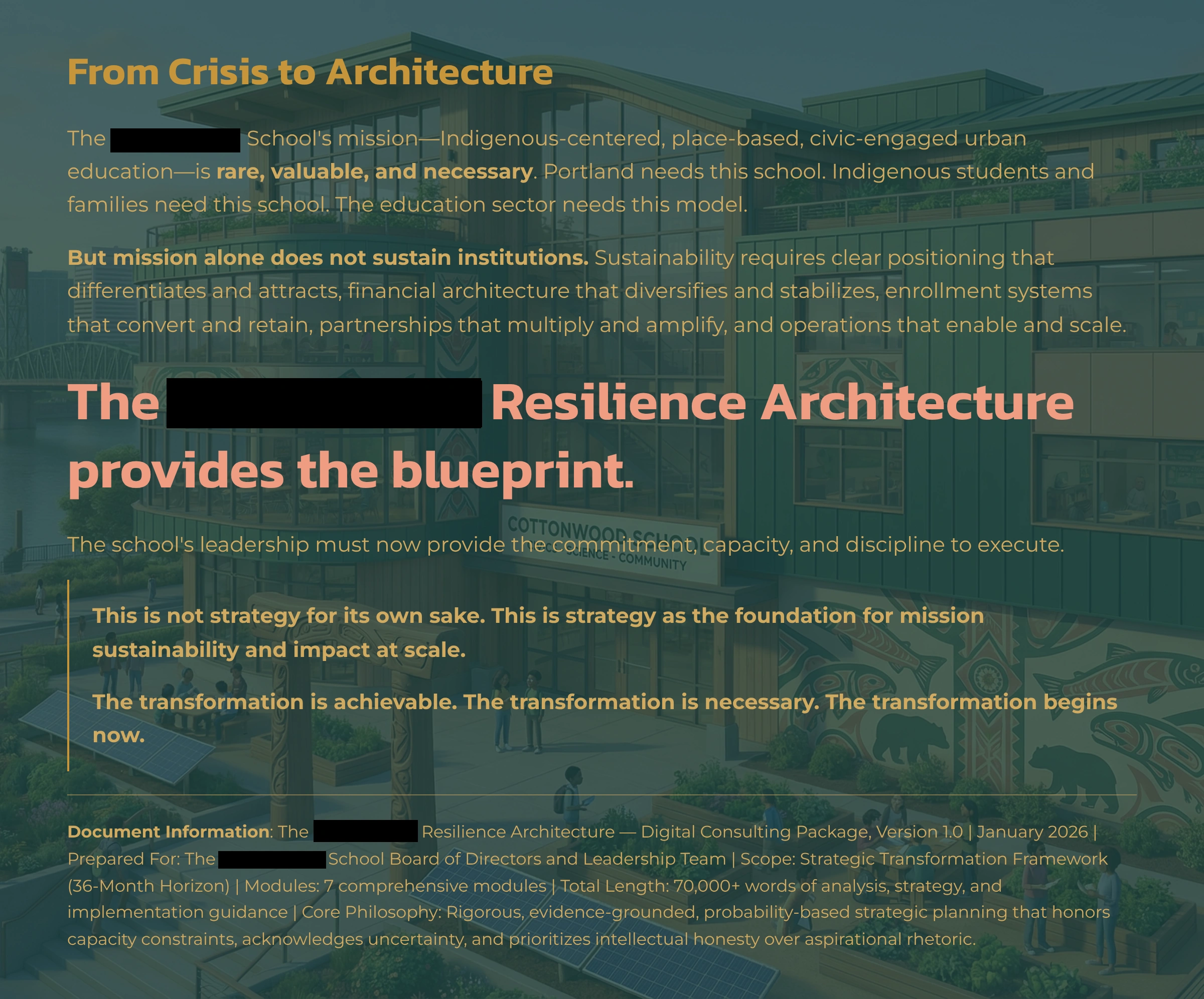
Resilience Architecture — The Blueprint
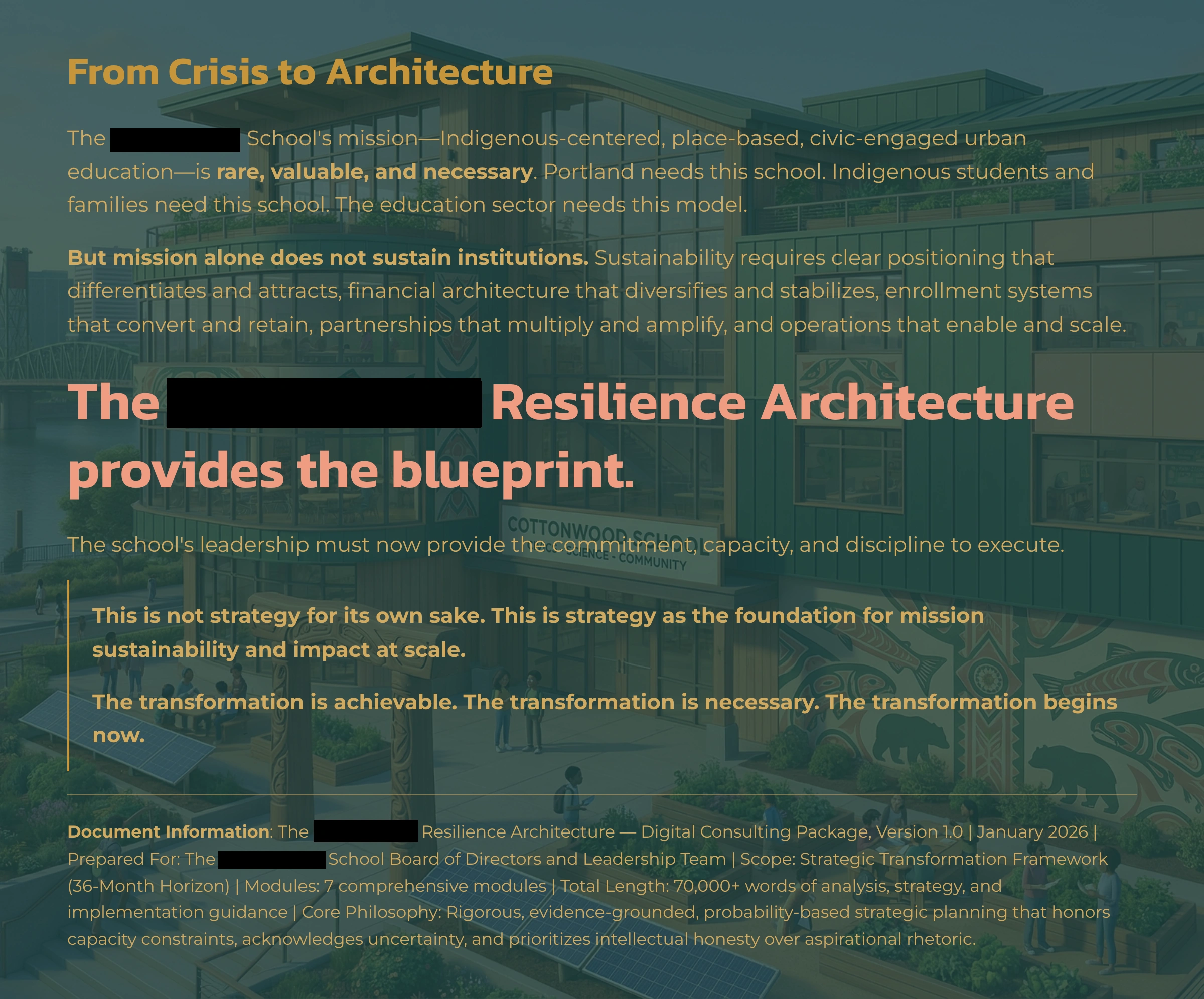
The Cottonwood Resilience Architecture
The Outcome
The framework helped shift internal perception of the institution's strategic options. Leadership moved from reactive decision-making to working within a structured system that connected narrative, finance, enrollment, and operations into a single coherent strategy.
The institution has used the framework. The degree of adoption and long-term impact remain theirs to measure. What I can say is that the deliverable was decision-ready on arrival, not a deck that needed six more meetings to interpret.
Institution name redacted. Completed January 2026.
Like this project
Posted Jul 20, 2026
One conversation. 36 working hours. A seven-module strategic transformation framework for a K-8 institution in crisis. AI-augmented with Claude, Genspark, and Gamma.
Likes
0
Views
9
Timeline
Jan 1, 2026 - Jan 31, 2026