Digital Lending Platform Upgrade at Cakos Ventures LTD

Divine Mike


Case Study: Upgrading the Digital Lending Platform at Cakos Ventures LTD
Project Overview
During my tenure as a Project Manager Intern at Cakos Ventures LTD (February 2021 – April 2024), I led a critical initiative to upgrade our digital lending platform. The goal was to enhance system performance, boost operational efficiency, and improve customer lending experience. Recognizing the growing demand for rapid and reliable lending services, the project was designed to address technical bottlenecks and process inefficiencies limiting the platform’s full potential.
Objectives and Scope
Reduce System Downtime: One of the primary objectives was to decrease platform downtime by at least 15%, ensuring continuous, reliable service for end users.
Improve Operational Efficiency: By optimizing resource allocation and refining processes, we aimed to enhance overall system efficiency by 30%.
Boost Loan Approvals: By fostering stronger vendor relationships and streamlining technical operations, the project sought to drive a 20% increase in loan approvals.
Role and Responsibilities
As the project manager, I managed a cross-functional team comprising 20 members from technical, operational, and vendor management backgrounds. My key responsibilities included:
Planning and Strategy: Developing a comprehensive project plan that outlined key milestones, resource allocation, and risk mitigation strategies.
Team Leadership: Coordinating daily stand-ups, sprint planning, and retrospectives, which fostered clear communication and timely progress updates.
Stakeholder Engagement: Acting as the bridge between technical teams, vendors, and senior management to ensure that the project is aligned with strategic business goals.
Vendor Negotiations: Identifying and onboarding critical vendor partnerships that were instrumental in upgrading technology and expanding service capabilities.
Implementation of Data-Driven Tools: Introducing a new planning system that leveraged data analytics for more efficient decision-making.
Challenges Faced
Legacy System Constraints: The existing digital platform had several legacy components that resisted rapid change, requiring careful planning and phased rollouts.
Resource Allocation: Coordinating efforts across a large, diverse team, while ensuring that every member had the resources needed to deliver on their tasks, was a significant challenge.
Vendor Coordination: Establishing new vendor relationships and integrating their services into the existing infrastructure involved intricate contractual and technical negotiations.
Balancing Innovation with Operational Stability: Introducing breakthrough changes while avoiding disruption to the ongoing services necessitated a robust contingency plan.
Methodologies Employed
Agile Project Management: We adopted an Agile approach to maintain flexibility throughout the project lifecycle. Regular sprint cycles allowed us to quickly incorporate feedback and adjust the project roadmap as needed.
Data-Driven Decision Making: By implementing a planning system that tracked key performance metrics in real time, we could swiftly identify issues and optimize processes.
Collaborative Communication: Daily stand-ups and routine retrospectives ensured that both successes and setbacks were shared transparently, enabling continuous improvement.
Solutions and Implementation
Revamping the System Architecture: I coordinated with the technical team to replace outdated components with scalable, cloud-based services. This overhaul laid the groundwork for a more resilient platform.
Optimizing Resource Utilization: Through detailed project planning and analysis, we optimized resource allocation. Detailed Gantt charts and resource matrices were used to streamline operations effectively.
Vendor Partnership Initiatives: I led initiatives to identify and onboard strategic partners who provided cutting-edge technological enhancements. These partnerships were crucial in integrating new features and ensuring smooth system upgrades.
Introducing a Data-Driven Planning System: The rollout of this system not only expedited decision-making but also provided comprehensive dashboards that tracked project progress, resource use, and key performance indicators (KPIs).
Results and Outcomes
Reduced System Downtime: Achieved a 15% reduction in downtime, ensuring users experienced far fewer service interruptions.
Increased Operational Efficiency: Overall system efficiency improved by 30%, which translated into faster response times and a better customer experience.
Enhanced Loan Approvals: Thanks to strategic vendor partnerships, loan approvals increased by 20%, boosting overall business performance.
Accelerated Decision Making: The new planning system cut strategic decision time by 40%, allowing the company to respond more rapidly to market and operational challenges.]
Lessons Learned
The Value of Cross-Functional Teams: Coordinating diverse perspectives was invaluable. It reinforced the importance of transparent communication and the synergy that comes from a well-integrated team.
Agile Adaptation is Key: Embracing an Agile methodology was pivotal in managing the complexities of the upgrade, especially when dealing with legacy systems and rapid market changes.
Data-Driven Insights: Implementing analytics-driven systems transformed our decision-making process, proving that measurable data is crucial in optimizing project outcomes.
Vendor Relations Matter: Strategic vendor partnerships not only provide technological support but can also become key stakeholders in delivering innovative solutions.
Conclusion
The digital lending platform upgrade was a transformative project at Cakos Ventures LTD. It strengthened our technological backbone, enhanced customer satisfaction through reduced downtime, and improved efficiency across the board. This experience has further honed my skills in Agile project management, cross-functional leadership, and driving innovation in challenging environments. The success of this project underscores my ability to lead complex technological transformations, skills that are directly transferable to international and remote project management roles.
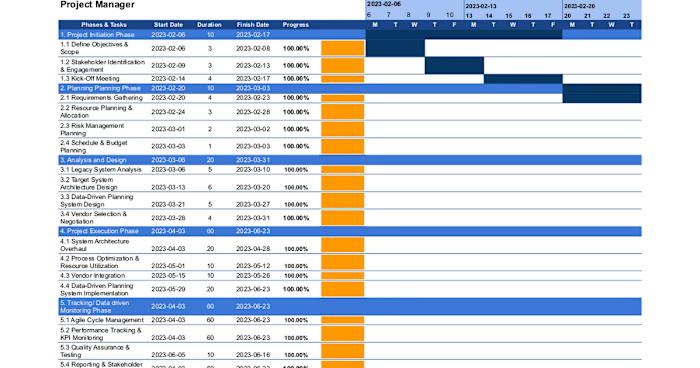
Detailed WBS in Tabular Form
The following table maps each phase and subtask with an assigned start date, duration in workdays, finish date, and shows 100% progress (indicating project completion). Calendar dates are computed assuming a Monday–Friday workweek without holidays.
Phase / Task
Start Date
Duration (workdays)
Finish Date
Progress
1. Project Initiation (Overall)
2023-02-06
10
2023-02-17
100%
1.1 Define Objectives & Scope
2023-02-06
3
2023-02-08
100%
1.2 Stakeholder Identification & Engagement
2023-02-09
3
2023-02-13
100%
1.3 Kick-Off Meeting & Documentation
2023-02-14
4
2023-02-17
100%
2. Planning (Overall)
2023-02-20
10
2023-03-03
100%
2.1 Requirements Gathering
2023-02-20
4
2023-02-23
100%
2.2 Resource Planning & Allocation
2023-02-24
3
2023-02-28
100%
2.3 Risk Management Planning
2023-03-01
2
2023-03-02
100%
2.4 Schedule & Budget Planning
2023-03-03
1
2023-03-03
100%
3. Analysis and Design (Overall)
2023-03-06
20
2023-03-31
100%
3.1 Legacy System Analysis
2023-03-06
5
2023-03-10
100%
3.2 Target System Architecture Design
2023-03-13
6
2023-03-20
100%
3.3 Data-Driven Planning System Design
2023-03-21
5
2023-03-27
100%
3.4 Vendor Selection & Negotiation
2023-03-28
4
2023-03-31
100%
4. Execution / Implementation (Overall)
2023-04-03
60
2023-06-23
100%
4.1 System Architecture Overhaul
2023-04-03
20
2023-04-28
100%
4.2 Process Optimization & Resource Utilization
2023-05-01
10
2023-05-12
100%
4.3 Vendor Integration
2023-05-15
10
2023-05-26
100%
4.4 Data-Driven Planning System Implementation
2023-05-29
20
2023-06-23
100%
5. Monitoring & Controlling (Overall)
2023-04-03
60
2023-06-23
100%
5.1 Agile Cycle Management
2023-04-03
60
2023-06-23
100%
5.2 Performance Tracking & KPI Monitoring
2023-04-03
60
2023-06-23
100%
5.3 Quality Assurance & Testing
2023-06-05
10
2023-06-16
100%
5.4 Reporting & Stakeholder Updates
2023-04-03
60
2023-06-23
100%
6. Deployment & Project Closure (Overall)
2023-06-26
20
2023-07-21
100%
6.1 Final System Deployment (Go-Live)
2023-06-26
10
2023-07-07
100%
6.2 Post-Implementation Review
2023-07-10
5
2023-07-14
100%
6.3 Formal Project Closure
2023-07-17
5
2023-07-21
100%
Case Study: Stakeholder Onboarding Project at a Fintech Company
1. Introduction
In today’s dynamic fintech environment, clear communication and aligned expectations among stakeholders are critical to ensuring efficient operations and rapid execution of projects. Recognizing this need, the Fintech Company launched a Stakeholder Onboarding Project to streamline the mapping, engagement, and ongoing communication with its key internal and external stakeholders. Managed by myself, the project deployed a structured approach with clearly defined tasks and rigorous timelines to onboard stakeholders effectively via a suite of collaborative tools.
2. Project Background and Objectives
Before the onboarding initiative, the company faced several challenges:
A lack of awareness of stakeholder roles and responsibilities.
Inconsistent communication formats and unstructured meeting cadence.
Absence of a unified workflow for tracking stakeholder interaction and progress.
Key Objectives of the Project:
Stakeholder Mapping & Role Identification: Establish a definitive view of the organization chart and compile a contact list to define roles.
Effective Communication Setup: Develop a kickoff meeting agenda and prepare a presentation deck that clearly outlines stakeholder objectives, time slots, and company priorities.
Systematic Workflow Deployment: Create a dedicated project shell in Asana, design the onboarding workflow document, set up an automated Asana workflow, and train users.
Governance & Tracking: Implement a version control and governance plan, configure a tracking dashboard with defined KPIs and access to relevant tools, and complete a final document handoff upon stakeholder sign-off.
3. Project Approach and Methodology
The project was structured into a series of interrelated tasks carried out over three weeks. Each task was scheduled with clear start and finish dates, and all tasks were completed within the planned durations. An agile mindset was employed to incorporate feedback from early meetings into subsequent deliverables. The process emphasized transparency, stakeholder engagement, and accountability at every step.
4. Work Breakdown Structure (WBS)
The following table outlines the detailed tasks, start dates, durations (in workdays), and completion dates for the Stakeholder Onboarding Project.
Task
Start Date
Duration (workdays)
Finish Date
Progress
Stakeholder Mapping & Role Identification
- Access to org chart, stakeholder contact list
April 22, 2025
3
April 24, 2025
100%
Kickoff Meeting Agenda + Deck Preparation
- Outline stakeholder objectives, time slots, priorities
April 24, 2025
2
April 25, 2025
100%
Initial Asana Workspace Setup (Project Shell)
- Define project scope outline, draft task list
April 25, 2025
2
April 26, 2025
100%
Onboarding Workflow Design Document
- Incorporate feedback from kickoff and stakeholder requirements
April 29, 2025
3
May 1, 2025
100%
Communication Cadence Plan
- Define role identification and meeting preferences
May 1, 2025
2
May 2, 2025
100%
Version Control & Governance Plan
- Integrate input from Legal and adopt templates
May 2, 2025
2
May 3, 2025
100%
Asana Workflow Automation + User Training
- Finalize process design to align with stakeholder availability
May 6, 2025
3
May 8, 2025
100%
Dashboard Setup for Tracking & Status
- Define KPIs and grant access to required tools
May 8, 2025
2
May 9, 2025
100%
Final Handoff: Docs + Access Permissions
- Perform QA on documents and obtain stakeholder sign-off
May 10, 2025
1
May 10, 2025
100%
Note: The weekdays displayed for each task correspond to the project’s first week as detailed in the planning materials, ensuring deliverables were met within specified start-to-finish periods.
5. Execution and Outcomes
The project was executed as per the defined plan, with every task completed on schedule. Key accomplishments include:
Robust Stakeholder Mapping: By securing access to the organizational chart and contact lists, the project team established a clear view of stakeholder roles and responsibilities.
Effective Kick-Off: The well-prepared meeting agenda and deck successfully aligned stakeholder expectations and set the tone for subsequent communications.
Seamless Workspace Setup: Creating an initial Asana project shell laid a strong foundation for task management and collaboration.
Tailored Workflow and Communication Plans: The onboarding workflow document and communication cadence plan were refined based on direct stakeholder feedback, ensuring that individual meeting preferences and information flows were honored.
Governance and Automation: The version control and governance plan provided a structured review mechanism. Additionally, the streamlined Asana automation and user training empowered the teams with self-help resources.
Real-Time Tracking: The tracking dashboard with clearly defined KPIs provided transparency and enabled proactive monitoring of ongoing stakeholder engagement.
Successful Handoff: On the final day, documentation quality was validated and stakeholder approval was secured, marking a successful project closure.
6. Lessons Learned and Future Recommendations
Stakeholder Engagement is Crucial: Early identification and direct feedback from stakeholders significantly improved the onboarding process design.
Automation Enhances Efficiency: Leveraging tools like Asana for workflow automation reduced manual follow-ups and improved transparency.
Clear Communication Protocols: Defining a detailed communication cadence early helped in maintaining alignment with stakeholder expectations.
Future projects can benefit from maintaining a similar detailed WBS and agile feedback incorporation to further refine communication and workflow processes as organizational needs evolve.
7. Conclusion
The Stakeholder Onboarding Project at the Fintech Company was a resounding success. By establishing a clear plan, leveraging collaborative tools, and aligning communication strategies with stakeholder needs, the initiative not only ensured a smooth onboarding process but also set a new standard for stakeholder engagement. The project’s success, as documented through its detailed timeline and structured execution, underscores the importance of a systematic approach to internal communications and process automation in today’s fast-paced fintech environment.
Like this project
Posted Apr 29, 2025
Led a digital lending platform upgrade at Cakos Ventures LTD, enhancing performance and efficiency.
Likes
0
Views
1
Timeline
Feb 6, 2023 - Jul 21, 2024