
Overview
Scheduling and resource allocation within busy educational environments is a notoriously complex problem. Administrators spend hours manually balancing room availability, teacher certifications, substitute mapping, and class rotations. EduPlanner replaces this chaotic process with an intelligent, automated scheduling engine that handles intricate constraints instantly.
How It Works
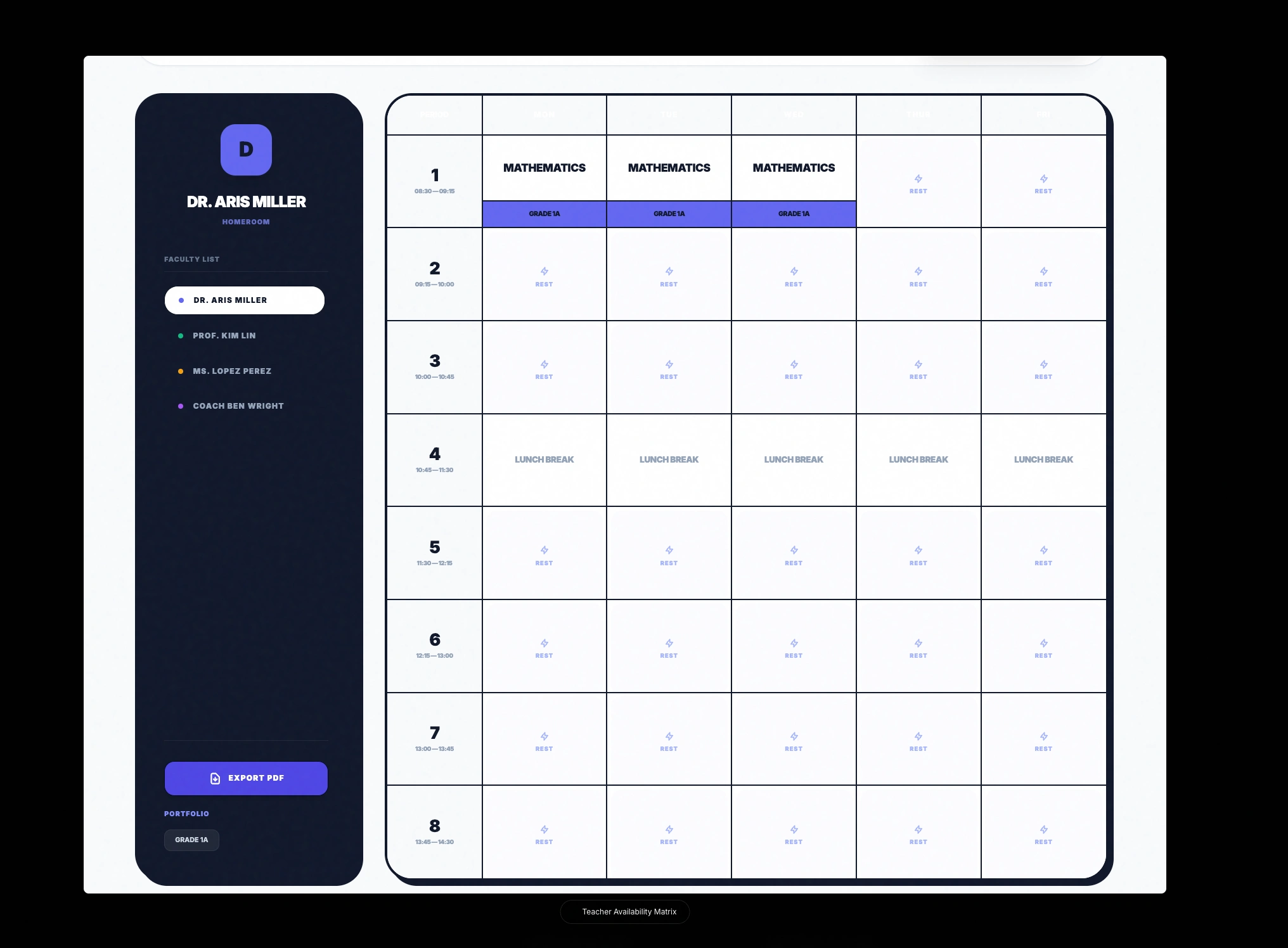
The system takes raw operational constraints—such as teacher availability, room capacities, curriculum tracks, and staff rotation rules—and processes them to generate optimal, conflict-free schedules. It actively flags potential issues and automatically suggests optimal substitute coverage or room re-mappings in real-time when changes occur.
Technical Deep Dive & Guardrails
Advanced AI Reasoning: Powered by a customized Google Gemini reasoning model that processes complex constraint matrices using recursive structural constraint re-weaving to find optimal scheduling paths.
Conflict Resolution Engine: Features a hard-coded algorithmic layer that enforces business rules with zero margins for error (e.g., ensuring a teacher is never double-booked across physical branches).
Real-Time Adaptability: Built to handle dynamic, live operational friction, such as last-minute sick leaves, by automatically recalculating and suggesting the lowest-impact substitute rotation.
0 likes · 0 views · Jun 21, 2026
Overview Scheduling and resource allocation within busy educational environments is a notoriously complex problem. Administrators spend hours manually balanc...


