AI Agent for Business Workflow Automation

Reza Tamanani


Problem
Organizations often store critical knowledge across PDFs, documents, internal files, and different repositories. Finding accurate information quickly can become difficult, especially when users need answers that are traceable to the original source and restricted by access permissions.
Solution
I designed and developed an enterprise Retrieval-Augmented Generation (RAG) knowledge assistant that transforms internal documents into a searchable and reliable AI knowledge system.
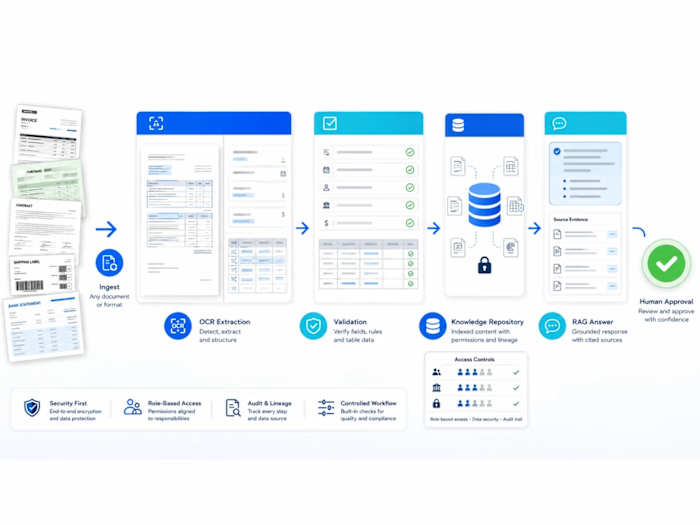
The solution processes uploaded documents, extracts and validates their content, stores structured knowledge, retrieves the most relevant context for each question, and generates grounded answers based on approved sources.
How It Works
The workflow is designed around five main stages:
Document Ingestion
Documents such as PDFs, Word files, spreadsheets, and other business files are uploaded into the system.
OCR & Content Extraction
The system extracts text, tables, and document structure and prepares the information for indexing and retrieval.
Validation & Knowledge Processing
Extracted content is validated and organized before being added to the knowledge repository.
Retrieval & RAG Answering
When a user asks a question, the system retrieves the most relevant information and uses an LLM to generate a grounded response based on the retrieved context.
Human Review & Control
Where required, responses or document-processing steps can include human review and approval before final use.
Key Features
Retrieval-Augmented Generation (RAG)
Semantic search across enterprise documents
OCR and document intelligence
Grounded answers based on internal sources
Source references and traceability
Role-based access control
Permission-aware knowledge retrieval
Audit and workflow controls
Human-in-the-loop approval
Support for multiple document formats
Architecture & Security
The system is designed for enterprise environments where information security and access control are important. Users only access knowledge they are authorized to view, while document processing and AI responses remain traceable throughout the workflow.
The architecture separates document ingestion, processing, retrieval, AI generation, and access control so each component can be managed and scaled independently.
Outcome
The solution creates a centralized AI-powered knowledge layer for business information. Instead of manually searching through large collections of documents, users can ask natural-language questions and receive relevant, source-grounded answers while maintaining organizational access controls.
This approach can support use cases such as internal knowledge management, policy and procedure search, document analysis, customer support knowledge bases, legal and compliance research, and enterprise AI assistants.
Like this project
Posted Sep 16, 2026
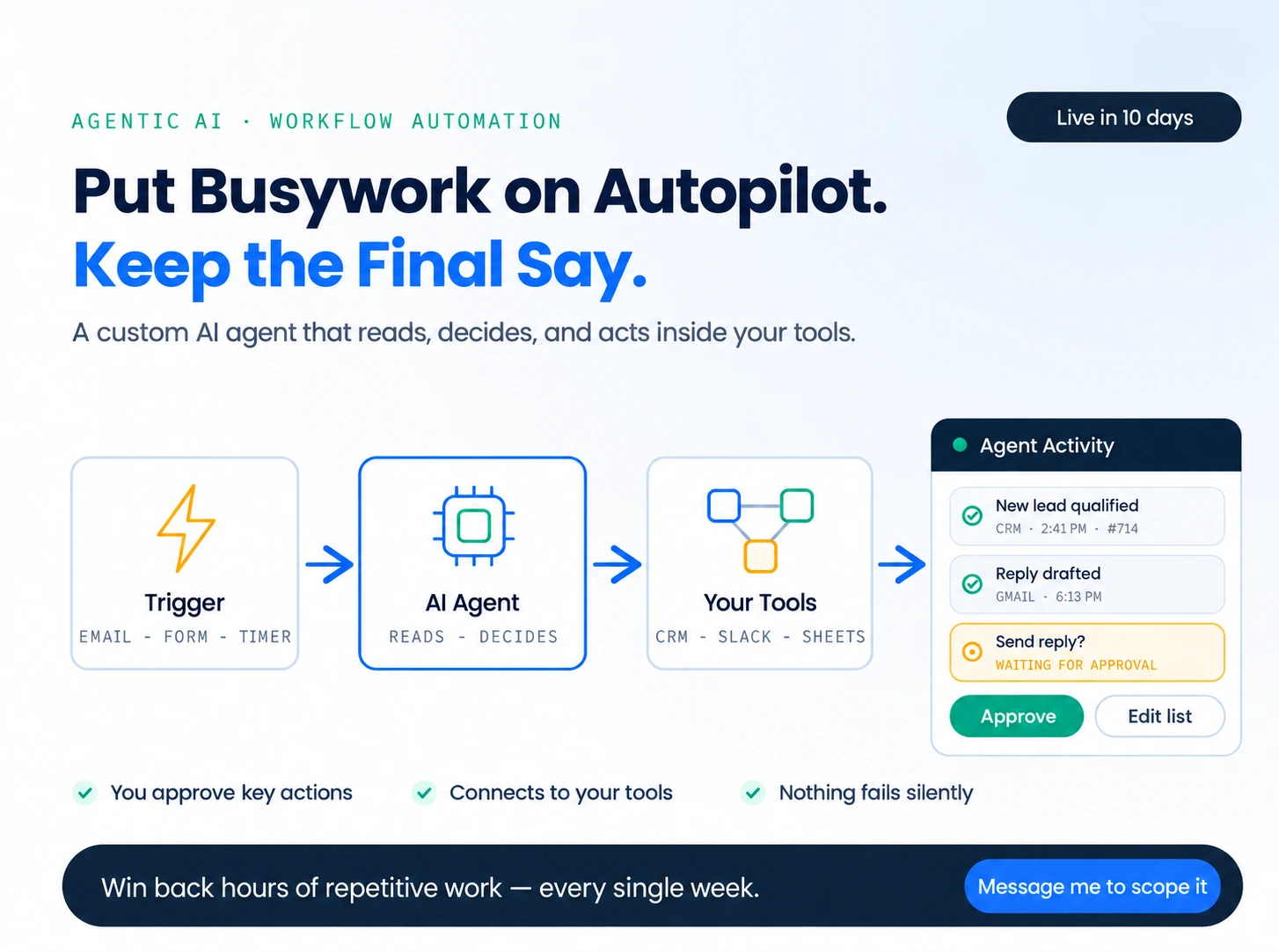
Built an AI agent that connects tools, APIs, and business workflows to automate repetitive tasks, improve decision-making, and reduce manual work.