Agentic AI: The Power of One vs. The Strength of Many

Emmanuel Ezeokeke


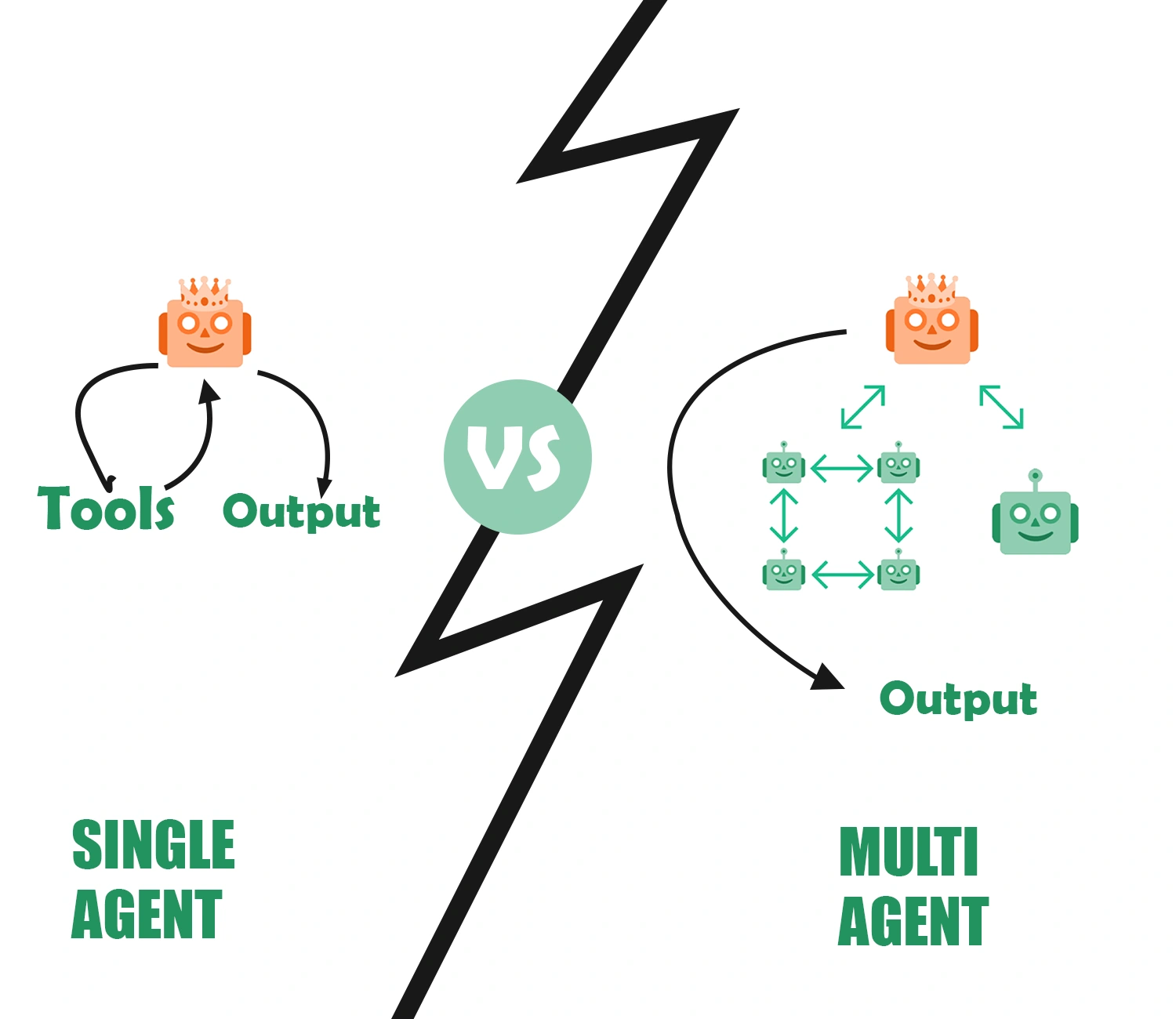
Agentic AI: The Power of One vs. The Strength of Many
In the world of Artificial Intelligence, we're moving beyond simple chatbots and into a new era of Agentic AI. This is the science of building autonomous AI systems that don't just respond, but can perceive their environment, reason, create plans, and take action to achieve goals. Think of them not as tools, but as digital workers.
But how you build these workers depends entirely on the job you need them to do. Do you need a single, focused expert, or a dynamic team that can collaborate to tackle something much bigger? This is the fundamental difference between single-agent and multi-agent systems.
1. Single-Agent Systems: The Lone Expert
A single-agent system is a standalone entity, like a master craftsman working alone in their workshop. It interacts with its environment, makes decisions, and acts independently without needing to coordinate with any other AI.
A) How It Works:
The agent operates on a continuous "perceive-think-act" loop. It senses its environment (e.g., receives a user query or a data update), uses its internal logic to decide on the best course of action, and then executes that action. It learns from the feedback it receives, constantly refining its performance.
B) Key Characteristics:
Focused and Specialized: Designed to excel at a specific, well-defined task.
Centralized Control: All intelligence and decision-making are contained within one unit.
Simplicity in Design: Being self-contained makes single agents easier to design, manage, and debug.
Limited Scope: They can struggle in complex, rapidly changing environments where multiple simultaneous tasks are required.
C) When to Use a Single Agent:
This architecture is perfect for tasks that are linear and isolated.
Personal Assistants: Siri or Google Assistant answering your direct question.
Automated Game Bots: An AI opponent in a video game that learns your strategy.
Industrial Robotics: A factory robot programmed to perform a single, repetitive task like welding or packaging with high precision.
2. Multi-Agent Systems (MAS): The Collaborative Team
A multi-agent system is a team of autonomous agents operating in a shared environment. Like a team of specialists, each agent has its own individual skills and goals, but they can communicate, coordinate, and collaborate to achieve a much larger, common objective.
A) How It Works:
Instead of a single "brain," intelligence is distributed across the system. Agents interact with each other, share information, negotiate tasks, and work in parallel. Their collective action gives rise to "emergent behavior," where the system as a whole can solve problems far more complex than any single agent could alone.
B) Key Characteristics:
Decentralized Intelligence: No single point of failure; intelligence is distributed across the network.
Scalability and Flexibility: New agents can be added to the system to handle increased complexity or workload.
Robust and Resilient: If one agent fails, the others can often adapt and redistribute tasks to complete the mission.
Complex Interactions: Requires sophisticated protocols for communication, coordination, and resolving conflicts.
C) Types of Team Dynamics:
Cooperative: All agents work together for a shared goal, like a team of drones mapping a search-and-rescue area.
Competitive: Agents compete against each other for limited resources, such as trading bots on the stock market.
Mixed-Motive: Agents may need to both cooperate and compete, like in supply chain negotiations where companies collaborate on logistics but compete on price.
D) When to Use a Multi-Agent System:
This approach is built for complex, dynamic, and distributed problems.
Swarm Robotics: A fleet of delivery drones coordinating flight paths to avoid collisions and optimize routes.
Smart Grid Management: Multiple agents managing energy distribution and consumption across a city.
Advanced AI Ecosystems: A complex problem is broken down and assigned to specialized LLM-based agents. A "Planner" agent creates the strategy, a "Researcher" agent gathers data, and an "Executor" agent takes action, all communicating seamlessly.
3. Key Differences at a Glance
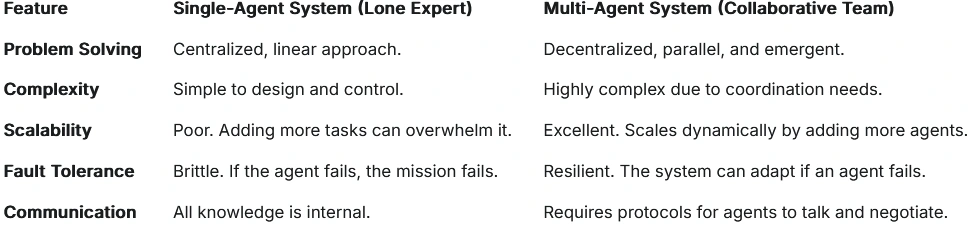
4. The Future is Collaborative
The future of Agentic AI is undeniably headed towards more sophisticated multi-agent collaboration. We're seeing the rise of self-organizing "societies of AIs" that can tackle enterprise-level challenges. This involves:
a) LLM-Powered Reasoning: Integrating the advanced reasoning and language capabilities of Large Language Models into each agent.
b) Cross-Domain Collaboration: Agents from different fields (e.g., logistics, finance, and marketing) working together to optimize an entire business.
c) Decentralized AI Ecosystems: Building robust systems that don't rely on a single central server, making them more secure and efficient.
d) Ethical Frameworks: Developing rules for AI cooperation to ensure decisions are made transparently, accountably, and ethically.
Ready to Build Your AI Workforce?
Understanding the theory is one thing, but applying it to solve your unique business challenges is where the real value lies. Whether you need a single, highly specialized AI agent to automate a critical task or a multi-agent system to revolutionize an entire workflow, the possibilities are no longer science fiction.
If you're ready to move from concept to implementation, let's talk. I can help you design and deploy an Agentic AI strategy that drives real-world results.
Contact me today for a consultation, and let's explore how to put your AI team to work or book a meeting with me today below:
Like this project
Posted Nov 6, 2025
Exploration of single-agent and multi-agent AI systems for business applications.