
Bilingual Arabic-English Sentiment Analysis
A reproducible machine-learning project for classifying Arabic and English sentiment with a shared character-level TF-IDF pipeline. The system compares two classical ML models, evaluates them with cross-validation and a held-out test set, saves the best model, and exposes predictions through both a CLI and a lightweight local web interface.
Portfolio note: This project was completed as a three-person academic team project by Mohammad Rouhi Khattab, Salam Al-Buhaisi, and Mohammad Abu Khammash. The repository contains the complete delivered implementation, evaluation artifacts, paper, and presentation.
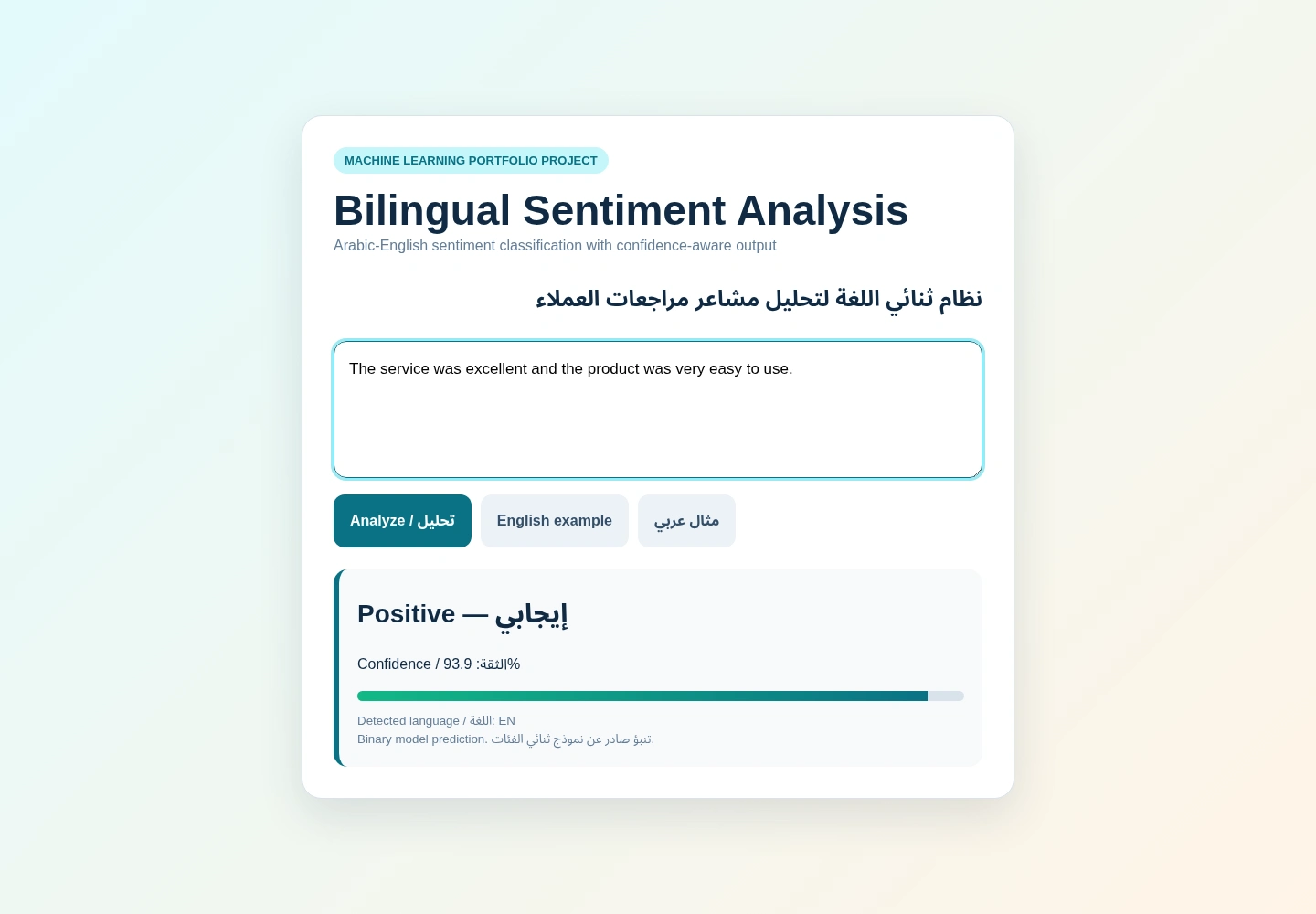
Demo
The interface accepts Arabic or English text and returns a bilingual sentiment label with confidence. If the model confidence is below the configured threshold, the result is reported as Neutral / uncertain. This is an abstention mechanism, not a separately trained third class.
Highlights
Arabic-English text normalization and language detection.
Character n-gram TF-IDF features (3–5 characters) that work across both scripts.
Model comparison between Logistic Regression and Multinomial Naive Bayes.
Stratified 80/20 hold-out evaluation and 5-fold cross-validation.
Reproducible data-preparation and training scripts with random seed 42.
Saved production-style inference pipeline with joblib.
Bilingual CLI and dependency-light local web UI.
Automated smoke tests and GitHub Actions CI.
Research paper, presentation, metrics, predictions, and evaluation figures included.
Results
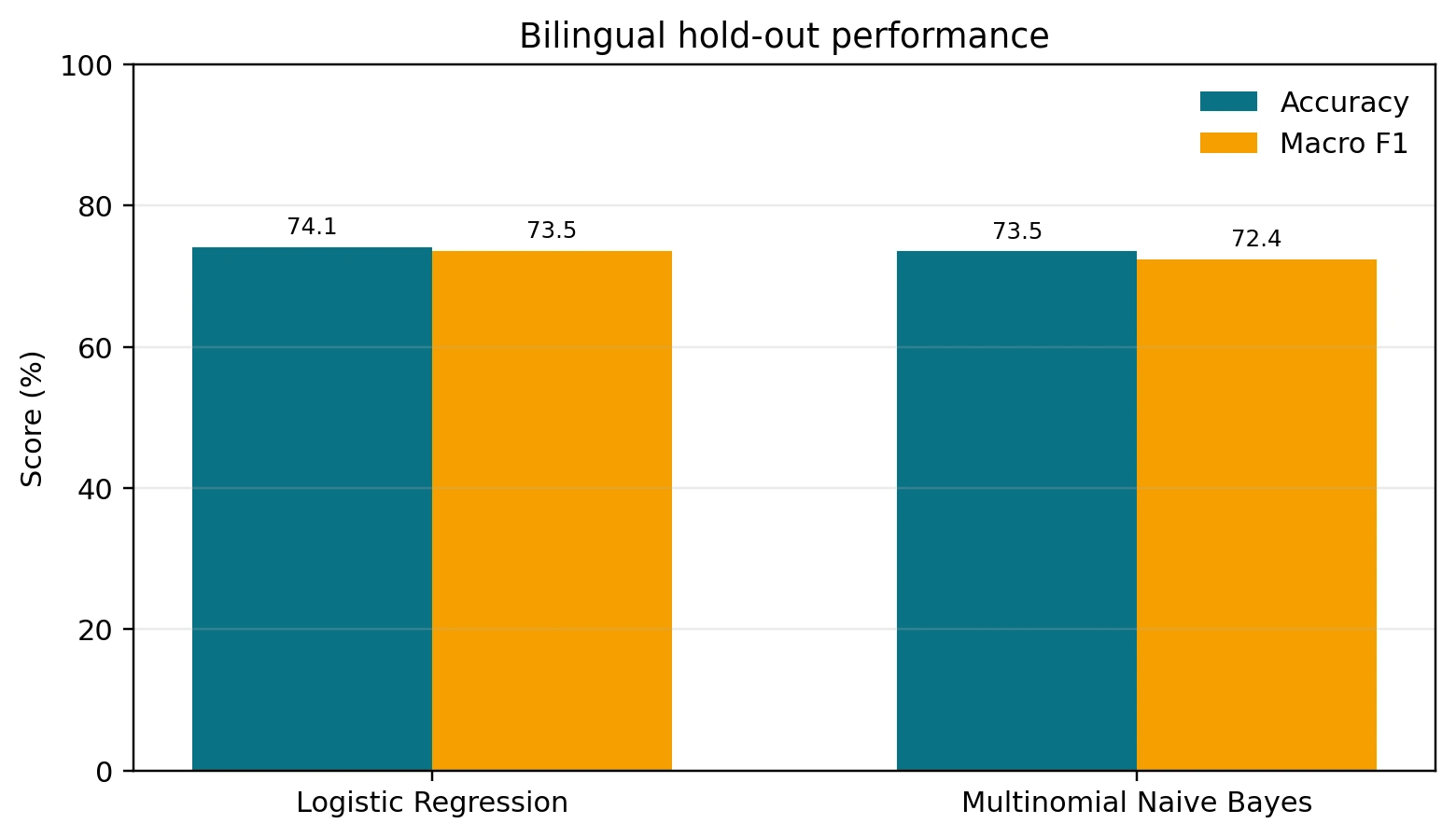
The processed dataset contains 6,262 records: 2,979 English review sentences and 3,283 Arabic lexicon entries.
Metric
Logistic Regression
Multinomial NB
Hold-out accuracy
74.06%
73.50%
Hold-out macro F1
73.53%
72.40%
5-fold CV macro F1
73.38%
72.22%
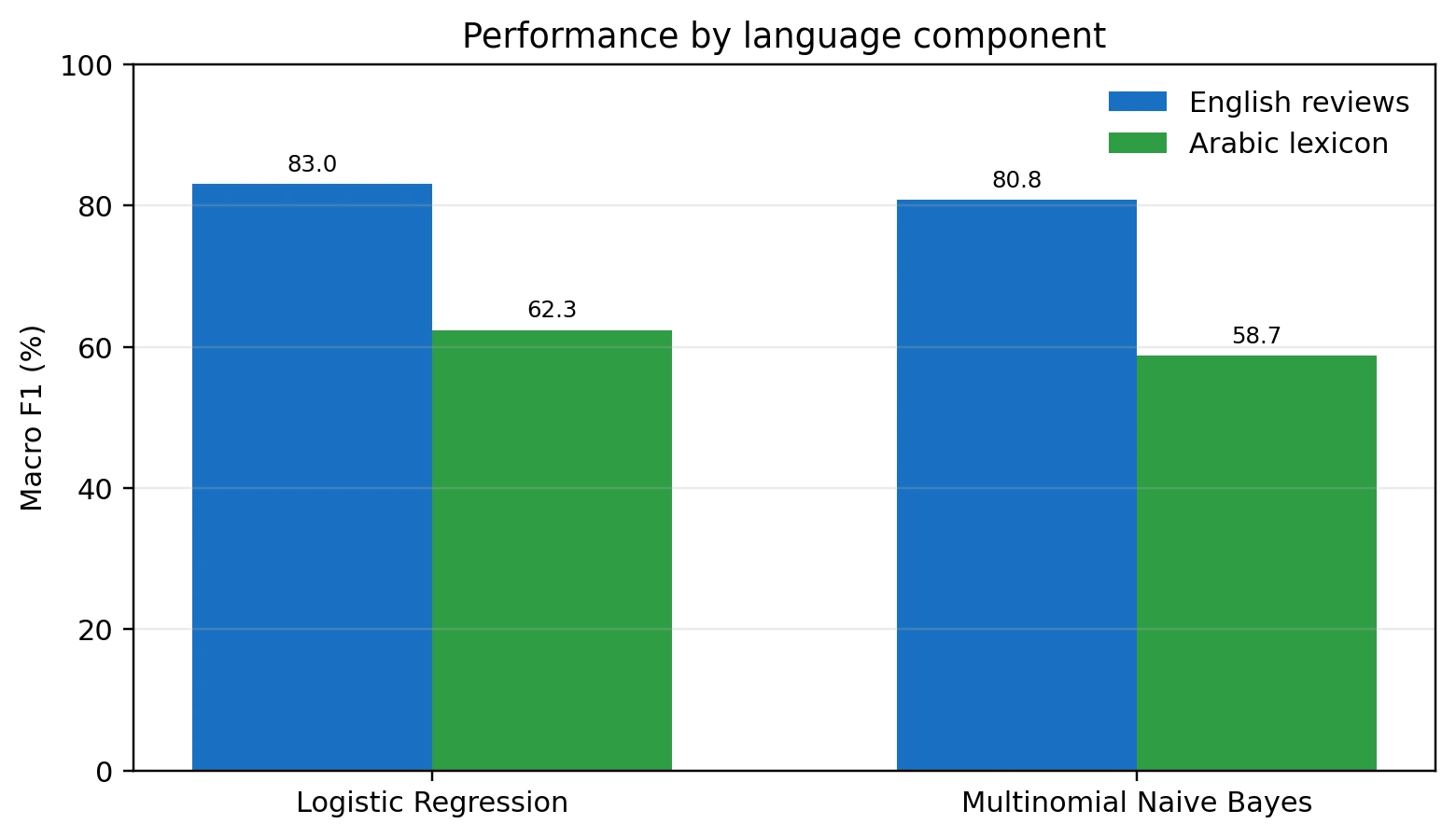
The selected Logistic Regression model achieved:
83.05% English accuracy on held-out customer-review sentences.
65.91% Arabic accuracy on held-out translated sentiment terms.
System Architecture
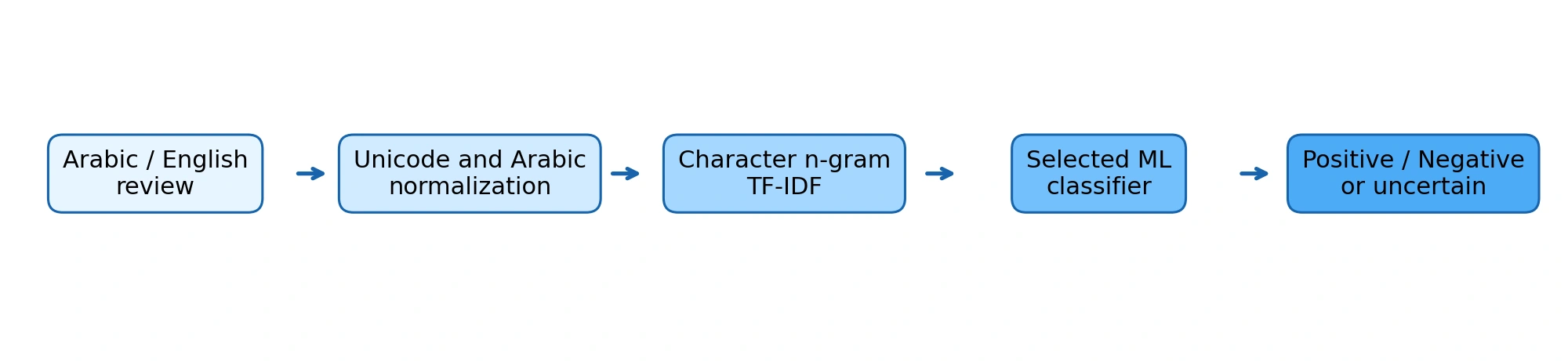
Arabic / English text ↓ Unicode + Arabic normalization ↓ Character n-gram TF-IDF ↓ Logistic Regression ↓ Positive / Negative / Uncertain output
Tech Stack
Python 3.12+
scikit-learn
pandas
NumPy
matplotlib
joblib
Python standard-library HTTP server for the local demo
Project Structure
. ├── app.py # CLI + shared inference function ├── web_app.py # Local bilingual web interface ├── src/ │ ├── prepare_data.py # Reproducible dataset construction │ ├── text_utils.py # Normalization + language detection │ └── train.py # Training, evaluation, charts, persistence ├── tests/ │ └── test_smoke.py # Text and end-to-end model smoke tests ├── data/ │ ├── raw/ # Source datasets / lexicon │ └── processed/ # Prepared bilingual dataset ├── models/ # Saved selected model + metadata ├── results/ # Metrics, predictions, evaluation figures ├── docs/ # Report and demo/discussion guide └── paper/ # Research paper and presentation
Quick Start
1. Clone and enter the project
git clone https://github.com/m7mdkh2003/bilingual-arabic-english-sentiment-analysis.git cd bilingual-arabic-english-sentiment-analysis
2. Create a virtual environment
Windows
python -m venv .venv .venv\Scripts\activate
macOS / Linux
python3 -m venv .venv source .venv/bin/activate
3. Install dependencies
python -m pip install --upgrade pip python -m pip install -r requirements.txt
4. Run the web demo
A trained model is already included, so you can start the app directly:
python web_app.py
Open http://127.0.0.1:8000.
CLI Usage
python app.py --text "This product is excellent and easy to use." python app.py --text "الخدمة سيئة وبطيئة جداً" python app.py --text "منتج ممتاز" --json
Example JSON output:
{ "detected_language": "ar", "label": "positive", "label_en": "Positive", "label_ar": "إيجابي", "confidence": 0.91 }
Rebuild the Dataset and Model
The repository includes the raw data required to reproduce the delivered experiment.
python -m src.prepare_data python -m src.train
Training regenerates:
models/best_model.joblib
models/metadata.json
results/metrics.json
results/test_predictions.csv
evaluation charts in results/
Tests
Run the local test suite:
python -m unittest discover -s tests -v
The CI workflow in .github/workflows/tests.yml runs the same tests automatically on pushes and pull requests.
Data Sources
English component
The English component uses the UCI Sentiment Labelled Sentences dataset, with review sentences from Amazon, IMDb, and Yelp. The project uses approximately 3,000 labelled English sentences.
UCI dataset DOI: 10.24432/C57604
License: CC BY 4.0
Full attribution and source details: DATA_SOURCES.md
Arabic component
The Arabic component uses non-zero Arabic entries from the translated AFINN-165 sentiment lexicon distributed by multilang-sentiment under the MIT license.
See DATA_SOURCES.md for the source and ethical-use notes.
Important Limitations
This project deliberately reports its limitations rather than presenting the Arabic evaluation as equivalent to full Arabic review classification:
English evaluation uses held-out natural customer-review sentences.
Arabic evaluation uses held-out translated sentiment terms and short phrases from AFINN, not a large natural Arabic review corpus.
Neutral / uncertain is produced when prediction confidence is below 0.60; it is not a third class learned during training.
The next research step should evaluate and fine-tune on a manually annotated Arabic review corpus, ideally including Palestinian Arabic and other dialects.
Because of these constraints, this repository is best interpreted as a reproducible bilingual ML prototype and research project, not a production-grade Arabic sentiment service.
Research Artifacts
paper/ICRE_2026_Final_Bilingual_Sentiment_Paper.docx
paper/ICRE_2026_Bilingual_Sentiment_Presentation_AR_EN.pptx
Arabic Summary / ملخص عربي
المشروع يقدّم نموذجاً عملياً لتحليل المشاعر في النصوص العربية والإنجليزية باستخدام TF-IDF على مستوى الأحرف ونموذج Logistic Regression. يمكن تشغيله من سطر الأوامر أو من واجهة ويب محلية، كما يحتوي على خطوات قابلة لإعادة الإنتاج لتجهيز البيانات والتدريب والتقييم.
التقييم الإنجليزي يعتمد على جمل مراجعات حقيقية، بينما الجزء العربي يعتمد على معجم AFINN مترجم؛ لذلك لا يتم تقديم دقة العربية على أنها تقييم كامل على مراجعات عربية طبيعية. نتيجة محايد / غير مؤكّد تعني انخفاض ثقة النموذج وليست فئة ثالثة مدرّبة.
About
Arabic-English sentiment analysis using TF-IDF and Logistic Regression with bilingual web UI, evaluation metrics, and automated tests.
Topics
Resources
Readme
Stars
0 stars
Watchers
0 watching
Forks
No releases published
Contributors 1 (1)

Languages
You can’t perform that action at this time.
0 likes · 0 views · Oct 16, 2026
Reproducible bilingual ML project for Arabic–English sentiment classification using character n-gram TF-IDF and Logistic Regression with a local web demo.


