Barcelona's Season Struggles: A Deep Dive

Ruddrava Banerjee


Why Barcelona hasn’t been good this season?
6 min read
·
2 days ago
--
Press enter or click to view image in full size
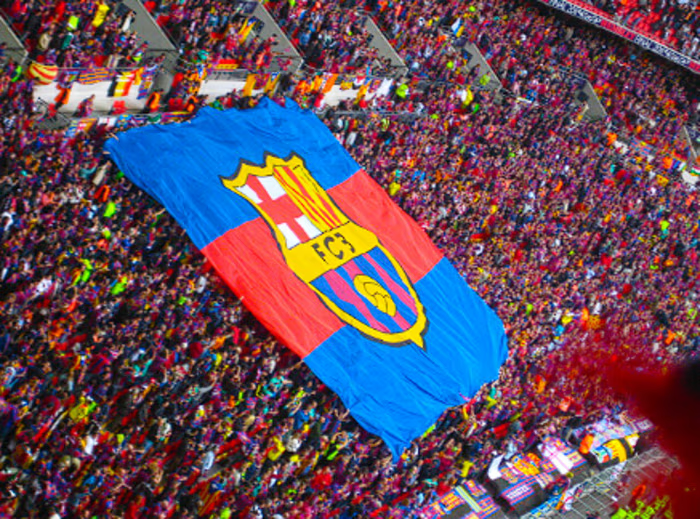
Barcelona has been dominant in the last season although they were eliminated agonizingly that too against a team who got humiliated in Champions League final. Barcelona after years of heartbreaks and defeats and humiliation against their arch-nemesis Real Madrid, although they won against madrid in super copa de espana and also in laliga under xavi, they dominated them under hansi flick. They went on to beat Real Madrid at every stage, every possible competition in a season. But this season, by the time I am writing this up, Barca has been defeated by Real Madrid, humiliated by Chelsea and also by 13th placed Sevilla. Let’s take a deep dive into what caused this,
1. Defence
If you thought that I would talk about attack first then you have mistaken, for attacking is the best department of Barcelona overall. Last season the attack has registered
· xG: 92.99
· xA: 63.71
· Goals + Assists (G + A): 174 (102 goals + 72 assists)
However this season till now barca has scored 34 goals and they are expected to get more than 100 goals and assists but less than previous season (I’ll come to that later). Barcelona’s defence in 2024/25 was solid overall: they conceded just 39 goals in 36 league games and kept 13 clean sheets, which gave them one of the top-four defensive records in the league. Their defensive resilience helped the attacking side flourish, allowing the team to pursue and win trophies without being overly punished at the back. Beyond raw numbers, the defensive style: a high line, proactive pressing and offside traps which meant that defenders and centre-backs had to be alert, coordinated, and tactically disciplined; and Barcelona’s defensive unit mostly delivered on that.
In that context, Iñigo Martínez’s role becomes especially vital. In 2024/25 he played around 2,043 minutes (23 league matches) and posted a duel-win rate of 74.2% which is among the highest in the league. This shows his ability to win individual battles and prevent danger in 1-on-1s. He also led the team in clearances across La Liga and European matches, demonstrating his reliability in aerial challenges and dangerous moments. On top of that, his ball-playing skill (passes from the back, composure under pressure) helped Barcelona maintain their positional style, which needs defenders comfortable with the ball as well as solid defensively
Íñigo Martínez’s departure weakened Barcelona’s defence in four clear ways.
First, they lost balance, because he was the only experienced left-footed centre-back, which made buildup slower and more predictable.
Second, the team lost leadership and organisation as Martínez kept the backline calm, coordinated the high line, and read danger better than anyone else.
Third, Barça became more vulnerable in the air and against crosses, since he was their most reliable defender for clearances and physical duels.
Finally, his exit put extra pressure on young CBs like Cubarsí and forced others to play more minutes, leading to more mistakes and inconsistency.
Overall: without Martínez, Barça’s defence became less balanced, less organised, and easier to attack.
2. Attack
As mentioned earlier barca’s attack were one of the elite and most talked about in the last season. Lamine yamal became one of the biggest breakout young star in the Europe. From Barcelona to national team he has gave some of the eyecatching performances. But his success in Barcelona particular came not only because of him and his talent but more due to the overall tactics and raphinha. The man whom should have been ballon dor winner, Raphinha had a spectacular 2024/25 season, finishing with 18 goals and 11 assists in La Liga and contributing around 34 goals + 25 assists across all competitions, earning him the La Liga Player of the Season award. His consistency made him the engine of Barcelona’s attack: he scored regularly, created chances at a high rate, and delivered a goal contribution almost every game. Beyond the numbers, Raphinha brought maturity, tempo control, and decision-making in the final third. His presence also perfectly complemented Lamine Yamal. While Yamal provided flair, unpredictability, dribbling and width on the right, Raphinha offered intelligence, timing, overlaps, underlaps, and the ability to switch positions seamlessly. Together, they created a balanced, dynamic wings: Yamal attracting defenders and stretching lines, and Raphinha exploiting the gaps with crosses, cut-ins, and link-up play. Their combination gave Barça a terrifying dual-threat on the flanks, forced opponents to over-defend one side, and opened up space for the rest of the attack. Overall, Raphinha didn’t just have a great season individually but he elevated the entire structure of Barcelona’s offence. This season raphinha was absent on big occasions due to injury which impacted barcas attack even more.
3. Pedri
Pedri is the heartbeat of Hansi Flick’s Barcelona, and the stats prove why any off-day from him becomes an off-day for the entire team. In 2024/25 he completed 2,418 passes and averaged 81+ passes per 90, making him the main controller of Barça’s tempo. He also led Europe in pre-assists, showing how he starts almost every attacking move, and contributed defensively with 1.73 tackles and 0.81 interceptions per 90, which are essential to Flick’s counter-pressing. Because he handles build-up, creativity, and pressing all at once, when Pedri’s rhythm drops, Barcelona lose control in possession, chance creation slows, and the press collapses. This is why Flick’s system depends so heavily on him. Pedri’s form directly shapes Barcelona’s form. This is a major weakness. Barca literally transitioned from messidependencia to pedridependencia.
4. Hansi Flick’s tactics
Hansi Flick’s Barcelona suffer from a structural imbalance rooted in the high defensive line and intense counter-pressing he demands, and the statistics show how fragile the system becomes when intensity drops even slightly. Early under Flick, Barça allowed 12 big chances in just three league matches, the most in La Liga at the time, revealing how easily opponents exploited the space behind the defence whenever the press wasn’t perfectly synchronized. Over the larger sample, Barcelona conceded 66 goals in 56 matches, a number far higher than a title-winning team should allow, proving the instability of their defensive mechanisms. This weakness worsened as the team’s physical output declined: Barça began the Flick era covering a strong 117.4 km per game, but later dropped to 113.4 km, falling to 15th in the league for distance covered. That small reduction is devastating in Flick’s approach because gegenpressing collapses without constant sprinting; once the press breaks, opposition forwards run directly into the huge spaces behind the high line. Even in games where Barcelona dominate the ball — like the 77.6% possession, 21 shots, and 2.35 xG they produced against Getafe — they often fail to turn control into goals. That inefficiency means the defensive risks are not compensated by offensive returns. Flick’s rigidity amplifies the issue: despite repeated warning signs, he keeps his back line aggressive, keeps full-backs high, and maintains a vertical rest-defence structure that relies almost entirely on perfect pressing. So when players tire, when distances between lines increase, or when a single press trigger is mistimed, Barça become one of the easiest elite teams to counterattack. In essence, Flick’s system is electrifying but extremely high-risk; the moment intensity, precision, or finishing drops, it exposes Barcelona’s biggest tactical flaw: a defence that lives on the edge and collapses under even moderate transition pressure.
Conclusion
Barcelona’s struggles this season stem from a combination of structural issues, the loss of Martínez’s defensive stability, injuries to key attackers like Raphinha, heavy dependence on Pedri, and the fragility of Flick’s high-intensity system when physical output drops. These weaknesses have made the team inconsistent and more vulnerable than last year. But importantly, the season is far from over, and the situation is not irreversible. The same core that dominated Europe last year is still here: Yamal is growing every week, Raphinha is returning, Pedri remains the heartbeat of the system, and young defenders like Cubarsí are learning fast. Flick’s model, while high-risk, is also capable of producing elite football when energy, coordination, and execution align. With tactical adjustments, improved fitness, and the return of crucial players, Barcelona can rediscover the balance and rhythm that defined their peak under Flick. The setbacks of these months may well become the turning point, a reminder of what needs correcting. The season still has room for a resurgence, and if Barça manage to stabilise their defence and regain attacking cohesion, they can finish strongly. The problems are real, but so is the potential.
Like this project
Posted Dec 6, 2025
Analysis of Barcelona's performance issues and potential for improvement this season.