IAU-USR Accessibility Audit Methodology

Sergiu Adrian Otlacan


The Problem
Existing accessibility audit frameworks focus heavily on digital compliance (WCAG for websites and apps) or treat physical space audits as in-person-only exercises. For people who rely on electric wheelchairs, the real barriers are physical: doors too narrow to pass through, ramps too steep or poorly surfaced, sidewalks blocked by obstacles or in disrepair.
There was no standardized methodology for auditing these physical barriers remotely, which meant organizations in different cities or countries had to hire local auditors every time, or skip the audit entirely.
The Solution: IAU-USR
I created the IAU-USR (International Accessibility & Universal Social Inclusion Review) methodology to fill that gap. It's a structured framework for conducting remote accessibility audits of buildings and public spaces, with a specific focus on electric wheelchair navigation.
The methodology evaluates:
Door sizing — whether entrances, internal doors, and emergency exits meet minimum clearance for powered wheelchairs
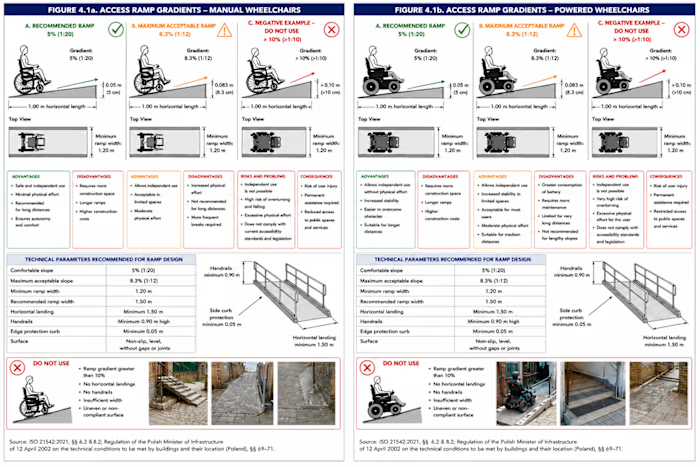
Ramp specifications — gradient, width, surface material, handrail placement, and landing areas
Sidewalk accessibility — surface quality, width, curb cuts, obstacles, and cross-slope
Overall social inclusion — whether the space allows independent participation, not just physical entry
The "social inclusion" component is what sets IAU-USR apart from a standard compliance checklist. It asks: can a person in an electric wheelchair actually use this space independently, or just technically enter it?
How It Works (Remote Process)
All audits are conducted remotely using documentation provided by the client:
Client submits materials — floor plans, architectural drawings, photos, video walkthroughs, and measurements
Structured evaluation — each space is scored against the IAU-USR criteria across all categories
Report generation — a comprehensive written report with findings, scores, and visual annotations
Deliverables
Every completed audit includes:
Written accessibility report — detailed findings for each area evaluated
Accessibility checklist — pass/fail assessment against IAU-USR criteria
Scoring assessment — quantified accessibility rating per space and overall
Prioritized remediation roadmap — ranked recommendations for improvements, from quick wins to structural changes
Why Remote?
Remote auditing makes accessibility evaluation available to organizations regardless of location. A building in Bucharest and a public park in Buenos Aires can both be assessed using the same standardized framework, without flying an auditor to each site. This lowers the cost barrier and makes accessibility auditing practical for organizations that would otherwise skip it.
Like this project
Posted Jul 23, 2026
Created the IAU-USR methodology for remote physical accessibility audits, helping buildings and public spaces become navigable for electric wheelchair users.
Likes
0
Views
2