Who Dun It?

Asha Wills

Who Dun It?
Role: Game Designer (Narrative/Systems)
Timeline: 2 months, December 2024
Context: Final project for CIM 204: Introduction to Game Design
Overview
"Who Dun It?" is a top-down murder mystery game where players navigate a hotel as a detective solving a murder. I shaped the narrative backbone—developing character backgrounds, crafting the plot, and ensuring the story worked within our level designs.
The core challenge: tell a complete mystery story through scattered clues and NPC interactions while keeping players engaged in a grid-based movement system where every step counts.
I focused on integrating narrative with gameplay, working with our developer to connect storyline with level layouts. I also ran playtesting sessions and used feedback to refine difficulty and storytelling clarity. The biggest lesson: narrative design isn't just writing a good story. It's letting players piece it together themselves.
Problem
Creating a solid game with tight constraints. We had one coder, limited time, and every feature had to be feasible. Early playtests revealed players were confused about the killer's mechanics, didn't know where to go, and missed key information.
Balancing guidance and challenge. Too many instructions felt hand-holdy. Too few left players lost. Finding that sweet spot was the real puzzle.
My Approach
Mechanics & Movement
I designed a move-based system inspired by stealth mini-games where resource scarcity forces strategic thinking. Instead of a time limit, we used move-counting, which meant players had to think carefully about their path while still having time to read dialogue and absorb the story.
Level Design
I created initial map designs in Figma using a grid-based template with a symbol key (red for obstacles, blue for NPCs, green for player, stars for clues). Started with a 6x6 grid, expanded as mechanics solidified. Each level needed to work as both a hotel space and a puzzle where move economy mattered.
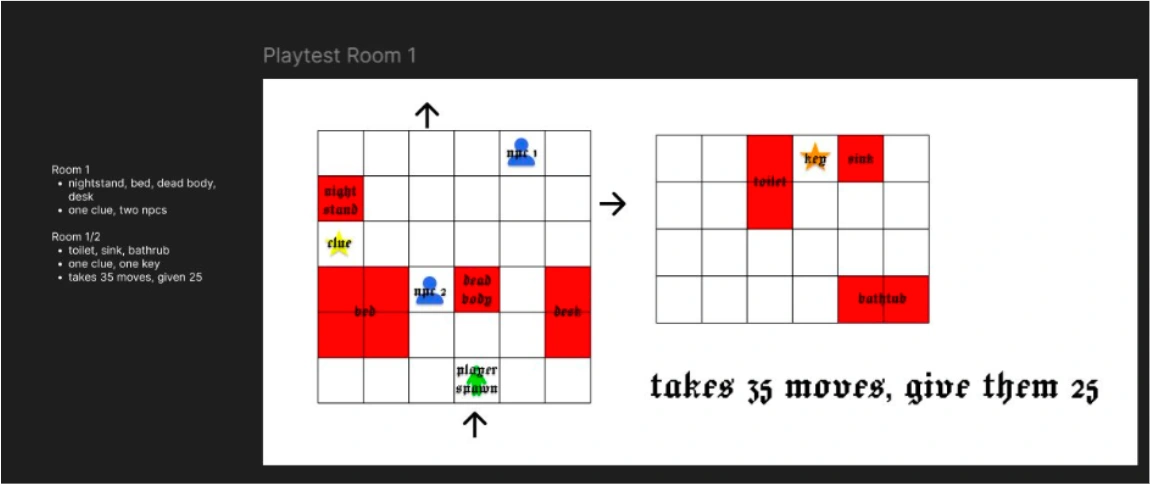
Figma map design for initial playtest
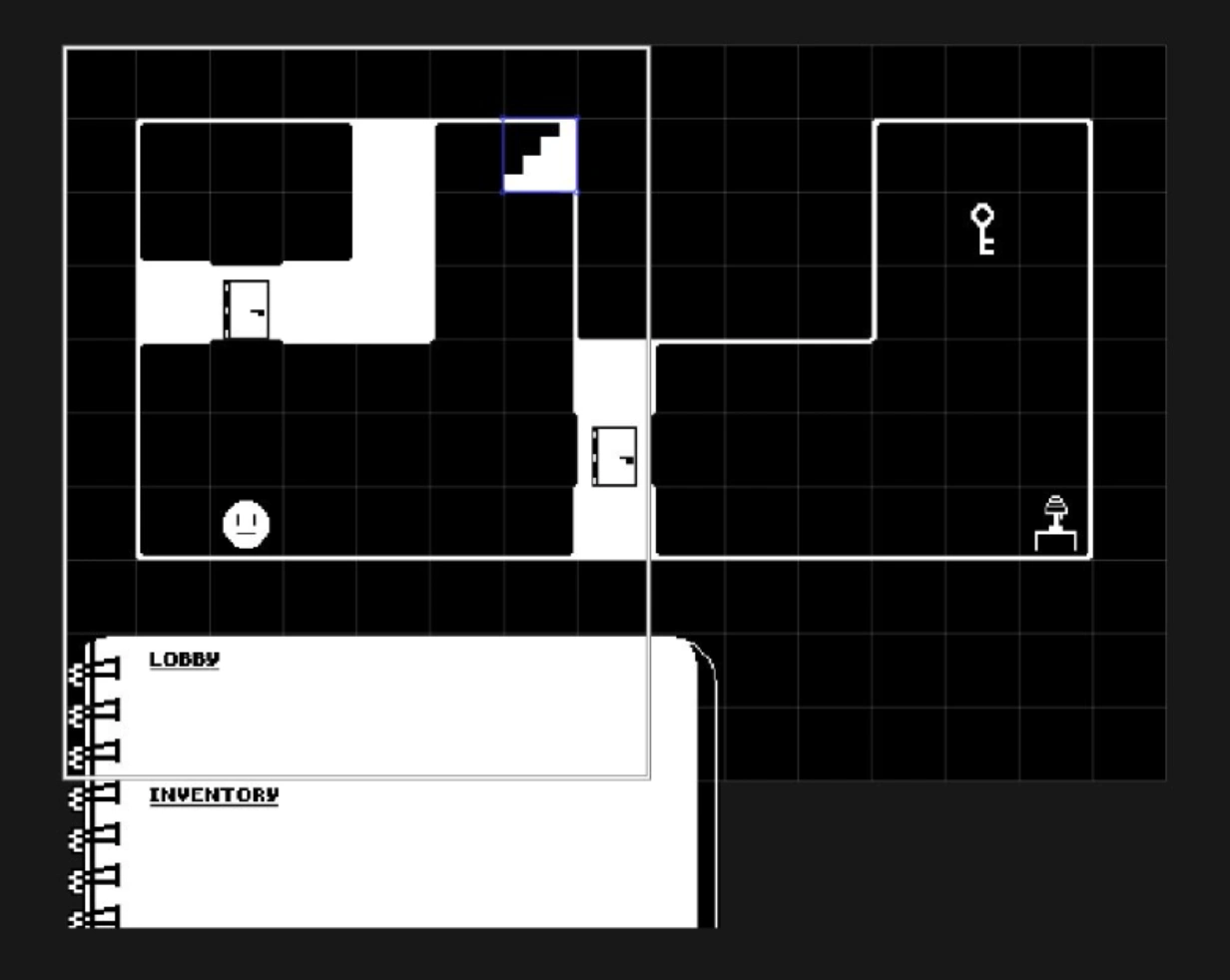
Earliest version of the map, focused on refining movement and interactive mechanics.
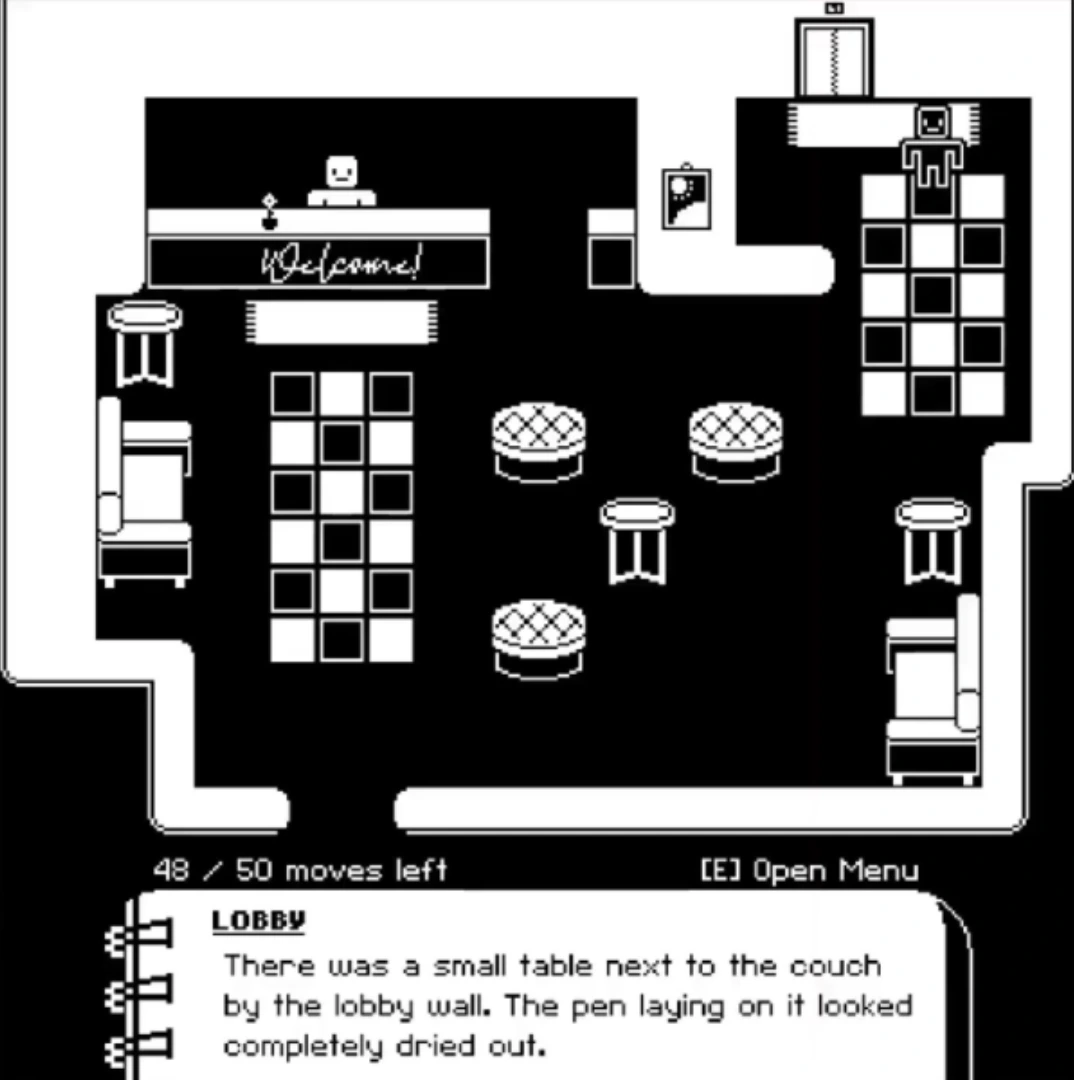
First look at the lobby (intro level) after establishing game art style and UI.
Narrative Integration
I built the initial story using Twinery for playtesting, and created a choice-based narrative where you're forced to play detective. Play the prototype here. For the final game, we wrote unique dialogue for every interactable element and designed a notebook system to track clues.
Iteration Through Playtesting
I monitored playtests and documented feedback, which drove our iteration process. View playtest footage here. This directly informed changes like limiting pop-ups to early levels, fixing navigation issues, and completely redesigning the pool area.
The Solution
Five-Level Mystery Structure: Tutorial lobby, three investigation levels (hotel room, hallway, pool), and final killer identification scene. Each level served narrative and puzzle purposes.
Strategic Visual Design: Black-and-white aesthetic with red highlights for important info. Pop-up indicators in early levels, then independent exploration. Killer entry notifications gave players agency to keep searching or move on.
Modular Storytelling: Story unfolds through NPC conversations, environmental clues, and object interactions. Players piece together the mystery across levels. You literally can't see everything in one playthrough, creating natural replayability.
Key Takeaways
Game design is 90% iteration. The original time-limit killer mechanic, escape sequences, and various systems got cut or redesigned. What mattered was adapting based on what actually worked, not protecting the original vision.
Playtesting reveals your blind spots. Things I thought were obvious—exit locations, killer rules—confused players. Watching real people play was humbling and essential. Designer assumptions are dangerous.
Narrative design is about player agency. Coming from other writing forms, I had to shift completely. It's not crafting a perfect linear story, it's creating a space where players discover the story in their own order and it still makes sense.
What I'd Do Differently
Plan for modular narrative from day one. We developed story before fully understanding technical limitations, leading to rewrites. Next time: flexible narrative framework with core beats that survive scope cuts.
Integrate story with gameplay earlier. One improvement we identified: making story unfold through interactions, not an info screen at the start. I wish I'd pushed for this from the beginning instead of treating it as a "nice to have."
Like this project
Posted Jan 1, 2026
Top-down detective game set in a mysterious hotel. I crafted the narrative backbone, character backgrounds, and ensured story worked with level design.
Likes
2
Views
11
Timeline
Nov 7, 2024 - Dec 10, 2024