SteamAI: Conversational AI for Game Discovery

Igor Dalmolin


User Experience & Conversational AI: SteamAI
A case study on game discovery on the Steam platform - proposing an ethical and transparent conversational AI chatbot that replaces confusing tag searches with natural dialogue and explainable recommendations.
Grade 10/10 · PUCRS
UX Research
Heuristic Analysis
Personas
Conversational AI
Explainable AI (XAI)
Algorithmic Ethics
LGPD
Overview
The paradox of choice across 220,000 games
Since 2003, Steam evolved from a distribution channel into the world's largest game marketplace, now hosting over 220,000 products (SteamDB, 2025). This expansion brought a classic UX problem: the paradox of choice.
Abundance doesn't lead to satisfaction - it leads to indecision and frustration. The current recommendation system prioritizes popularity and recent history, ignoring intent and context. The result: users can't describe what they want in natural language, and the system can't listen.
220K+
Products on Steam (SteamDB, 2025)
~30
Observational sessions conducted
3
Personas with distinct journeys
Identified Failures
What the heuristic analysis revealed
Around 30 anonymous browsing sessions (no login, no history) were conducted between July and August 2025 to avoid algorithmic bias. The failures concentrate around three of Nielsen's heuristics (1994).
Error prevention: The "realistic" tag indicates graphics, not gameplay mechanics. A user looking for realistic fishing simulation finds completely unrelated games.
Consistency and standards: The "immersive simulator" filter returns titles unrelated to the immersive sim genre.
Flexibility and efficiency: Only a fraction of tags appear on the main screen.
The Proposal — SteamAI
A chatbot as the intermediary layer between algorithm and user
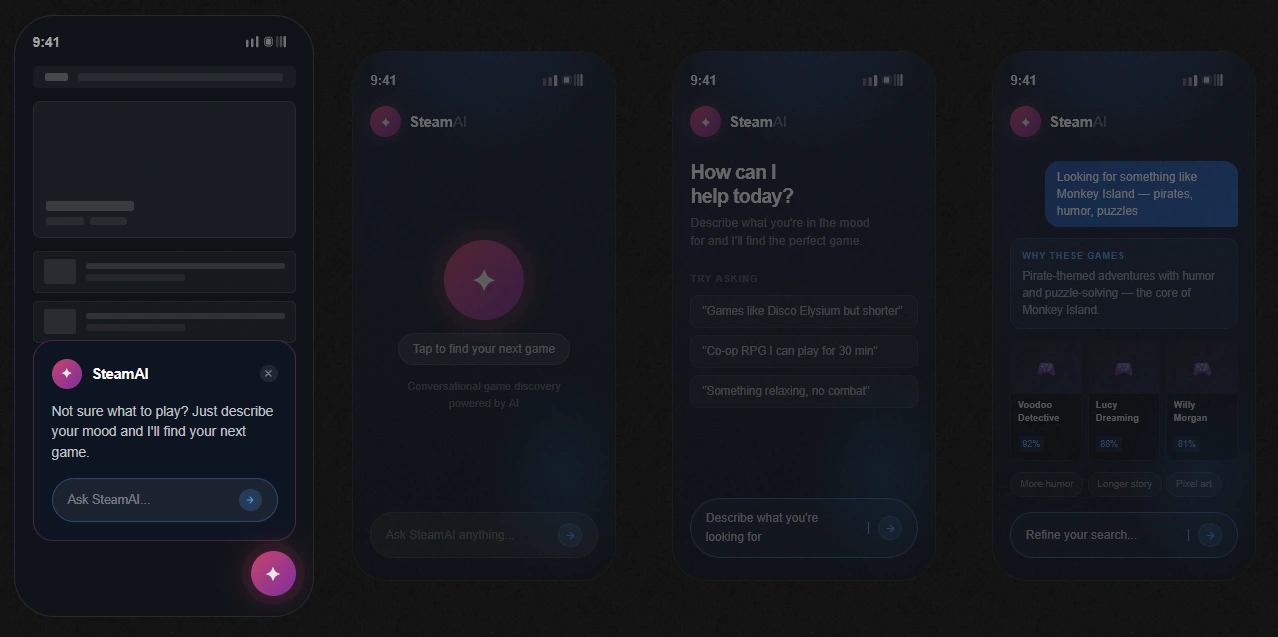
SteamAI is conceived as a chatbot integrated into the Steam interface, acting as a mediator between the traditional recommendation system and the user - translating subjective preferences into humanized search parameters.
Interaction Flow
Natural language input: "I want a light-looking adventure game I can play for 30 minutes a day".
Contextual AI processing: Semantic analysis of the request cross-referenced with the game database.
Recommendations with reasoning: Each result comes with an explanation of why it was recommended.
Iterative refinement: The user can adjust the request or deepen the dialogue.
Key Screens
Three core states of the SteamAI interface — entry point, empty state with suggestions, and results with XAI reasoning.
Expected Benefits
For the user, the experience becomes humanized and the cognition effort is reduced.
For Valve, increased conversion rates and prolonged retention.
Acknowledged Limitations
Technical: Incomplete metadata compromises recommendation accuracy.
Ethical: Behavioral data usage requires compliance with LGPD.
Operational: Continuous maintenance requires specialized teams.
Methodological: Personas were built without real user interviews.
Study Conclusions
Discovery is an ethical challenge, not just a technical one. Transparency is a feature; conversational design is UX design.
— Igor Dalmolin Tronco, PUCRS Postgraduate Thesis 2025
Like this project
Posted May 22, 2026
A case study on an AI chatbot for enhancing game discovery on Steam, focusing on user experience and ethical design.
Likes
0
Views
4