AuditWave: Unified Website Audit Tool Development

Sameer Sabir


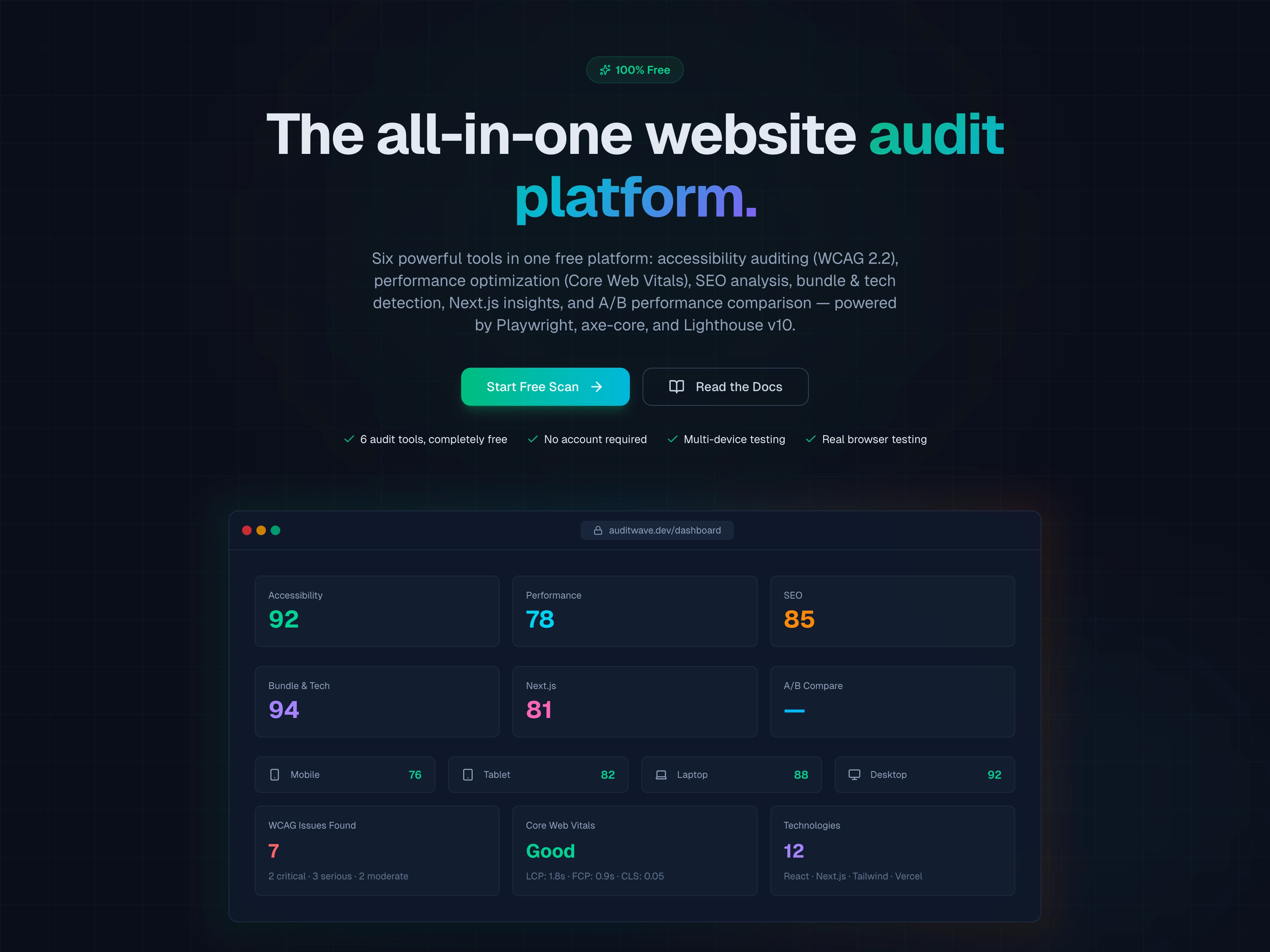
AuditWave is a personal project I built to solve a real problem: most website audit tools give you one thing - Lighthouse scores, or an accessibility checker, or an SEO scanner - and make you pay for the rest. AuditWave puts six audit tools in one place, completely free, with no account required. Paste a URL, pick a device, and get a detailed report in seconds.
What makes it different from running Lighthouse locally: AuditWave uses Playwright to load pages in a real browser across four device profiles with real network throttling. The results reflect what actual users experience, not what a synthetic test assumes.
The Challenge
Building a website audit tool sounds straightforward until you get into what "real" auditing actually means. Synthetic tests run in a sandboxed environment and miss what real browser behavior introduces - render blocking, lazy loading triggers, third-party script timing, device-specific layout shifts. Getting accurate numbers means running a real browser.
Playwright solved that, but it introduced a different problem: Playwright in a serverless environment is heavy. Cold starts, memory limits, and execution timeouts on Vercel all become real constraints when a single audit spins up a full browser, loads a page across four device profiles, runs axe-core for accessibility, runs Lighthouse for performance, extracts the tech stack, and streams results back to the client - all within a time window the platform can actually keep up with.
The other constraint I set for myself: no login, no setup, no friction. The tool had to work the moment someone landed on it.
What I Built
Six audit tools, one sidebar
The navigation structure is clean: Accessibility, Performance, SEO, Next.js Insights, A/B Compare, Bundle & Tech, and Settings. Each module is independent but shares the same scan session - run one scan and all six tools have data to work with. Switching between modules doesn't trigger another network request.
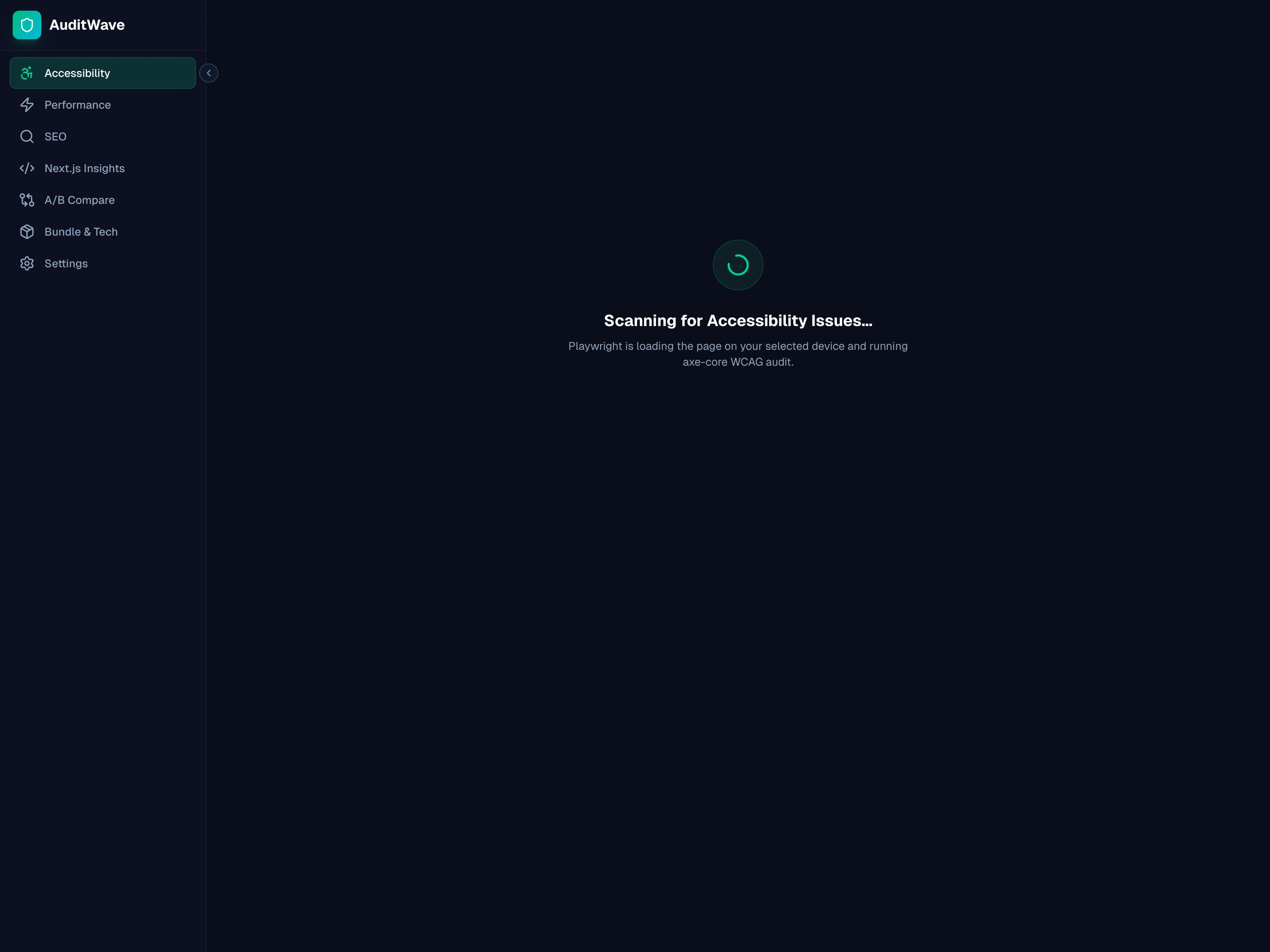
Dashboard
Accessibility Auditor (WCAG 2.2)
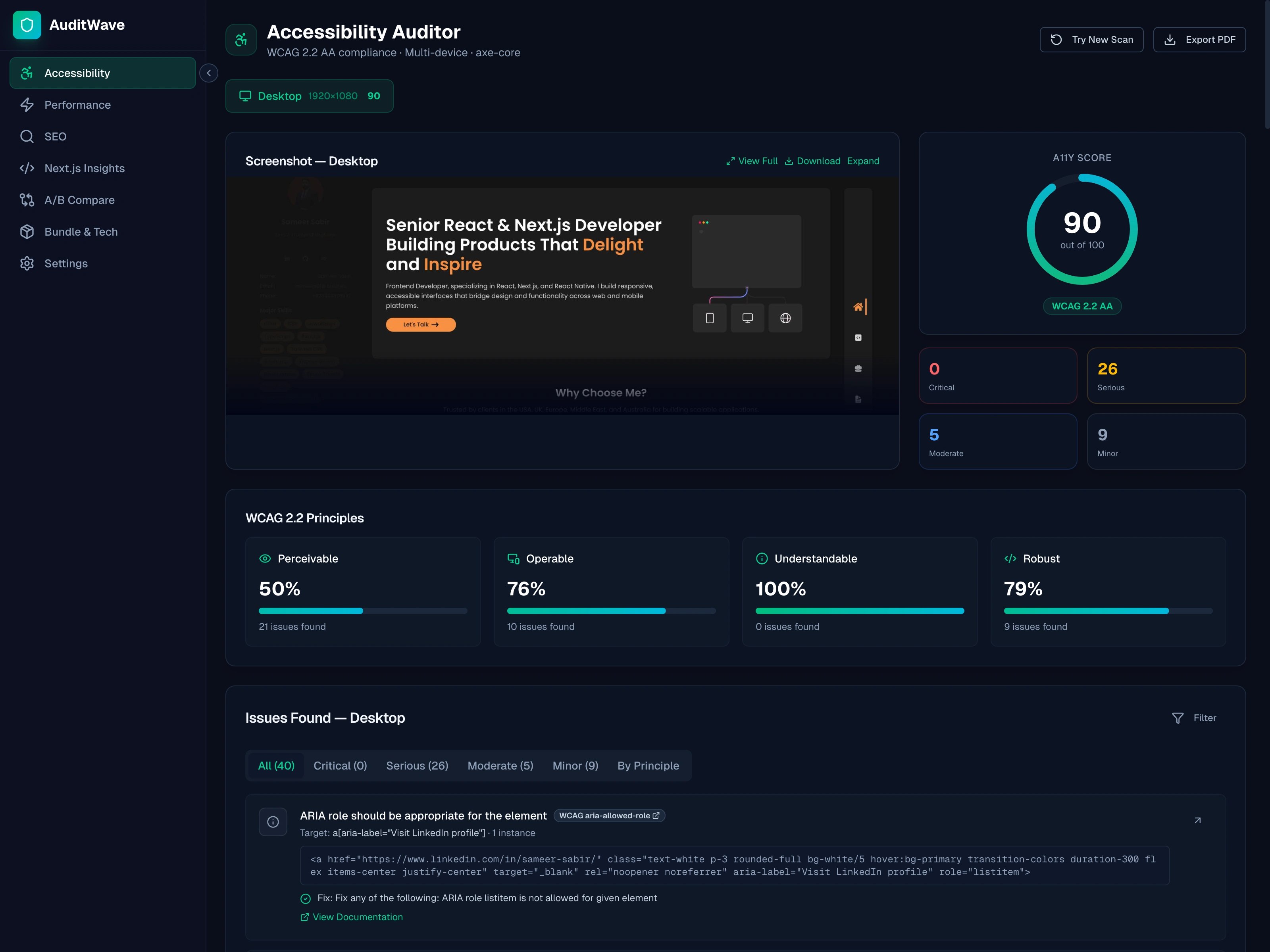
The accessibility module runs axe-core against a real browser render and surfaces results across four WCAG 2.2 principles - Perceivable, Operable, Understandable, Robust - each with a compliance percentage and issue count. Issues are categorized as Critical, Serious, Moderate, or Minor. Each issue includes the exact DOM element, the specific WCAG rule violated, a suggested fix, and a link to the relevant documentation.
The a11y score is a composite number, not a pass/fail. A score of 90 with 0 Critical and 26 Serious tells a very different story than a 90 with 35 Minor issues - the module surfaces that distinction clearly. Reports export to PDF with full issue detail included.
Accessibility Auditor (WCAG 2.2)
Performance Audit - device and throttle configuration
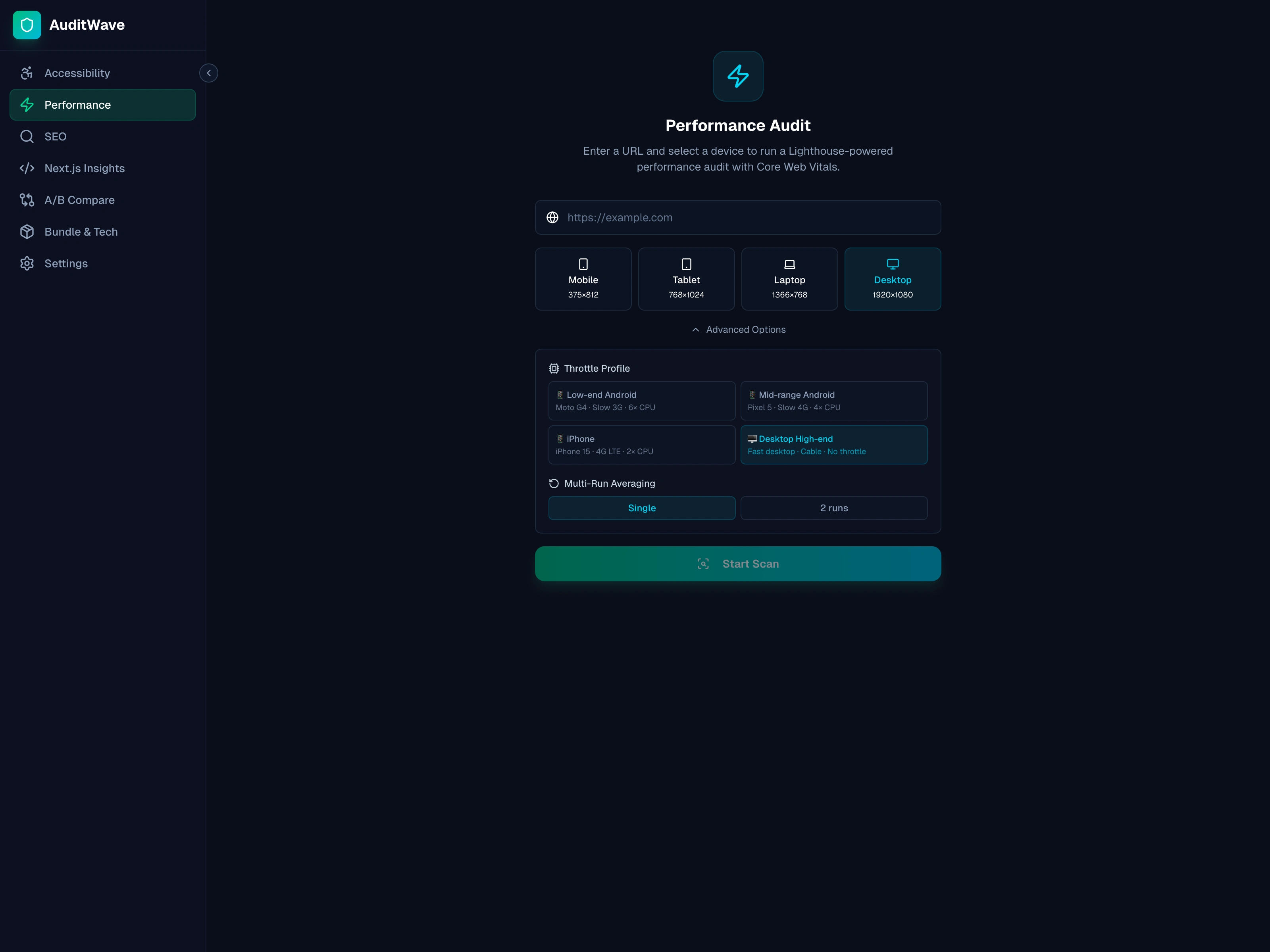
Before a performance scan runs, users configure exactly what they want to test. Four device profiles (Mobile 375×812, Tablet 768×1024, Laptop 1366×768, Desktop 1920×1080) and five throttle presets (Low-end Android on Slow 3G, Mid-range Android on Slow 4G, iPhone on 4G LTE, Desktop High-end with no throttle) let you test the URL against conditions that match your actual audience. Multi-run averaging is available for more stable results on variable networks.
This is the detail that separates AuditWave from a basic Lighthouse wrapper. A mobile score on a slow 3G connection and a desktop score on a fast cable connection are measuring completely different things - treating them the same is how performance regressions get missed.
Performance Audit - device and throttle configuration
Performance Optimizer - Core Web Vitals results
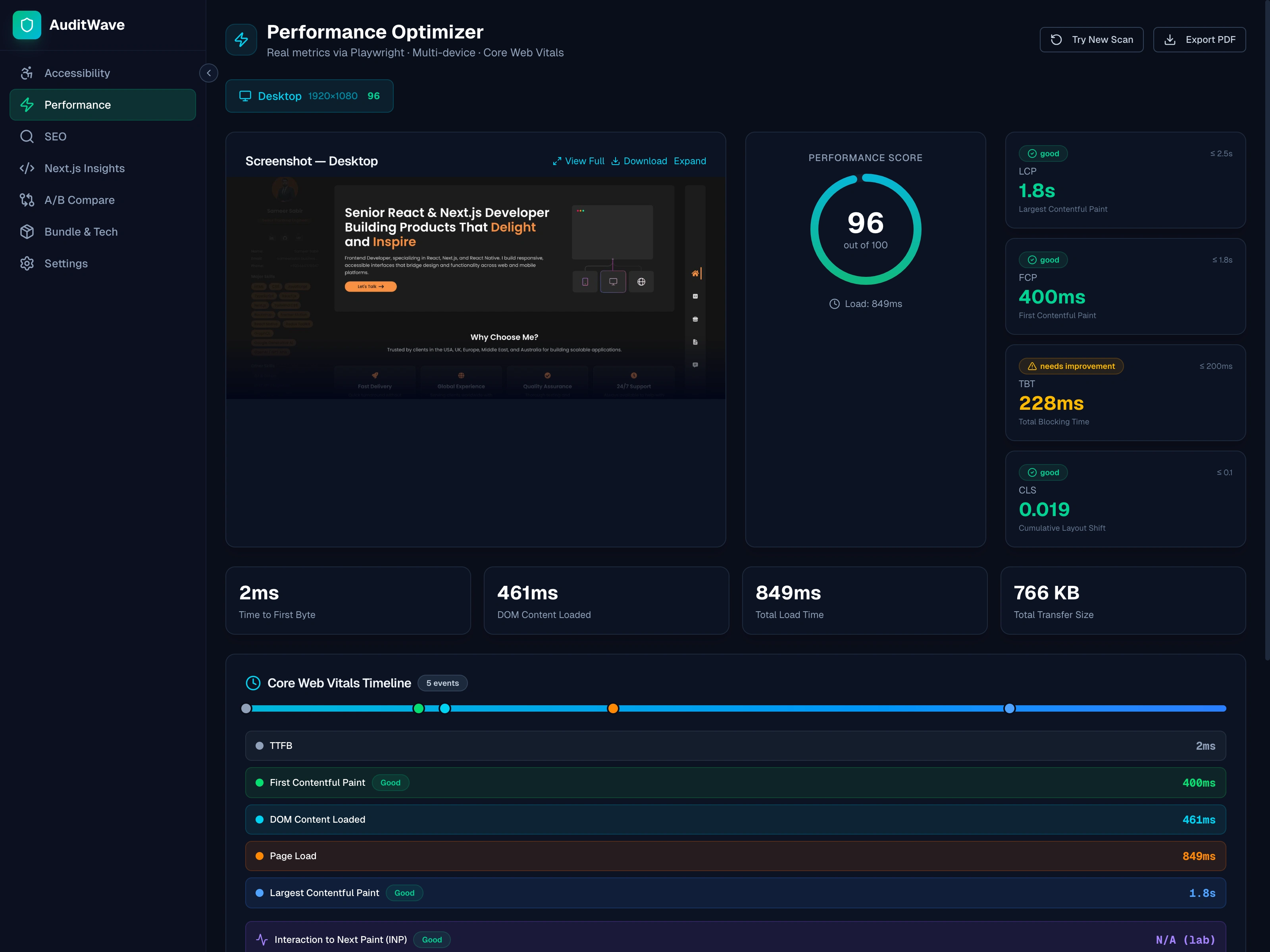
Performance results show a score, load time, and a full Core Web Vitals breakdown: LCP (Largest Contentful Paint), FCP (First Contentful Paint), TBT (Total Blocking Time), and CLS (Cumulative Layout Shift) - each with a good/needs improvement/poor threshold marker. Below the score, four timing metrics surface TTFB, DOM Content Loaded, Total Load Time, and Transfer Size. A Core Web Vitals Timeline visualizes when each milestone fires relative to page load, giving a clear picture of where time is actually being spent.
The screenshot in the case study shows a performance score of 96/100 on Desktop - LCP 1.8s, FCP 400ms, CLS 0.019 - with a TTFB of 2ms and total load of 849ms. These are real numbers from a real Playwright browser session, not estimated values.
Performance Optimizer - Core Web Vitals results
SEO Analyzer
The SEO module runs a full meta analysis - title tag length, meta description length (with visual character count bars), Open Graph completeness, schema markup, robots.txt, heading structure validation, link and image counts, and an overall SEO score. Results split into Critical, Warnings, Info, and Passed categories. The heading structure tree shows the full H1→H2→H3 hierarchy so structural SEO issues are immediately visible.
The screenshot shows a 92/100 score with 0 Critical issues, 2 Warnings, and 11 checks passed - 37 headings, 22 links, 7 images, 5/5 Open Graph tags, 7 schema items, and fully indexable.
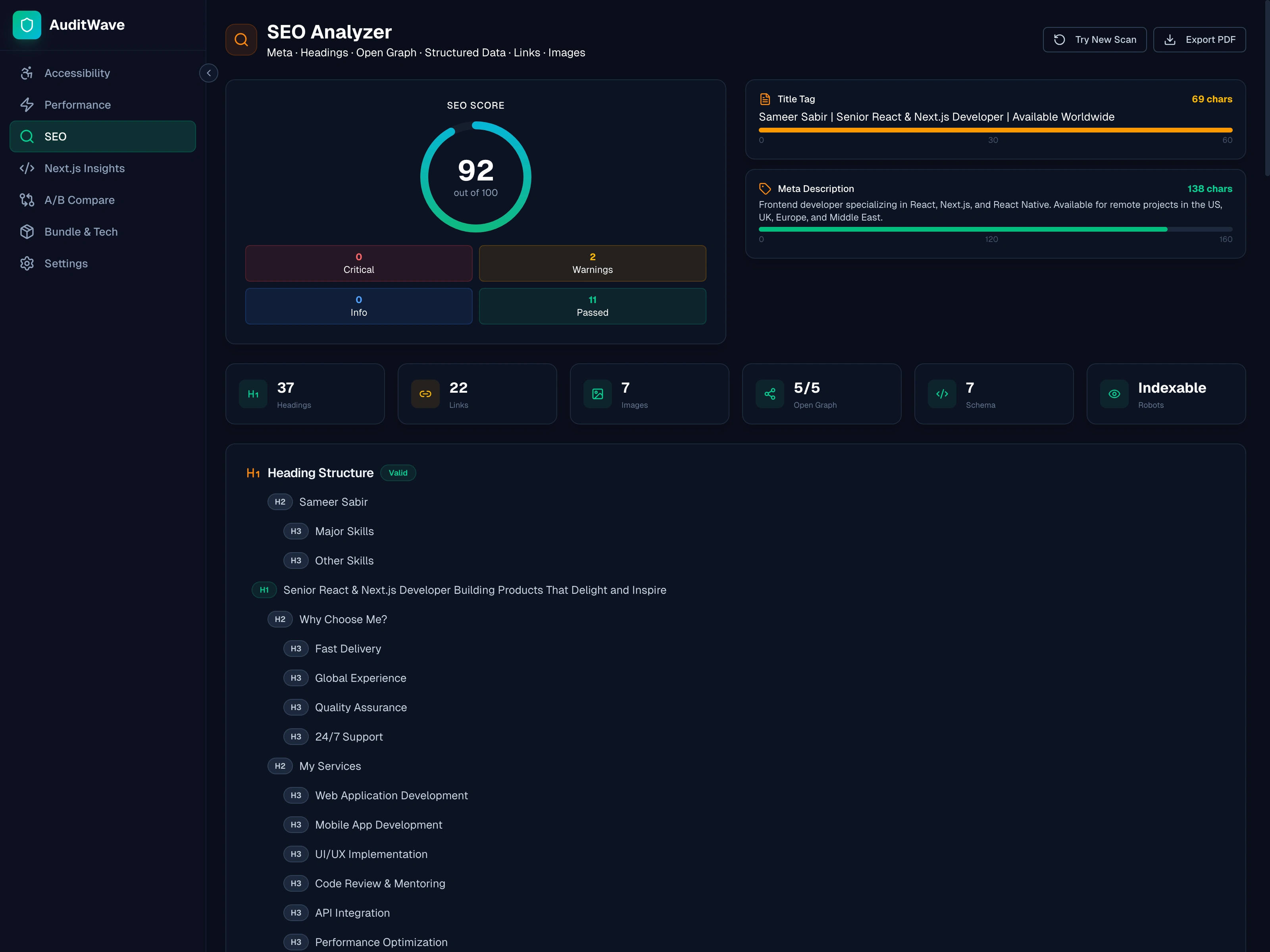
SEO Analyzer
Architecture
The platform runs on a serverless Next.js deployment on Vercel. Each audit type has its own API route that spins up a Playwright browser instance, runs the relevant tool (axe-core for accessibility, Lighthouse v10 for performance, custom extractors for SEO and tech detection), and returns structured results to the client. Keeping each audit module as an independent serverless function means they scale independently and don't compete for memory.
The frontend is stateless - no database, no authentication, no session management. Scan results live in client-side state for the duration of the session. That simplicity is what makes the "no login required" promise possible without compromising on what the tool actually does.
Results
6 audit tools in one platform - Accessibility (WCAG 2.2), Performance (Core Web Vitals), SEO, Bundle & Tech, Next.js Insights, A/B Compare
Real browser testing via Playwright across 4 device profiles and 5 throttle presets - not synthetic estimates
Audit results in seconds from a cold URL with no pre-configuration
PDF export on every report module for sharing and documentation
Zero friction - no account, no login, no setup required
Serverless architecture on Vercel handling concurrent scans without a dedicated backend
Full-stack implementation - API development, real browser automation, performance profiling, accessibility auditing, SEO analysis, and tech detection all built and maintained by one engineer
Like this project
Posted May 18, 2026
Built AuditWave, a free website audit tool that runs 6 comprehensive checks (SEO, performance, accessibility, security, meta tags, and broken links) in one click, with zero logins or signups. Designed to make professional-grade auditing accessible to anyone with a URL.
Likes
1
Views
10