Sci-Fi Coastal Desert Transformation

Alejandro Garcia


Case Study: Sci-Fi Coastal Desert – VFX Matte Painting & Compositing
Project Overview: A technical case study focusing on transforming a grounded, real-world location (a coastal desert) into a surreal, alien planet environment using advanced 3D compositing, sky replacement, and atmospheric effects inside Adobe After Effects.
📋 The Challenge
The objective was to take a daylight, high-contrast plates of a person walking on a coastal desert beach and seamlessly integrate multiple fantastical elements: a cosmic nebula sky, a distant exoplanet, and a futuristic glowing tower structure. The primary challenge was achieving harmonic integration—making sure the lighting, shadows, and perspective of the added sci-fi elements perfectly matched the organic textures of the sand and water.
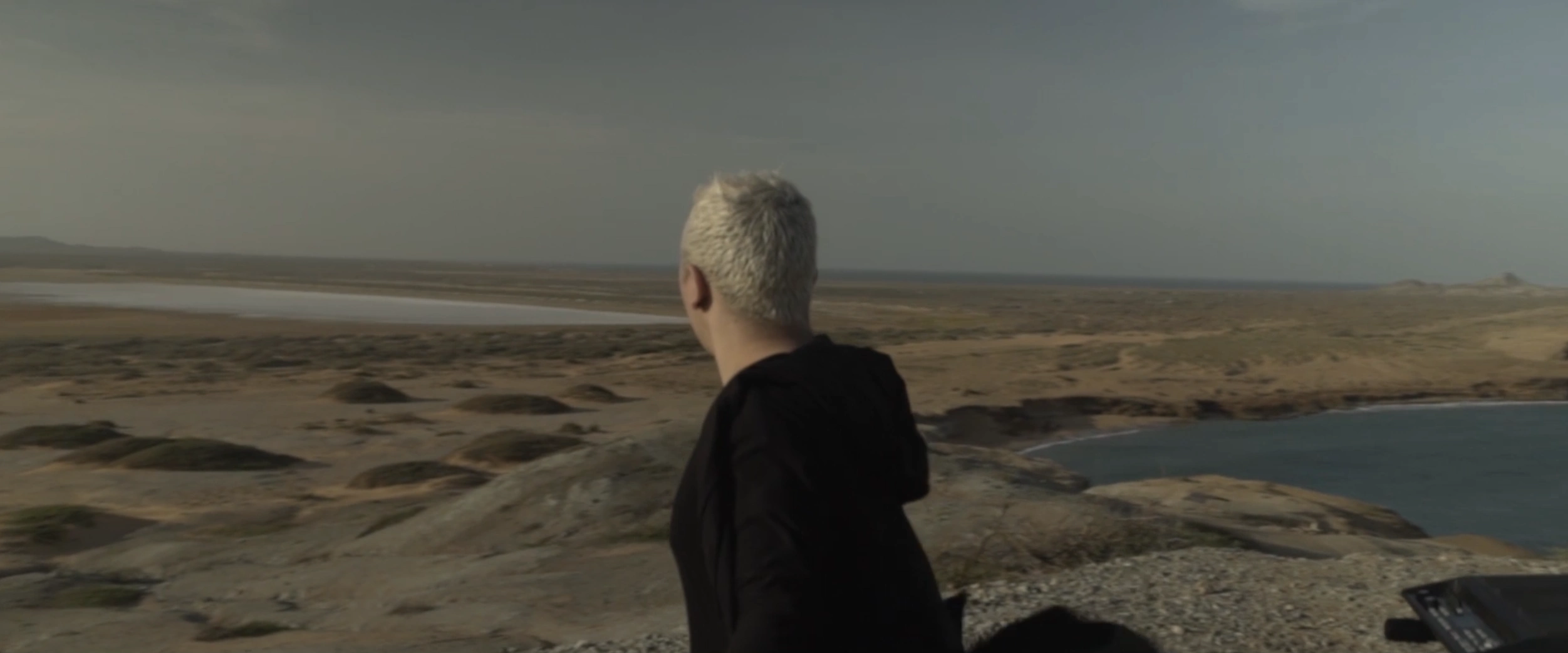
clean
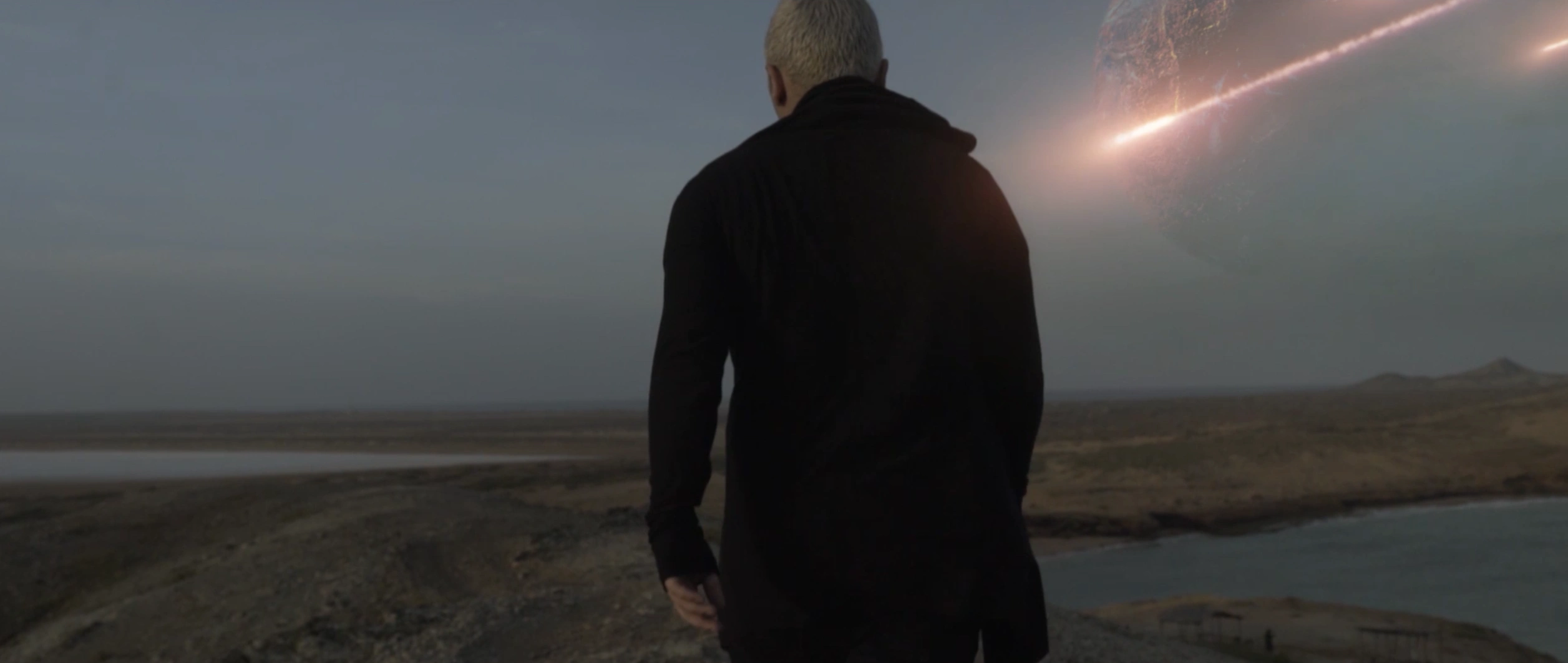
compositing
This shot presented two major technical and artistic hurdles:
Long-Distance Tracking: Because the camera was positioned very far from the subject and the horizon lacked high-contrast details, standard tracking algorithms struggled to find solid anchor points.
Emotional Color Theory: The narrative demanded a visual shift towards intense solitude, depression, and desolation. The challenge was achieving a heavy, melancholy mood without losing the structural details of the environment.
Dynamic Emissive Elements: Integrating a massive planet structure firing destructive orbital lasers required precise interactive lighting on an otherwise overcast, flat day plate.
🛠️ The Solution (Workflow Breakdown)
Sub-Pixel Tracking & Planar Stabilization:
To solve the tracking limitations caused by the camera's extreme distance, Mocha AE’s planar tracking engine was used instead of point tracking. By defining a large, high-resolution plane across the distant desert ridges and shorelines, the software extracted stable tracking data, perfectly locking the massive background planet and laser beams to the camera's minimal drift.
Destructive Light Emission & Matte Painting:
The sky was replaced with a heavy, overcast atmosphere to reflect the character's internal state. In the upper-right corner, a detailed exoplanet asset was composited. The orbital energy beams were generated using stylized particle layers and glow effects, using a linear light blending pass to make the orange plasma realistically burn through the dense haze.
Interactive Light Wrapping:
To sell the realism of the laser strike, a custom Light Wrap was applied to the right side of the subject's hoodie and hair. A faint, orange ambient glow was masked onto the distant hills and water surface, reacting dynamically to the light emitted by the explosion.
Melancholic & Desaturated Color Grading:
To evoke a powerful sense of depression and loneliness, the vibrant tones from the previous scene were completely stripped away. A heavy Lumetri Color pass was applied to crush the midtones into cold, muted grays and desaturated earthy browns. The contrast was softened to mimic a gloomy, oppressive atmosphere, ensuring the only warm punctum in the entire frame was the ominous glow of the cataclysmic event.
📋 The Concept: Testing Emerging Tech
As visual effects evolve, relying solely on traditional digital double rigging and manual rotoscoping can severely bottleneck production. This shot serves as a benchmark test to evaluate how next-generation tools—specifically generative AI (such as Runway Gen-3 Alpha), real-time environment platforms (NVIDIA Omniverse), and procedural heightfield systems—can be weaponized by a single artist to achieve complex, studio-quality character substitution and world-building.
🛠️ The Next-Gen Toolset & Integration
AI Character Swap & Temporal Consistency (Gen-3 / Advanced AI):
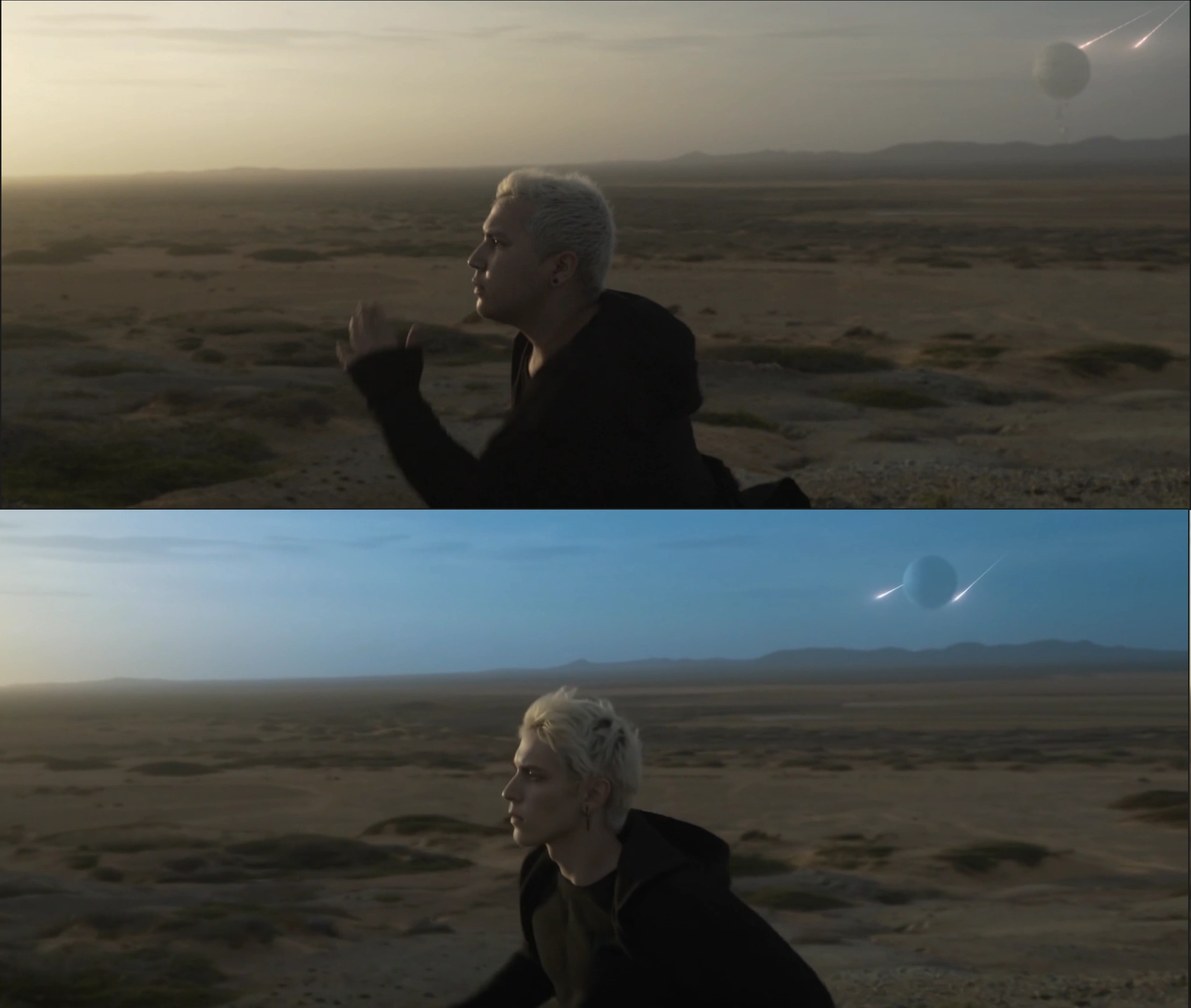
The Challenge: Replacing the actor in the original plate (top) with an entirely new character profile (bottom) without losing the realistic physics, motion blur, and framing of the running sequence.
The Solution: The original actor’s performance and silhouette acted as a driving matte. The generative video-to-video model successfully transformed the character's facial structure, hair aesthetic (creating a more stylized, chaotic look), and wardrobe textures. The system preserved the organic weight and momentum of the run while establishing perfect temporal consistency across the frames.
Procedural Terrains via Highfields (Heightfields):
The Tech: Using procedural heightfield nodes to generate mathematically accurate, infinite desert topography.
Application: These heightfields replaced flat background details with real 3D depth maps. This allowed After Effects to precisely calculate environmental depth, keeping the distant mountain ridges and the planet in the sky correctly tracked to the camera's perspective.
Real-Time World Building (NVIDIA Omniverse / Omni Frameworks):
The Tech: Leveraging an OpenUSD-based real-time environment to manage complex scene assembly and lighting setups.
Application: Omniverse served as the interactive hub to preview how the alien celestial bodies and orbital streaks interact with the atmosphere. This allowed for real-time look development, removing the need for slow, traditional offline render passes.
Unified Multi-Pass Compositing & Color Re-Styling:
The Solution: The AI-generated character passes and the virtual environment assets were brought back into After Effects for final grading. The original warm, golden-hour wash (top) was completely overhauled into a cold, desaturated, twilight blue palette (bottom). This stylistic color shift emphasizes the narrative theme of isolation, while custom light-wraps seamlessly glued the synthetic character into the new atmospheric mood.
Like this project
Posted Sep 15, 2026
Transformed a coastal desert into a surreal alien landscape using VFX and 3D compositing.