AI Agent Operator Cockpit for Long-Running Codex Sessions

Fedor Gorbunov

AI Agent Operator Cockpit for Long-Running Codex Sessions
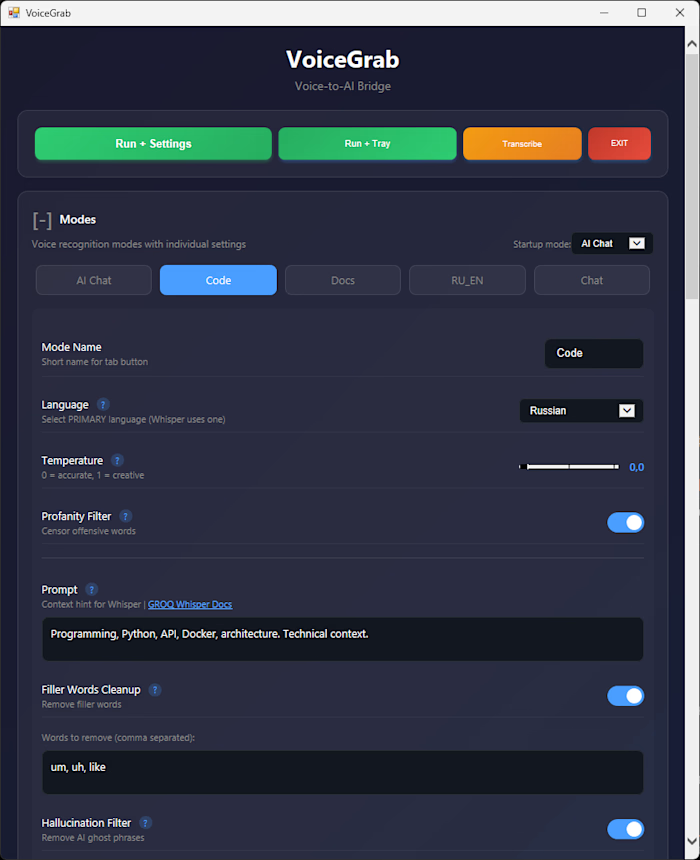
I designed and built a private operator cockpit for long-running AI-agent engineering sessions. The goal was not to create another chatbot UI. The goal was to make AI-assisted work observable, controllable, recoverable, and easier to verify.
Problem
AI agents can produce useful work, but long-running sessions are difficult to operate safely when the human operator cannot clearly see:
which session is active;
what the agent is doing now;
what prompt or task is being handled;
whether the runtime is alive or stale;
what artifacts were created;
which result still needs human validation;
where the source of truth is: UI, logs, runtime, API, files, or documentation.
Without a clear operator surface, AI-assisted engineering becomes fragile. Work can drift, context can be lost, and the human reviewer has to reconstruct the state manually.
What I Built
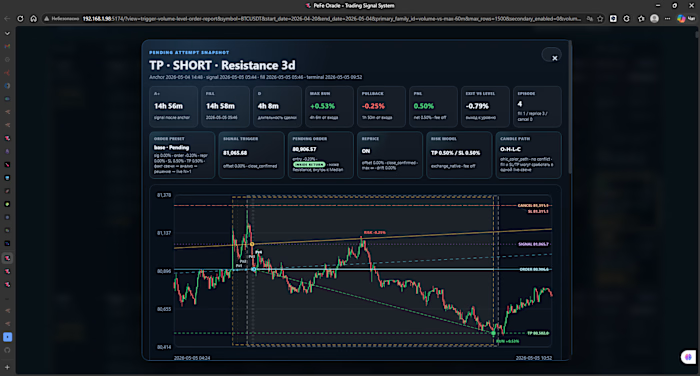
The cockpit brings the main operator surfaces into one practical workspace:
dialog-first control surface;
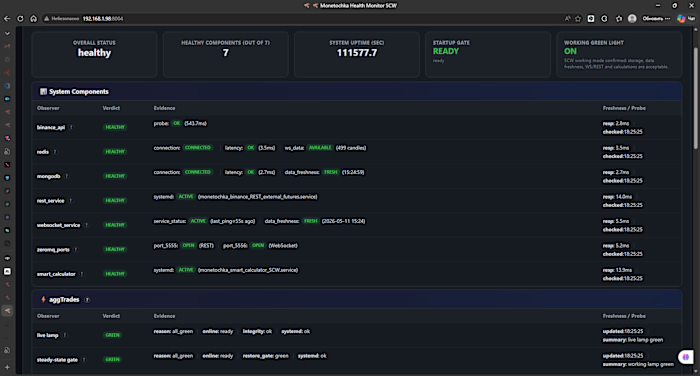
runtime/session status;
task planning and notes;
documentation access;
board-based reasoning;
translation support;
bookmarks and session artifacts;
terminal/log observer views;
recovery actions and session routing.
The dialog remains the main control surface. Terminal and log views are used as observer surfaces, so the operator can compare what the AI says with what the runtime actually shows.
Architecture Ideas
The core idea is a common observer point between human and agent:
human sees the UI
agent checks runtime/API/files/logs
truth is the overlap between both surfaces
This matters for AI-assisted work. If the UI says one thing and the runtime says another, the system must not hide the mismatch. The cockpit is designed around visible state, explicit ownership, and recoverable workflows.
Key design elements:
fail-closed status model;
session-bound artifacts;
task/plan visibility;
runtime registry for live and dead sessions;
recovery paths for stale or interrupted sessions;
documentation kept close to execution;
written handoff and validation notes.
Stack / Skills Used
Python
FastAPI-style backend thinking
browser/runtime integration
session state modeling
operator UI design
workflow automation
AI-assisted coding
Codex CLI
Cursor
documentation systems
runtime/log review
My Role
I defined the product model, requirements, architecture, acceptance rules, UI flow, runtime truth model, and AI-assisted delivery workflow.
This was not just a UI task. It required system thinking across:
operator workflow;
backend/runtime state;
documentation;
session recovery;
human validation;
AI-agent prompt and execution flow.
Result
The result is a more reliable AI-assisted engineering workflow. The operator can supervise work, track session state, recover context, inspect artifacts, keep documentation connected to execution, and review results before they become accepted truth.
This experience is directly relevant to client work involving:
AI/API workflow diagnostics;
internal AI tools;
automation reliability;
technical documentation;
human-in-the-loop review;
monitoring and operational handoff.
Relevant Services
This project directly supports the services I offer:
AI/API Integration Diagnostic.
Python Automation for Reports, Docs, or Data Checks.
OpenAI / FastAPI MVP Fix when the task involves API-backed AI workflows.
Backend / Data Pipeline Monitoring Audit when the issue is around runtime observability and recovery.
Not Disclosed
Private account data, tokens, internal repository paths, full repository structure, private runtime/session internals, and sensitive local infrastructure details are intentionally not disclosed.
Like this project
Posted May 20, 2026
AI agent cockpit for Codex sessions: runtime state, artifacts, plans, logs, recovery, and operator control in one workspace.
Likes
0
Views
1