The Hidden Hypnotic Heart of India: Orchha

Debashis

Debashis Kar
Copywriter & Creative Professional
Published Mar 25, 2025
Content
1... Raja Mahal
2... Jahangir Mahal
3... Chhatris or Cenotaphs
4... Chaturbhuj Temple
5.. Ram Raja Temple
6... Laxmi Narayan Temple
7... Sound & Light Show
8... Rai Praveen Mahal
9... Palaki Mahal
10... Where to eat
11... Where to stay
12... Things to do
13... Getting there
Orchha, in the Niwari district of Madhya Pradesh, a Bundelkhand region at the banks of the river Betwa, means hidden. It is an 18-kilometre drive from Jhansi and well connected.
Here, both Shri Krishna and Sri Rama are worshipped, and one gets both the Royal Palaces of Rudra Pratap Singh and Jahangir, but the king of this place is the Lord Rama of the Ikshvaku dynasty, known as the Ram Raja Sarkar.
This is India's only place where Rama is worshipped as a king. Here, the Government of Madhya Pradesh gives a Guard of Honour during his four Aartis.
Behold the Ganesh Darwaja, the landmark Second Old Gate from the north, and Shahi Darwaja from the northeastern part as you enter Orchha.
Raja Mahal
Soak in the Rajput & Mughal regalities and architecture of Raja Mahal, Orchha, initiated by King Rudra Pratap Singh in the 16th century and completed under the observation of King Madhukar Shah in 1551.
In its several rooms, immerse yourself in the vivid, colourful murals of antiquities like Vishnu, Brahma, Rama, Sita, the Buddha, Krishna, Ganesh, and Orchha royalties like wrestling, hunting, dancing, fighting, sitting, and lying across the walls and ceilings.
Behold the scenic beauty across the town through the stone-framed windows of the upper floors.
Jahangir Mahal
The Jahangir Mahal of this palace was completed in the 17th century by Bir Singh Deo for the Emperor, who stayed there for just one night.
Witness the pinnacle of Indo-Islamic architecture on the walls crowned with eight domed towers. It also has eight pyramid tower-domed pavilions, eight more pavilions below the level, and beautifully composed archways and doorways leading our sights to the countryside.
Witness the history in its 136 rooms, where 100 rooms are resting beneath the fort.
You can see the influence of Rajput and Mughal architects in the palaces, temples, and chhatris, which the Bundela Rajput Rajas built, as they retreated from Garkhundar due to the Tughlaqs of Delhi in the 15th century.
Chhatris or Cenotaphs
These are the obituary monuments to the Orchha royalty.
They are built near the south of the town as sprawling and serene structures beside the meandering River Betwa. You can spot Bir Singh Deo's chhatri, which is constructed slightly apart. The Chhatris are best seen at dusk on the river's far bank.
Blessed by historical sites, Orchha has been a must-visit place in this part of India.
Chaturbhuj Temple
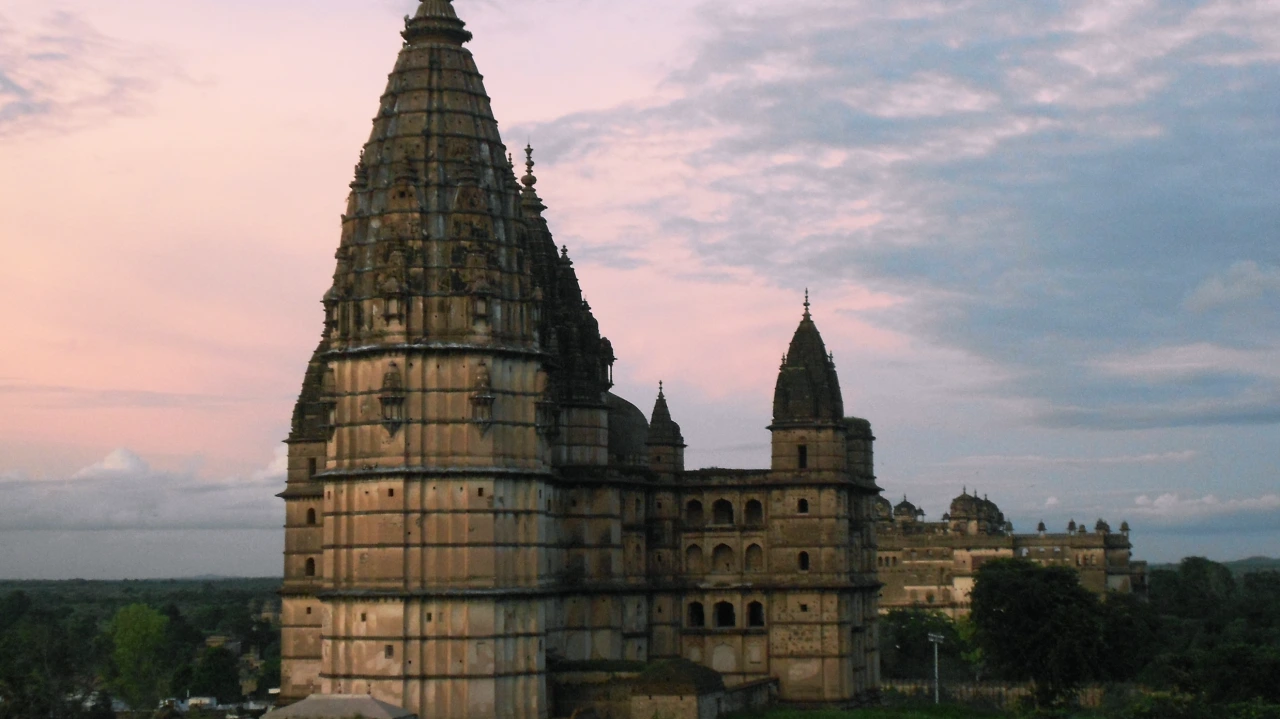
Behold the soaring tops of the 16th-century Chaturbhuj Temple. The temple of the four-handed avatars of Vishnu is visible from all over the town.
The idol of Lord Rama has never been used for the real purpose, which stays in the Ram Raja Temple next door.
You may climb a steep and dark staircase to emerge amongst the mossy roof pinnacles to get a bird's-eye view of the town and its shrouding nature.
Recommended by LinkedIn
Ram Raja Temple
The pink and tangerine-coloured domed temple at the west end of a lively square once used to be the kitchen of Kanwar Ganeshi Bai, a Rama devotee, and the Rani of Raja Madhukar Shah, who was a Krishna devotee.
While having dinner, Raja requested that Rani accompany him to Vrindavan in Janmashtami. Still, the Rani refused, so they went to Ayodhya and spent one year meditating for Lord Rama at the bank of the River Sariyu.
Rama was pleased and agreed to Rani's request to come to Orchha, but on three conditions. He will move only during Pokh Nakshatra and not from where he will be placed first. And he will be the king of that place and be known as "Ram Raja Sarkar."
Today, the 16th-century palace of the wife of Madhukar Shah has become a temple where she temporarily kept an idol of Shri Rama, and it has proved impossible to move since then.
This is the major attraction for the pilgrims and is the only temple in India where Rama is worshipped as a king.
Do not forget to leave your leather belt and wallet as you remove your shoes. And no photography, please.
Laxmi Narayan Temple
Visit the bizarre Temple of Laxmi-Narayan.
It appears triangular from the outside but is square from the inside and bedecked by wall paintings from Rama & Krishna Leela to the Indian Rebellion of 1857.
The soaring temple-cum-fort on the road to Ganj village has a fine rooftop view of the town. It was built by Bir Singh Deo and renovated around 1793.
The temple can be seen from any part of the town. The locals believe that the temple ushers the blessing of fortune to its subjects in the town.
Sound & Light Show
Lose yourself in the Sound and Light of Orchha. It portrays the antiquity of Orchha's history, with the galloping of the horses, the hunting game, attacks and wars, the infidelities, suicides, and murders, and yet, finding a place in the ebbs and flow of life.
Rai Praveen Mahal
If you love art and care about your romantic side, visit the Mahal of the most talked-about lovers of Orchha of the 16th century, Raja Indrajit and Rai Parveen.
Various murals of Parveen at different dance poses and Indrajit on horseback are well preserved along the Mughal Garden outside.
Palaki Mahal
Remember the hero of Bundelkhand culture at Pink Mahal or Phool Bagh, Dinman Hardol, son of Bir Singh Deo, who committed suicide to prove his innocence over a made-up affair with his brother Jhujar's wife.
You will find its open courtyards full of souvenir sellers, where his memorial at Phool Bagh is bedecked with a traditional Charbagh adjacent to the Mahal.
Merge your soul in the animated backdrop of women singing songs about Him, tie a thread into the ceremonial Jala, and walk around it five times to make a wish, hoping that he will fulfil it.
During the sunset over the river, relax at the Chhatris by the Betwa while the birds return to their home. Meander in the back alleys of history, spirituality, and nature in Orchha at the heart of India.
Where to eat
Tickle your taste buds with Indian and Multi-Cuisine restaurants in this place, like
Jharkhand Restaurant, Ram Raja Restaurant, Bundela Restaurant, Laxmi Betwa Tarang, and many more.
Where to stay
Hotel Sunset Orchha
Hotel Monarch Rama
Hotel Fort View
Betwa Retreat
Bundelkhand Riverside
Shree Ram Homestay
Hotel Om
Comfort & Cozy
Hotel Shri Kishori Ju Plaza
Hotel Brij
Hotel Baidyaraj
Hotel Shri Prayag
Hotel Orchha Inn
Hotel Sangam
Hotel Aditya Orchha
Shri Ramraja Guest House
Orchha Dham Guest House
Monarch Rama Palace
Shri Mahant Guest House
Hotel Shri Mahant
The Orchha Resort
Temple View Guest House
Couple Friendly Hotel Sunset
Sunset Backpacker Hostel
Homes of India
Orchha Best Homestay
MPT Sheesh Mahal
Amar Hotel
Things to do
Learn to cook the best MP recipes at Rajni Cooking Classes
Boating in River Betwa
A Royal Stay at Sheesh Mahal
Kayaking in River Betwa
Nature Trail in Orchha Nature Reserve
Light and Sound Show at Orchha Fort
Enjoy the Delicious Food at Jharokha Restaurant
Jungle Safari at Orchha Wildlife Sanctuary
River Rafting in River Betwa
Getting there
Gwalior is the nearest Airport, situated at a distance of 126 km. Delhi, Mumbai, and Jabalpur are connected to Gwalior by air.
New Delhi, at 440 km, is the International Airport.
The distance between Jhansi and Orchha is 18 kilometres. An autorickshaw or taxi from Jhansi railway station to Orchha will take about 45 minutes.
Several trains run daily from New Delhi to Jhansi via Agra and Gwalior. They depart either from New Delhi station or Hazrat Nizamuddin station. Shatabdi Express is the fastest train. It leaves New Delhi station at 6 a.m. and reaches Jhansi at 10:45 a.m. Other trains take about 6.5 hours from Delhi to Agra or Gwalior.
The fastest train from Bhopal to Jhansi is the Shatabdi Express. It departs Bhopal at 15:12 and reaches Gwalior at 18:32 hours.
There are two trains from Khajuraho to Jhansi - the Khajuraho - Udaipur Express departs at 9.10 hours and arrives at 13.45 hours, and the Khajuraho - Nizamuddin Express departs at 18.20 hours and arrives at 23.10 hours
Like this project
Posted Mar 31, 2025
Know more Content 1..
Likes
0
Views
5
Timeline
Mar 23, 2025 - Mar 25, 2025
Clients
Self