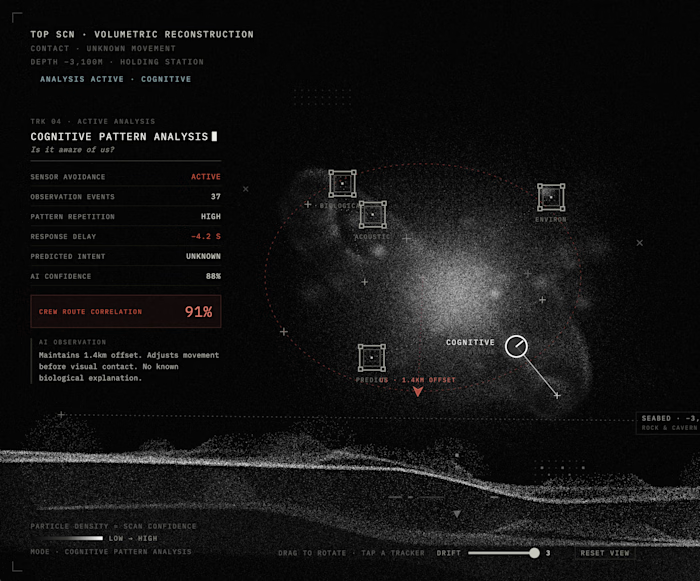
Predictive Reconstruction Engine

Kyle Chaplin


Challenge.
How do you visualize something that cannot be directly observed?
Traditional interfaces are built to increase certainty as more data is collected. I wanted to explore the opposite: a scientific system studying an unknown organism where each new observation raises more questions than answers. The challenge became designing an interface that communicated uncertainty, contradiction, and discovery without relying on conventional horror or explicit creature reveals.
Solution.
I designed a cinematic research platform centered around a volumetric particle reconstruction engine. Rather than rendering the organism directly, the system fuses sonar, pressure, acoustic, biological, chemical, and environmental data into a probabilistic point-cloud model. Each investigation mode acts as a different scientific instrument, revealing unique evidence while challenging previous conclusions, allowing the narrative to unfold through interaction instead of exposition.
Result.
The result is a fictional operating system that blends HUD, FUI, and scientific visualization into an interactive investigative experience. Instead of presenting answers, the interface encourages exploration by making uncertainty the primary output—transforming raw sensor data into an evolving story about humanity’s attempt to understand something fundamentally beyond its current model of reality.
Like this project
Posted Jul 13, 2026
An AI-driven volumetric reconstruction system that investigates unknown alien life through evolving particle-based scientific inference.
Likes
0
Views
10