Developmental Editing — Character Arc Overhaul

Sonja Antic


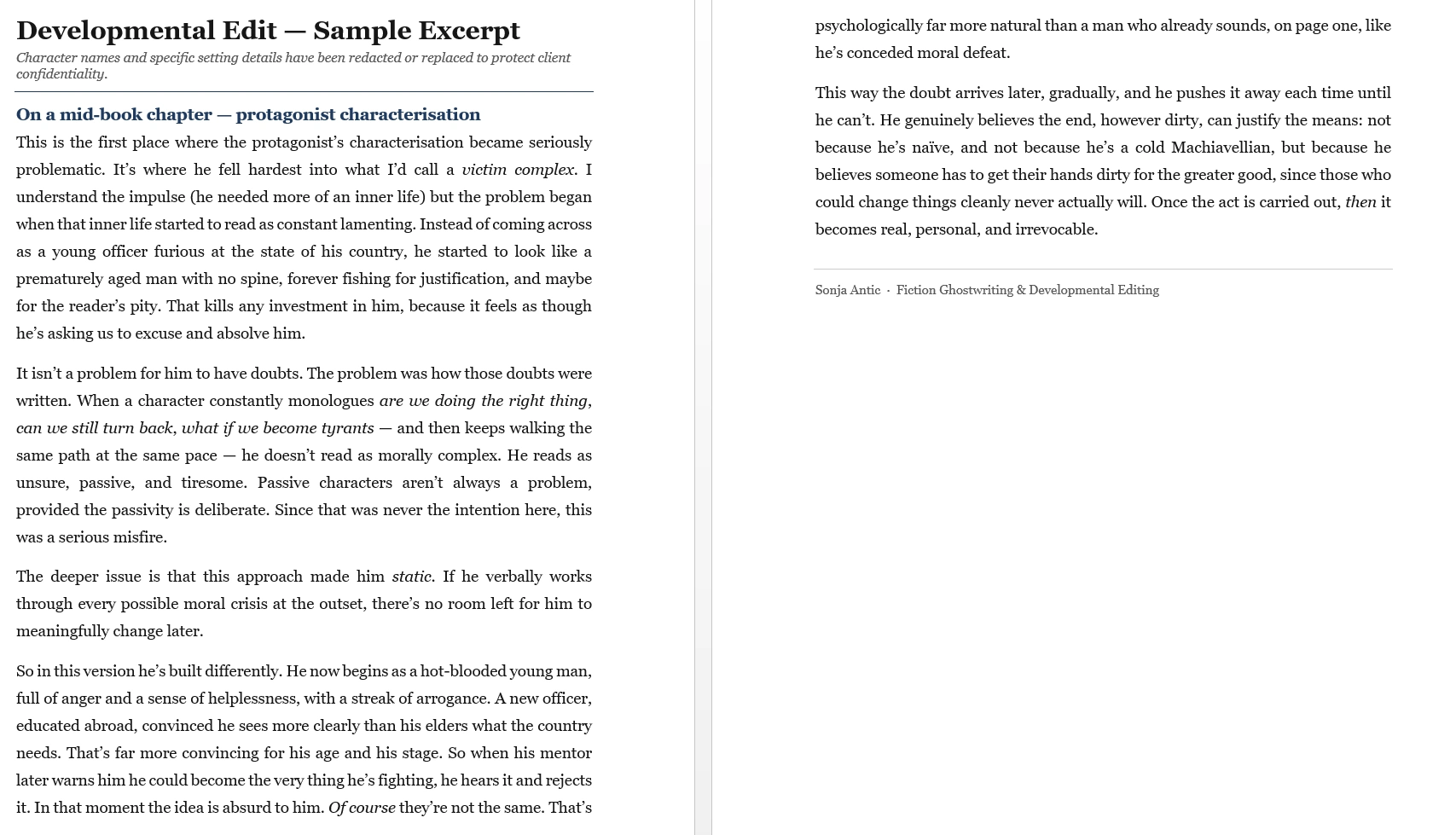
An anonymized excerpt from a developmental edit on a fiction manuscript. This is what structural editing actually looks like: not line-level grammar fixes, but rethinking how a character is built from the ground up.
All identifying details have been removed to protect client confidentiality.
The problem: a protagonist stuck in victim mode
This is the first place where the protagonist's characterisation became seriously problematic. It's where he fell hardest into what I'd call a victim complex. I understand the impulse (he needed more of an inner life) but the problem began when that inner life started to read as constant lamenting. Instead of coming across as a young officer furious at the state of his country, he started to look like a prematurely aged man with no spine, forever fishing for justification, and maybe for the reader's pity. That kills any investment in him, because it feels as though he's asking us to excuse and absolve him.
It isn't a problem for him to have doubts. The problem was how those doubts were written. When a character constantly monologues are we doing the right thing, can we still turn back, what if we become tyrants — and then keeps walking the same path at the same pace — he doesn't read as morally complex. He reads as unsure, passive, and tiresome. Passive characters aren't always a problem, provided the passivity is deliberate. Since that was never the intention here, this was a serious misfire.
The deeper issue is that this approach made him static. If he verbally works through every possible moral crisis at the outset, there's no room left for him to meaningfully change later.
The fix: rebuilding the arc from the ground up
So in this version he's built differently. He now begins as a hot-blooded young man, full of anger and a sense of helplessness, with a streak of arrogance. A new officer, educated abroad, convinced he sees more clearly than his elders what the country needs. That's far more convincing for his age and his stage. So when his mentor later warns him he could become the very thing he's fighting, he hears it and rejects it. In that moment the idea is absurd to him. Of course they're not the same. That's psychologically far more natural than a man who already sounds, on page one, like he's conceded moral defeat.
This way the doubt arrives later, gradually, and he pushes it away each time until he can't. He genuinely believes the end, however dirty, can justify the means: not because he's naïve, and not because he's a cold Machiavellian, but because he believes someone has to get their hands dirty for the greater good, since those who could change things cleanly never actually will. Once the act is carried out, then it becomes real, personal, and irrevocable.
Why this matters
This is what developmental editing is. Not fixing commas. Not rewriting prose. It's identifying where a character, a structure, or a narrative choice isn't doing what the author intended, diagnosing why, and rebuilding it so it works. The author's vision stays intact. The execution gets sharper.
Client details are anonymized. If you'd like references from past editing clients, I'm happy to arrange that.
Like this project
Posted Jun 16, 2026
Likes
0
Views
2