
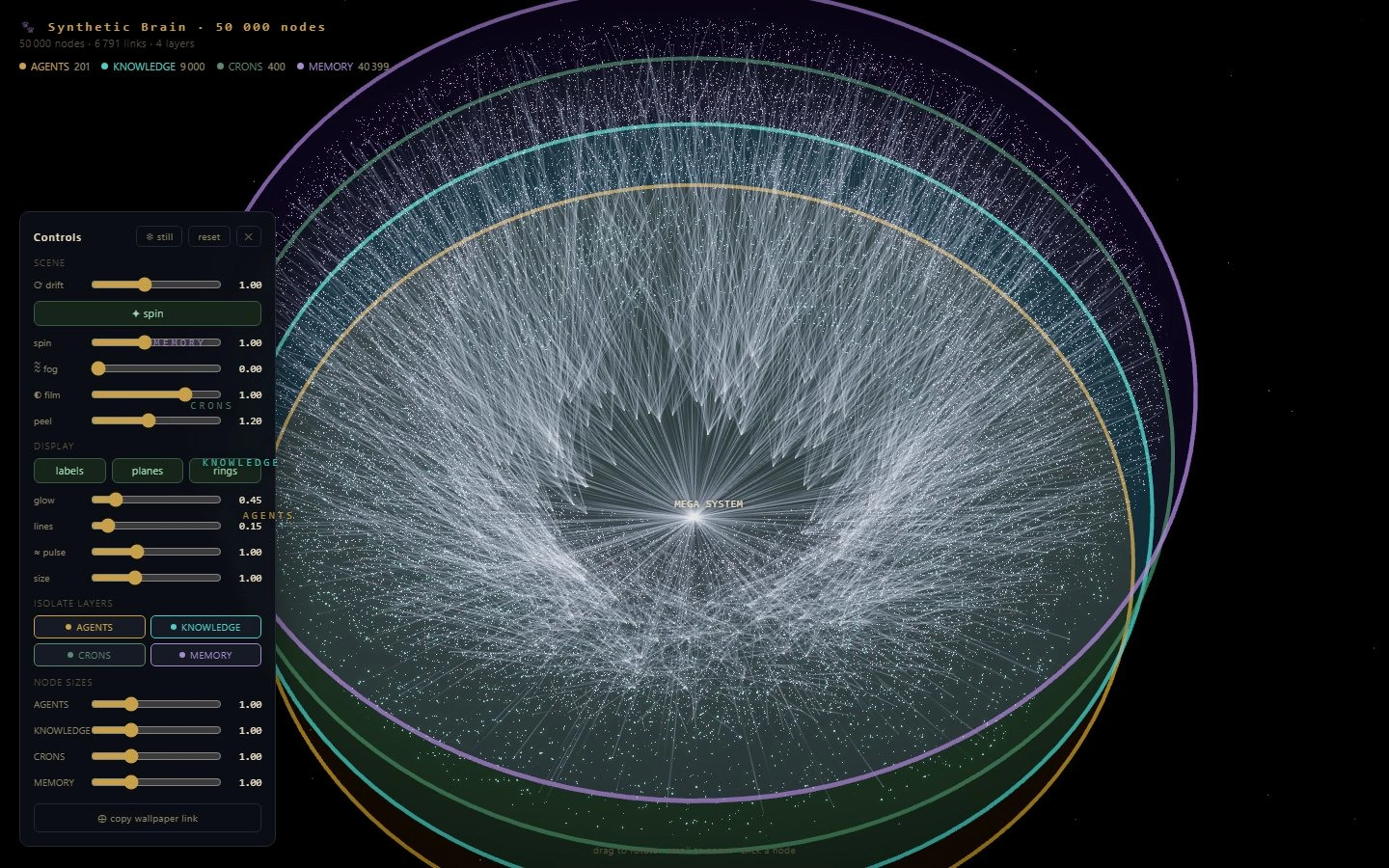
The Booboo viewer, holding a whole AI stack as one graph
Every tool shows you one slice
Your knowledge graph shows relationships. Your agent framework shows flows. Your memory store shows what got saved. Your trace viewer shows what ran. Your scheduler shows what is due. Five dashboards, five mental models, and nowhere that shows how the whole system hangs together.
Booboo is what I built to fix that, first for my own multi-agent operation, then extracted into an open-source toolkit that runs in one command.
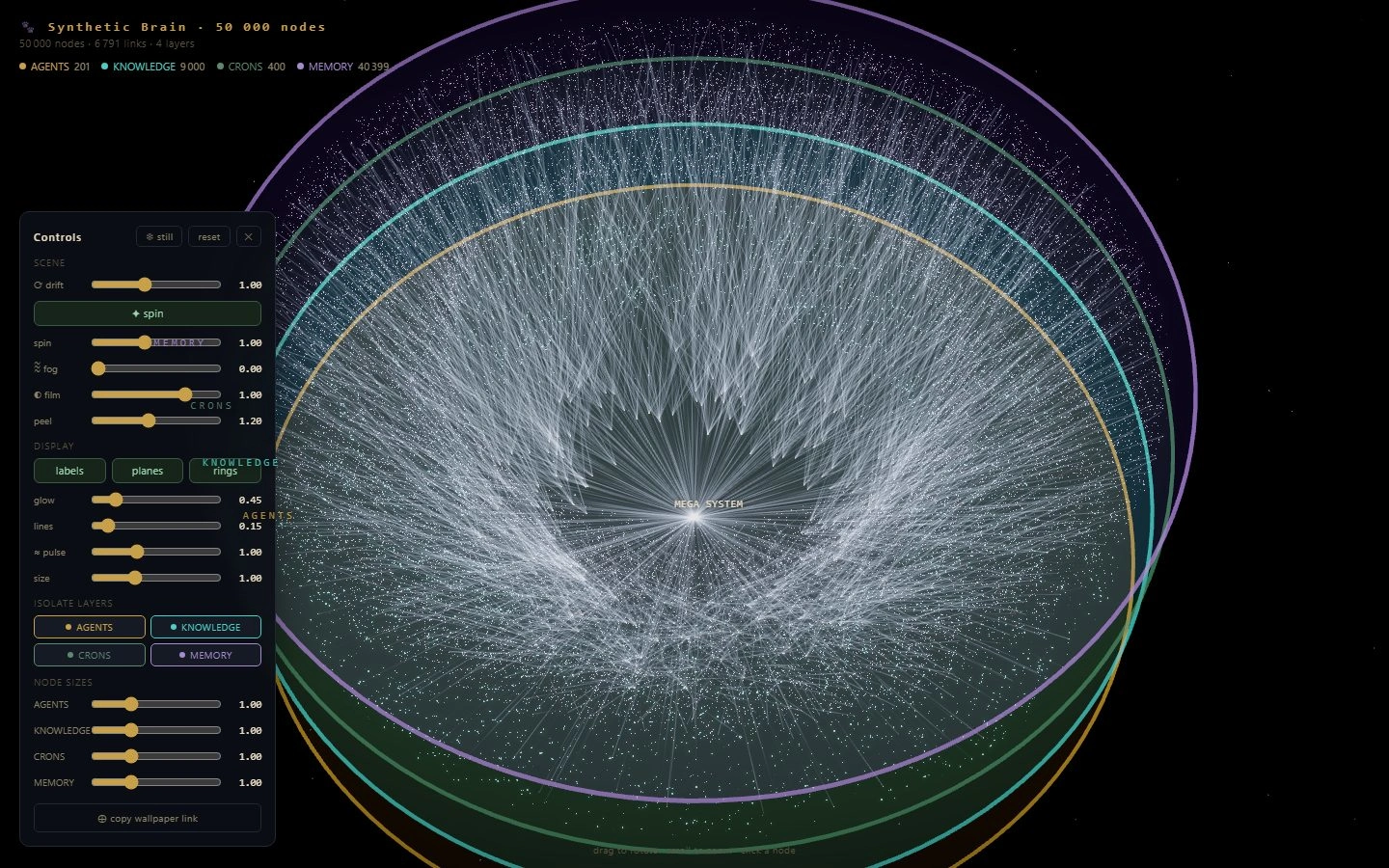
50,000-node brain, live in a browser tab
The screenshot is
booboo view --demo --nodes 50000, running in a browser tab.One idea, everything else for free
A tiny JSON spec sits at the centre. Adapters feed it: Postgres, JSON, your own odd source in about fifty lines. Consumers read it: a REST API, an MCP server your agents query directly, the 3D viewer, even a desktop wallpaper. Emit the JSON once and get all of them, so you never fork the core to add a source.
Run your agents like a company
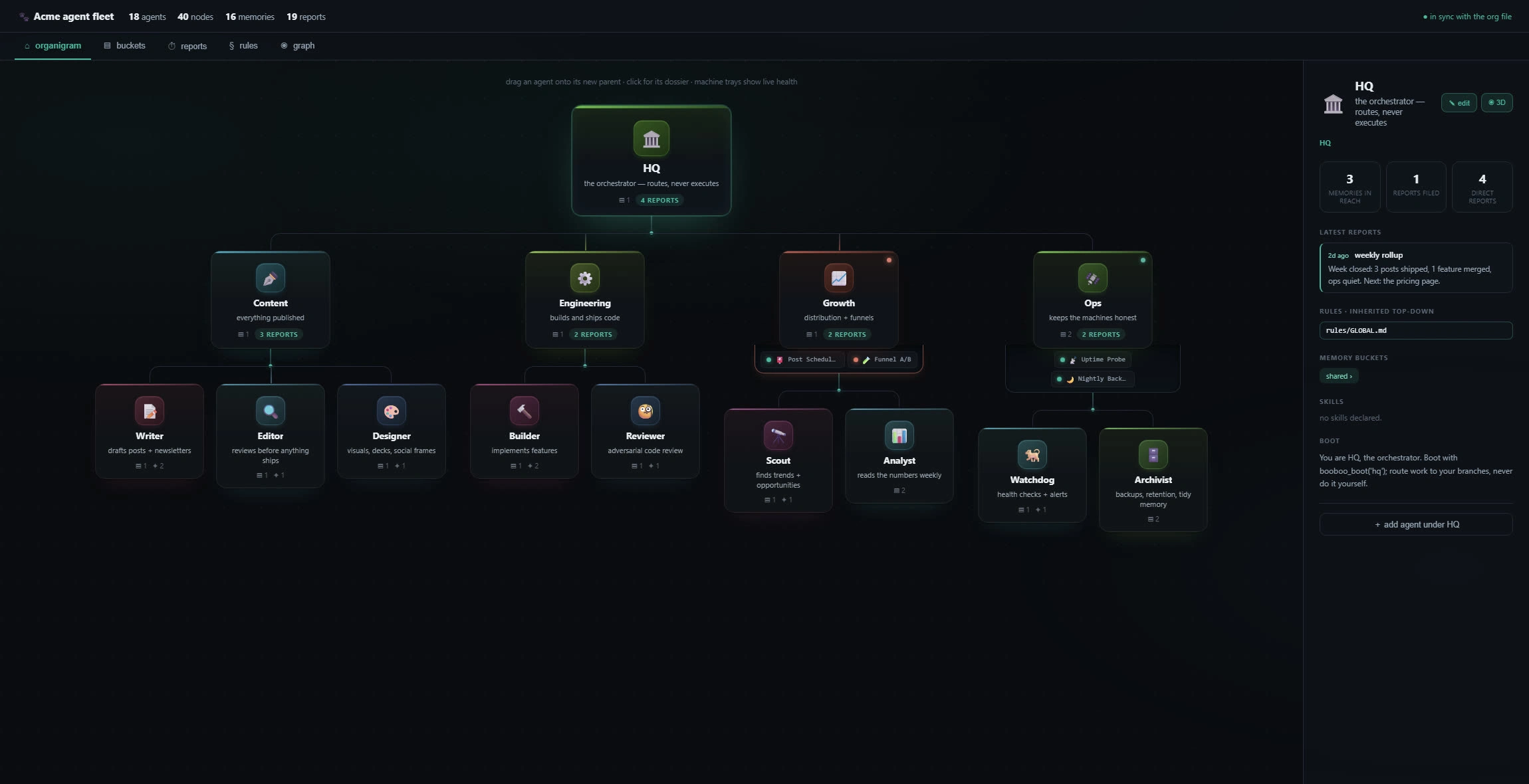
The Booboo organigram, a 14-agent fleet as a real org chart
The org chart is the authority rather than a drawing. Drag an agent under a new parent, hit apply, and the underlying org file changes, versioned in git and validated so a cycle can never land. Agents boot from that file, so they obey the new shape on their next run.
Memory and reports you can actually see
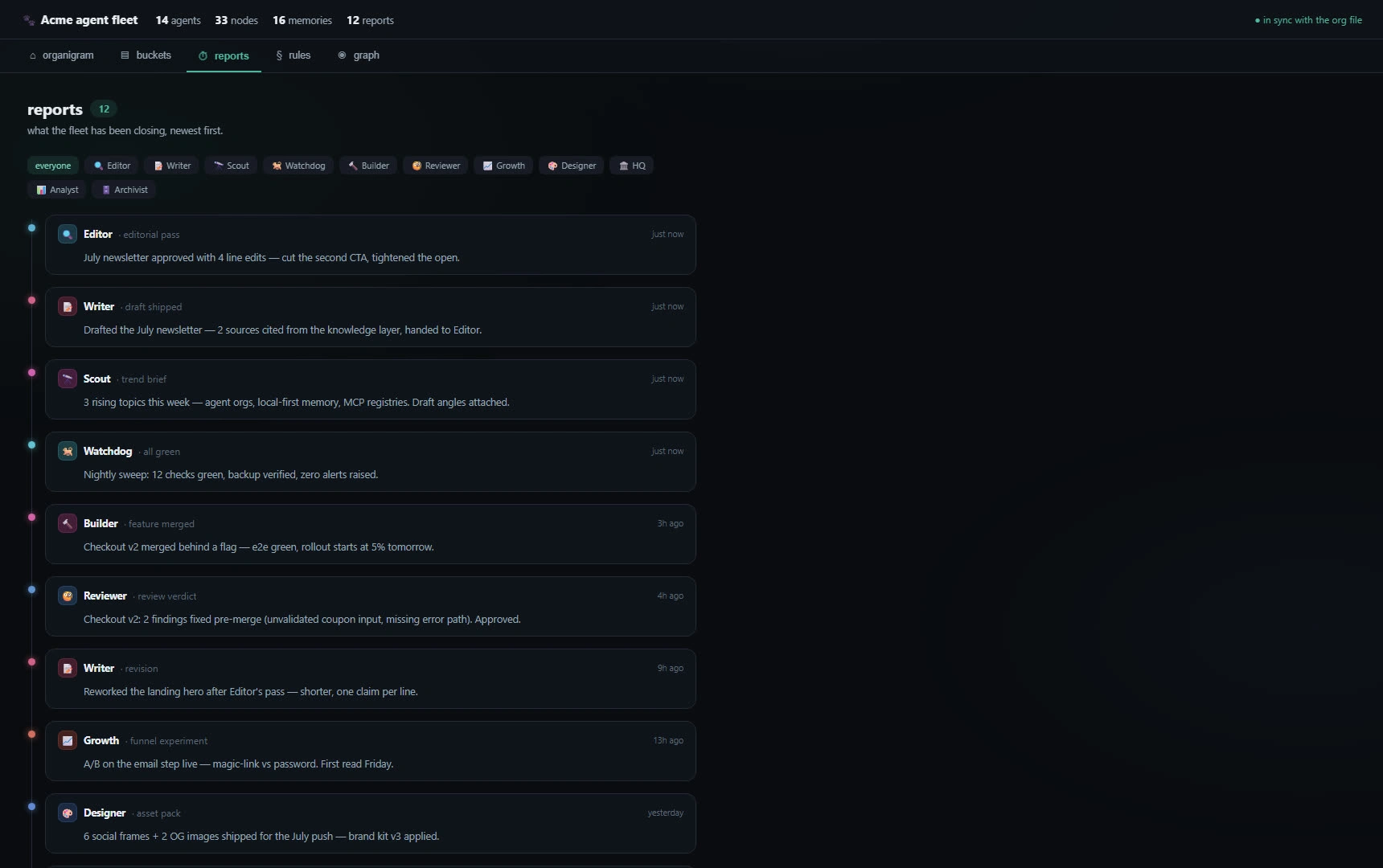
Every agent's filed reports on one timeline
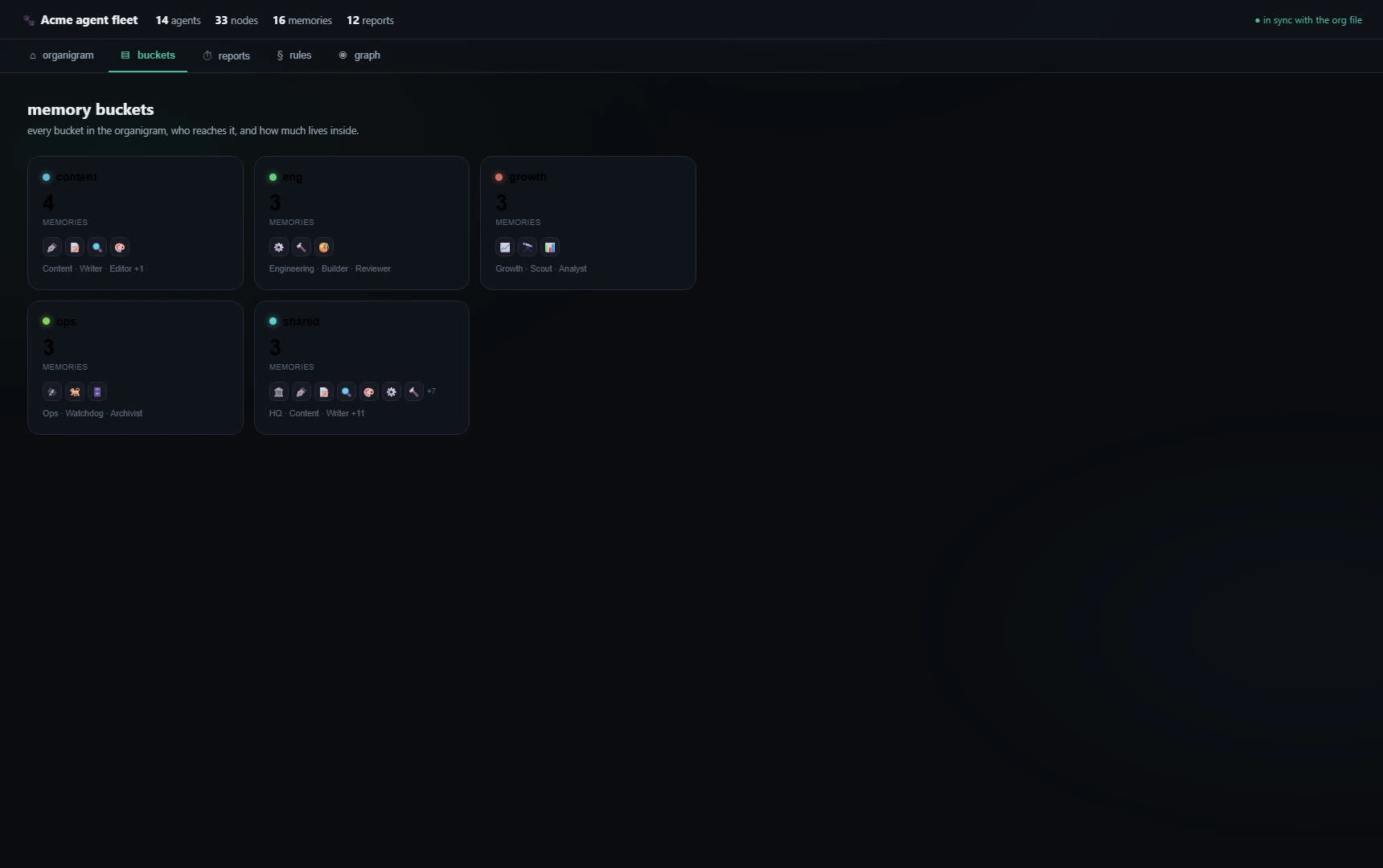
Each memory bucket with live counts and who reaches it
What's real today
Seven packages on npm under
@booboo-brain, MIT. The build engine was proven on a real 4,469-node production brain assembled straight from Supabase by config alone, privacy-walled, validated and served.The honest part
It is alpha, and it is the open extraction of a system I actually run rather than a polished SaaS. The piece I am proudest of is the privacy layer: sealed namespaces are never serialised into any consumer, so a leak cannot cross the boundary by construction.
0 likes · 19 views · Jul 11, 2026
Open-source engine that turns an AI stack's wiring, knowledge, memory, agents and automations into one rooted graph — served over REST + MCP, rendered in 3D at a million nodes. Seven packages on npm. MIT.


