
Small cooperative loan books often show no recorded defaults, and standard models then put their default risk at zero. Regulators, insurers and investors will not accept that number. I wrote and published a technical note, with open and tested code, on how to set a defensible upper bound on probability of default instead. It came out of Amani's SACCO work, where guarantor-backed books show zero formal defaults.
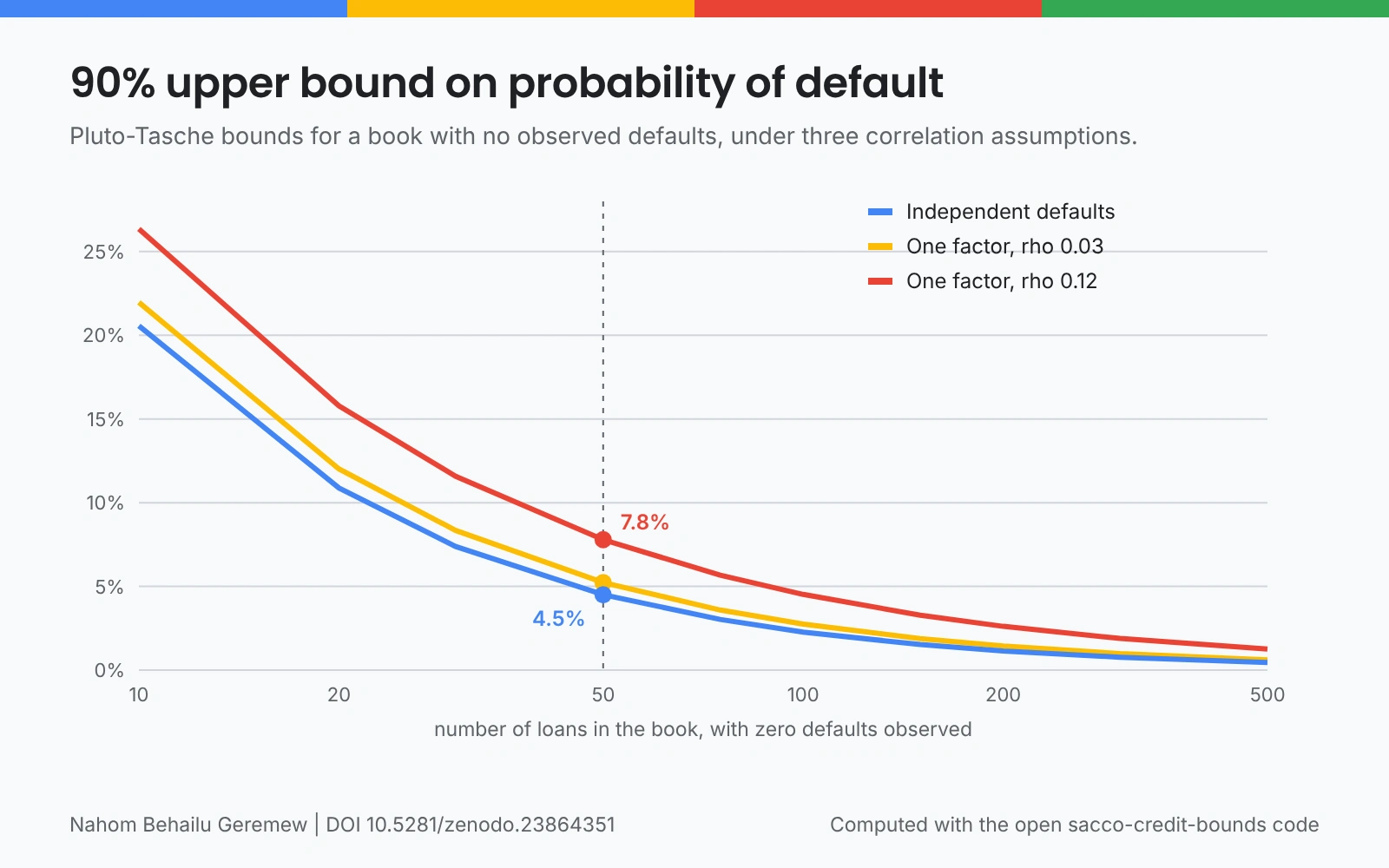
90% upper bound on probability of default as the book grows, under three correlation assumptions
The method
Pluto-Tasche bounds for independent defaults and for correlated defaults under a one-factor Vasicek model.
A Bayesian bound under a uniform prior, with a beta-binomial cross-check.
Sensitivity to the confidence level and to asset correlation across the Basel retail range of 0.03 to 0.16.
A scorecard on a synthetic book that mirrors the pilot's aggregates, reported in-sample, cross-validated and for borrowers only.
A one-round simulation of borrower recourse for the case where borrowers also own the lender, which is how cooperatives work.
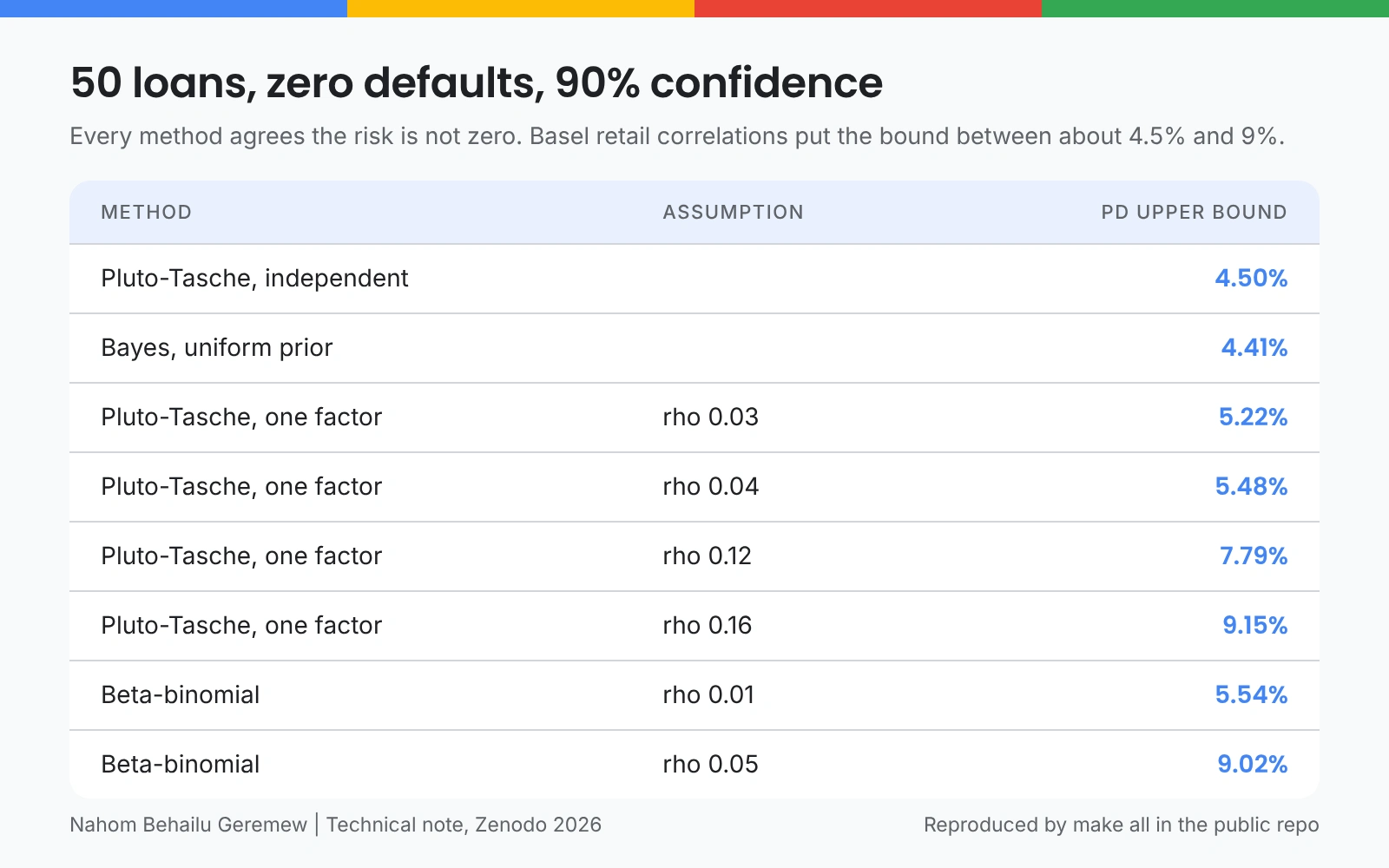
Bounds for a 50-loan book with zero defaults, by method
Key findings
For a 50-loan book with zero defaults, the 90% upper bound on probability of default sits between about 4.5% and 9%.
The correlation assumption moves that bound more than the scorecard does, so it deserves the most scrutiny.
Engineering
One command rebuilds every number in the note.
17 automated tests with continuous integration on GitHub.
MIT licence, so any lender can reuse the code.
Links
Technical note, DOI 10.5281/zenodo.23864351. Code at github.com/Nahombehailu22/sacco-credit-bounds.
0 likes · 0 views · Nov 12, 2026
Published technical note with open, tested Python code on probability-of-default bounds for small books with zero defaults.


