Ensuring Accuracy in AI-Generated Health Content

Dr Abbas Okanga


The Quiet Danger in AI-Generated Health Content (And What Actually Fixes It)
4 min read
·
3 hours ago
--
Share
By Dr. Abbas Okanga, MD
Press enter or click to view image in full size
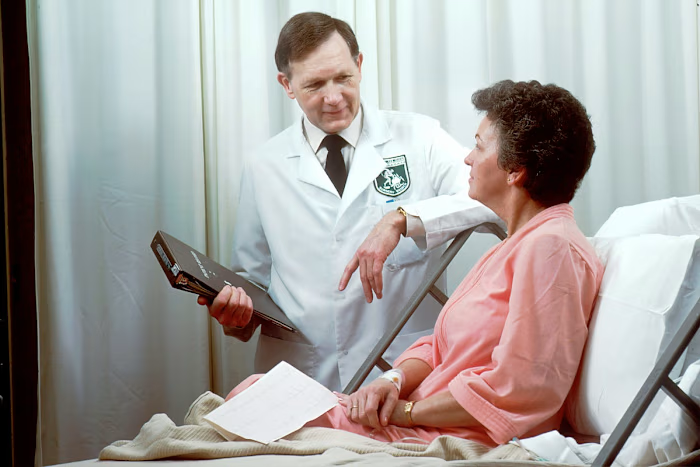
Photo by National Cancer Institute on Unsplash
A few months ago, I read a blog post from a well-funded health-tech startup explaining how their app helped users “recognize the early signs of sepsis.” The post was well-written. Clean structure, confident tone, good SEO instincts. It was also wrong in a way that mattered — it described a symptom pattern that could just as easily point to a dozen far less urgent conditions, framed with a certainty that real clinical presentation almost never has.
Nobody caught it before it went live. Nobody on that team had the training to catch it.
This is happening constantly, and mostly quietly, across the health-tech and ed-tech industry right now.
The content boom nobody clinically reviewed
AI tools have made it trivially easy to produce health content at scale. A founder can generate a full content calendar — symptom explainers, condition overviews, patient education pages — in an afternoon. The writing reads fluently. The structure looks professional. And that’s exactly the problem: fluency isn’t accuracy, and most people, including most editors, can’t tell the difference until something goes wrong.
I’ve seen this pattern from both sides. As a clinician, I’ve watched patients arrive with confident misconceptions traceable to something they read online. As a writer working adjacent to health-tech, I’ve watched marketing teams publish content that sounds authoritative because the sentence structure mimics a textbook, without anyone checking whether the actual medicine holds up.
The gap isn’t laziness. It’s that “does this read well” and “is this clinically correct” are two different skill sets, and most content pipelines only have people checking for the first one.
Where it actually breaks
Three places, consistently:
Overconfident causality. Health content written to be scannable and SEO-friendly tends to flatten nuance. “X causes Y” reads better than “X is associated with Y in some patients, though the mechanism isn’t fully established” — but the second one is usually what’s true. AI-generated drafts default to the confident version because it’s more common in training data and more satisfying to read.
Outdated or conflated guidelines. Clinical guidelines shift — sometimes yearly, sometimes because of a single major trial. Generic AI writing tools don’t know which version is current, and neither do most non-clinical editors reviewing the output. I’ve seen otherwise well-produced content quietly repeating a dosing guideline or screening recommendation that was revised two years ago.
Symptom lists without context. This is the sepsis example above, and it’s the most common failure mode I see. Listing “signs to watch for” without conveying how those signs actually present, cluster, or evolve in a real patient gives readers a false sense of pattern-matching ability. It’s technically accurate information assembled in a way that’s clinically misleading.
None of these are dramatic errors. That’s what makes them dangerous — they don’t look wrong. They read exactly like the rest of the article.
What actually fixes it (and what doesn’t)
The obvious answer — “have someone check it” — is right, but vague enough to be useless in practice. What actually works is narrower:
Clinical review has to happen at the claim level, not the article level. A quick skim for “does this seem medically reasonable” catches almost nothing. Someone has to go sentence by sentence through the specific medical claims and check them against current evidence, the way you’d fact-check a statistic.
The reviewer has to understand both the medicine and the medium. A physician with no writing or content background will flag accuracy issues but often can’t tell you how to fix the sentence without breaking the flow of the piece. A writer with no clinical background can’t tell there’s a problem at all. The useful reviewer sits at the intersection — which, practically speaking, is a small pool of people.
It has to happen before publication, not after. Retroactive corrections rarely reach everyone who read the original version, and by then the content has usually already been indexed, shared, and cited elsewhere.
Why this matters more now, not less
AI writing tools are getting better at sounding right, which is precisely why clinical review is becoming more necessary, not less. The old failure mode was content that was obviously thin — short, generic, easy to spot as low-effort. The new failure mode is content that’s well-structured, well-cited-sounding, and confidently wrong in ways that only someone with actual clinical training would notice.
Health-tech and ed-tech companies are, correctly, moving fast on content production. The teams that will hold up under scrutiny — from regulators, from competitors, from users who eventually notice something’s off — are the ones treating clinical accuracy as a production step, not an afterthought.
That’s a narrow, specific problem. It also happens to be one I’ve spent a career either solving or watching go unsolved, from both sides of the exam table and the editing desk.
Dr. Abbas Okanga is a licensed MD who writes clinically accurate content for health-tech and ed-tech companies. He’s available for freelance and contract work — portfolio.
Like this project
Posted Jul 9, 2026
Dr. Abbas Okanga highlights the need for clinical review in AI-generated health content to ensure accuracy.
Likes
0
Views
4