Lockton Ergonomics Pocket Guide

Pamela Markarian


ERGONOMICS Pocket GUIDE
Created at Lockton as an internal ergonomics pocket guide designed to stay within arm’s reach. Built for fast, in-the-moment reference, it uses color-coded wayfinding and scan-first templates to translate posture observations into immediate corrective actions. Later shared as a client-facing resource and reprinted multiple times before a corporate-wide rebrand.
case study 04 / 04
design CHALLENGE
Ergonomics specialists needed a pocket-ready reference for live evaluations. Guidance was scattered across materials, making it slow to find and inconsistent to apply. The solution required a single-field tool that enabled fast lookups and standardized corrective recommendations across evaluators.
The guide needed to work as a pocket reference used on the spot, not read end-to-end.
Specialists needed answers in seconds during live evaluations.
Standardize risk identification and corrective guidance across evaluators.
Maintain clarity across dozens of pages and repeated modules.
PAGE SYSTEM + WAYFINDING
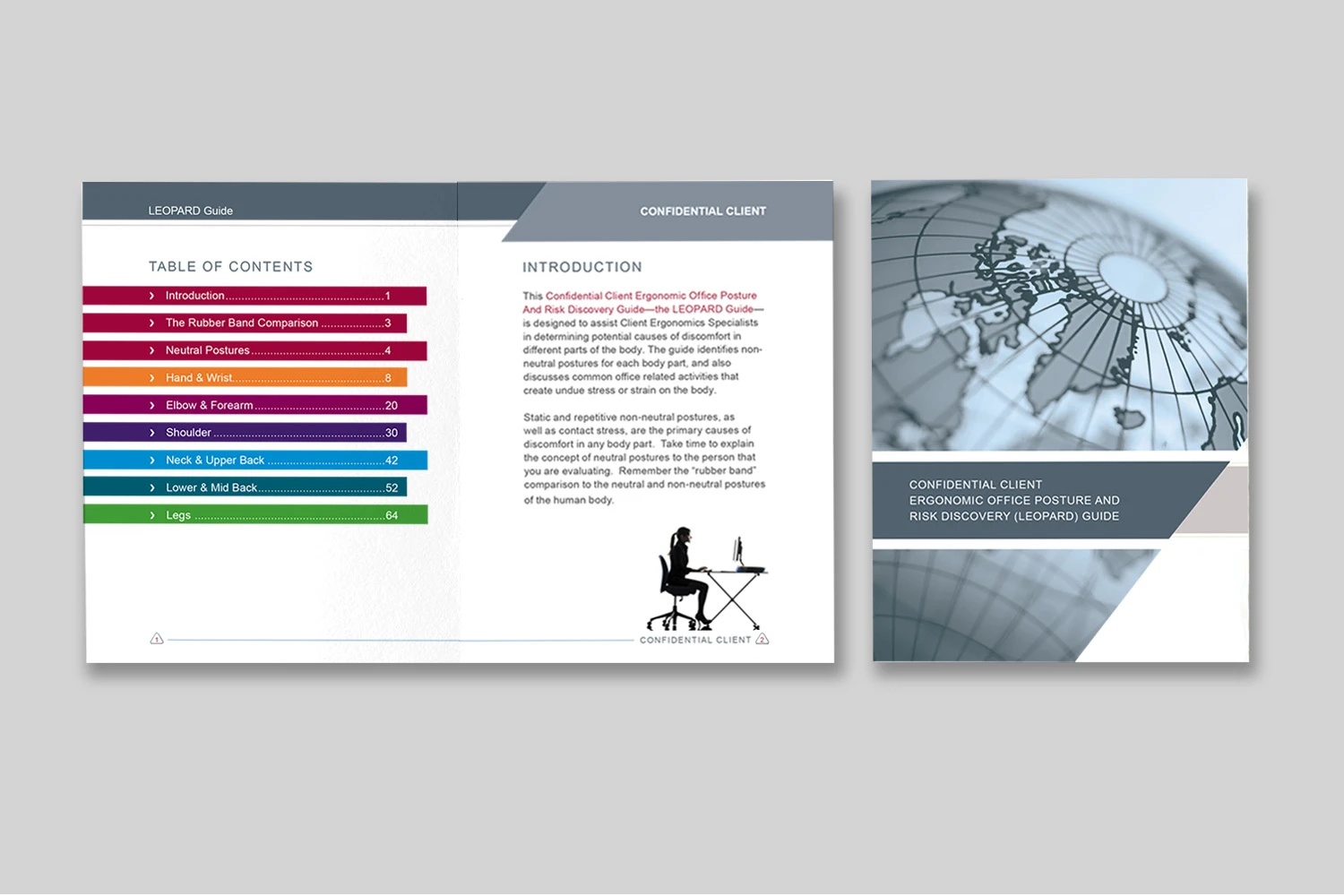
A pocket-friendly structure organized by body region, using color-coded navigation and repeatable templates that move from risk → causes → immediate adjustments → equipment → reminders.
Ergonomics Pocket (Leopard) Guide — Cover
Professional reference tool cover with confidential client branding applied.
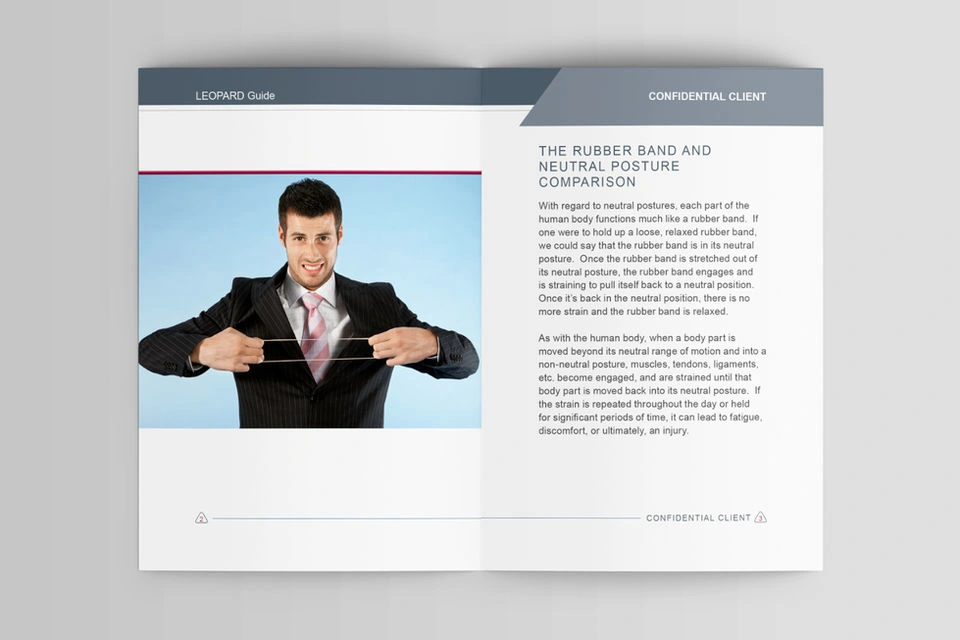
Leopard Guide — Rubber Band & Neural Position Analogy
Visual analogy that makes the concept of neutral posture immediately understandable.
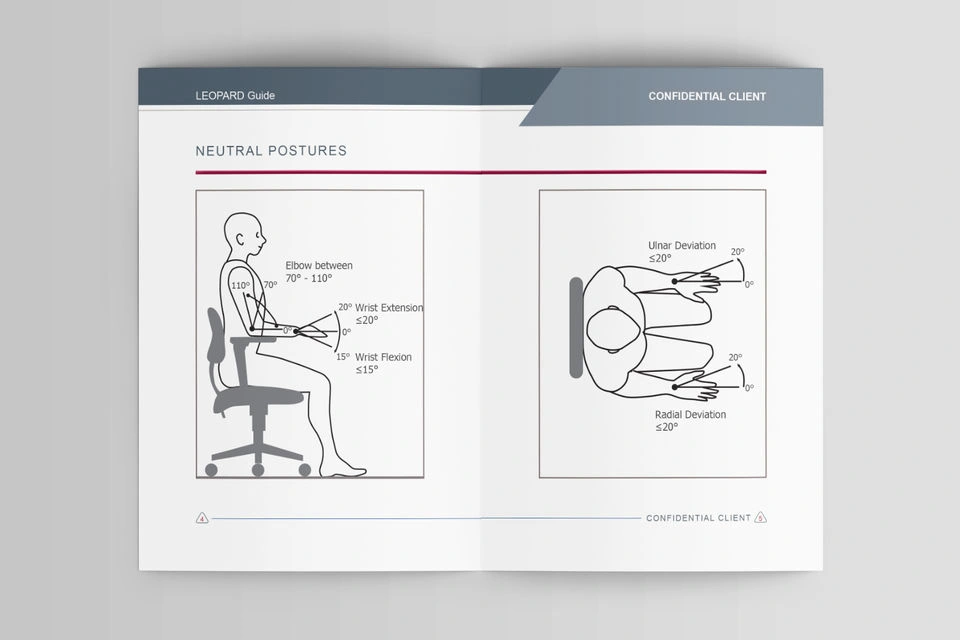
Leopard Guide — Neutral Postures: Baseline Reference
Baseline reference page with annotated seated posture measurements.
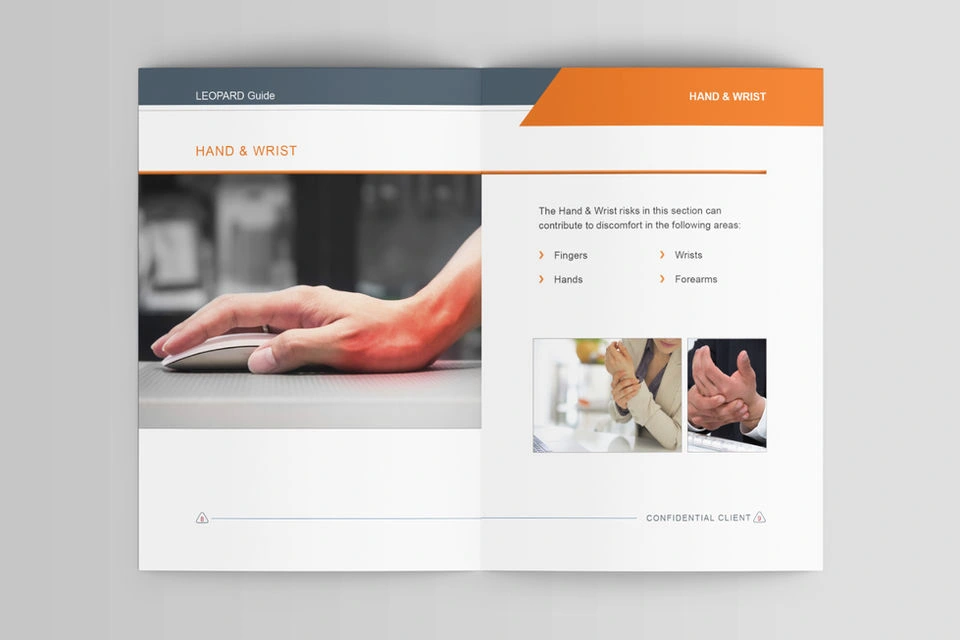
Leopard Guide — Hand & Wrist: Section Opener
Color-coded section opener for fast body-region navigation.
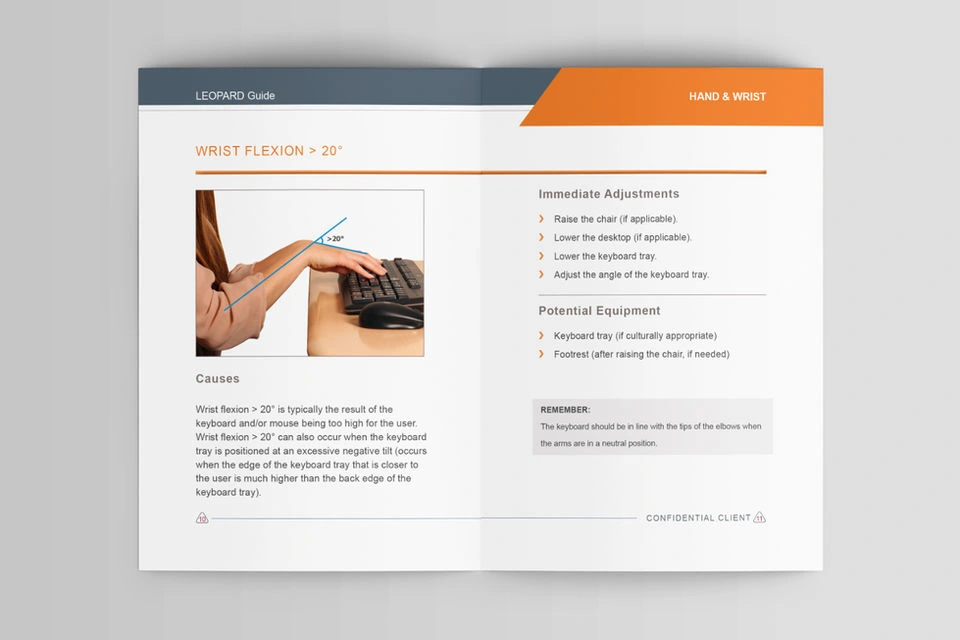
Leopard Guide — Hand & Wrist: Wrist Flexion Risk
Repeatable risk page format — threshold, causes, adjustments, and equipment in one scan.
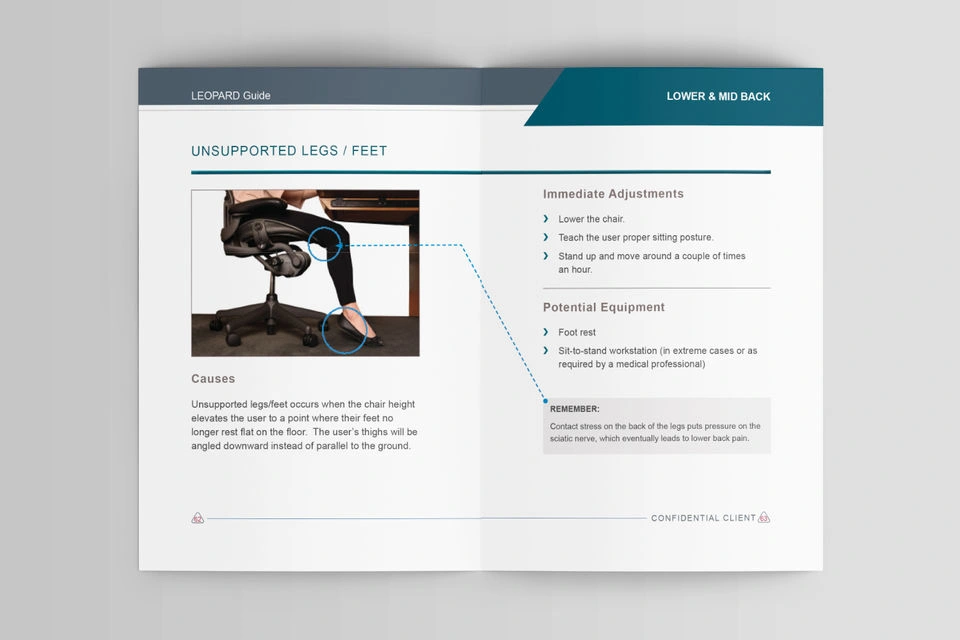
Leopard Guide — Lower & Mid Back: Unsupported Legs/Feet
Same modular template applied across body regions, maintaining consistency throughout.
Structure-First Methodology
Designed around field use: quick lookup, minimal cognitive load, and consistent corrective guidance. I built the navigation, hierarchy, and modular templates first, then refined typography and spacing for fast comprehension in real-world conditions.
↓ WHAT I OWNED
01 Information Architecture + Wayfinding
Body-region taxonomy, color system, TOC logic, scan hierarchy.
02 TEMPLATE SYSTEM + PAGE MODULES
Repeatable “risk → causes → immediate adjustments → equipment → reminders” structure.
03 VISUAL COMMUNICATIONS
Annotated imagery and callouts for quick interpretation.
04 PRINT-READY PRODUCTION
Print/PDF-ready layouts and long-document consistency.
WHAT WAS DELIVERED
● Ergonomics pocket guide for print + PDF reference
● Color-coded TOC and section architecture by body region
● Standardized risk pages with thresholds, causes, and callouts
● Quick-action pages with immediate adjustments and equipment guidance
● Modular system designed to scale across additional sections and updates.
IMPACT & OUTCOMES
● Enabled fast, consistent corrective guidance through pocket-ready, scan-first templates.
● Reduced friction during evaluations by making fixes easy to find and apply immediately.
● Shared beyond internal use as a client-facing resource and reprinted multiple times.
● Packaged complex ergonomics guidance into a field-ready reference tool.
CONFIDENTIALITY NOTE
Client-identifying information has been removed or blurred. Pages shown reflect the pocket-guide system, wayfinding framework, and template architecture.
Like this project
Posted May 30, 2026
Designed a compact ergonomics pocket guide for live workplace evaluations, turning ergonomic guidance into a clear reference for comfort and usability.