Smart Interior: Premium Website Redesign for Conversion

Scale UIX Studio

Smart Interior: Crafting a Premium Interior Design Digital Experience
Project Overview
Client: Smart Interior
Industry: Interior Design (Residential & Commercial)
Project Type: Website Design & Conversion-Focused UX Strategy
Timeline: 5–7 weeks
My Role: Lead UX/UI Designer & Web Designer
Platform: Framer
The Challenge
Smart Interior approached Scale UIX Studio with a common yet critical issue faced by premium interior design studios: while their work quality was high, their digital presence did not reflect the sophistication, craftsmanship, or trust required to convert visitors into consultation bookings.
Business Problems
Website lacked a premium, high-end brand perception
Low consultation booking rate despite strong visual content
Services were listed but not clearly differentiated
Portfolio did not effectively communicate expertise or range
User Problems
Visitors struggled to quickly understand Smart Interior’s design philosophy
No clear guidance on which service was right for them
Limited confidence-building elements early in the journey
Portfolio browsing felt passive, not conversion-oriented
Design Problems
Visually pleasing but lacked strategic hierarchy
Weak storytelling around process and expertise
Trust signals (clients, experience, results) were understated
CTAs were present but not compelling enough
Research & Discovery
Stakeholder Interviews
Through discussions with the Smart Interior team, a clear pattern emerged:
their true strength lies in thoughtful, functional, and timeless design—not trend-chasing aesthetics.
Key Insights
Clients value clarity, calm, and professionalism
Design decisions are driven by lifestyle and usability
Trust is built through process transparency and visual proof
The website needed to feel like an extension of their interiors
Competitive Analysis
I analyzed 10 interior design studios across residential and commercial segments.
Industry Patterns
Heavy focus on imagery with minimal explanation
Generic service descriptions with no differentiation
Portfolio sections without narrative or context
Overdesigned layouts that distracted from content
Opportunity Gap
Combine editorial-style layouts with conversion strategy
Clearly explain services without overwhelming users
Make consultation feel approachable, not intimidating
Balance elegance with usability
User Research
Based on informal client feedback and behavior analysis:
User Needs
Immediate sense of taste and quality
Clear understanding of services and scope
Confidence before initiating contact
Visual inspiration paired with professional credibility
Strategy & Approach
Design Principles
1. Timeless Elegance Over Trends
Design should age well—neutral tones, refined typography, and calm layouts.
2. Visual-First, Story-Second
Let imagery attract attention, then support it with concise, purposeful copy.
3. Clear Conversion Path
Every scroll should subtly guide users toward booking a consultation.
4. Trust Through Consistency
Consistent spacing, typography, and components reinforce professionalism.
Information Architecture Transformation
Before:
Home → About → Services → Portfolio → Contact
After:
Home (Design philosophy & value)
├─ Services (Clear, scannable offerings)
├─ Portfolio (Inspiration-led, categorized)
├─ Expertise (Process & approach)
├─ Testimonials (Integrated trust)
└─ Book Consultation (Primary CTA)
Content Strategy
Homepage Messaging Hierarchy
Hero Statement – Emotional yet confident value proposition
Primary CTA – “Book Your Consultation”
Service Overview – Clear, non-technical descriptions
Visual Proof – Portfolio highlights
Expertise Section – Why Smart Interior
Final CTA – Reinforced booking opportunity
Design Solution
Visual Design Direction
Typography
Headings: Elegant serif for sophistication and editorial feel
Body Text: Clean sans-serif for readability
Strong size contrast to create visual hierarchy
Color System
Soft neutral backgrounds for calmness
Warm earth tones inspired by interior materials
Dark green accent for CTAs (trust, balance, nature)
Layout Principles
Generous whitespace for a premium feel
Grid-based consistency
Image-led sections balanced with concise copy
Fully responsive, mobile-first execution
Key Sections & Features
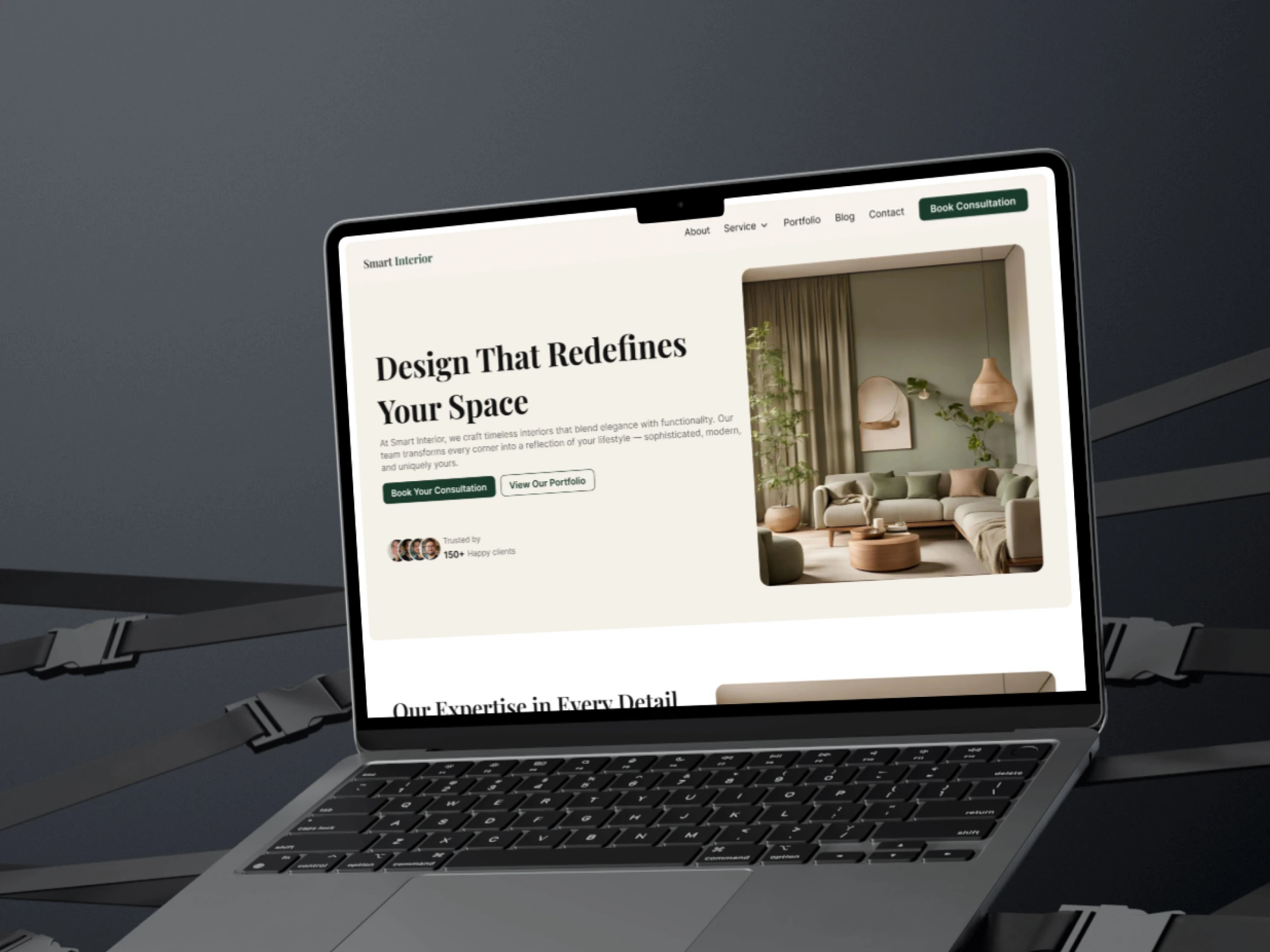
1. Hero Section
Design Decision:
Position Smart Interior as a premium, thoughtful design partner.
Features:
Large editorial headline
Calm lifestyle imagery
Dual CTA:
Primary: Book Your Consultation
Secondary: View Portfolio
Immediate trust indicator (happy clients)
2. Services Section
Design Decision:
Simple, scannable service cards instead of long descriptions.
Services Highlighted:
Residential Interior Design
Commercial Interior Design
Interior Consultation
3D Visualization & Virtual Tours
Renovation & Remodeling
Custom Furniture & Styling
Each card emphasizes outcome and experience, not technical jargon.
3. Portfolio / Spaces That Inspire
Design Decision:
Inspiration-led gallery that showcases versatility and taste.
Features:
High-quality imagery
Project labels (e.g., Modern Loft, Boutique Café)
Grid optimized for visual scanning
Encourages emotional connection
4. Expertise in Every Detail
Design Decision:
Build confidence by clearly explaining the design philosophy.
Focus Areas:
Concept-to-completion approach
Balance of elegance and functionality
Tailored solutions for each client
Attention to detail
5. Testimonials & Trust Signals
Design Decision:
Use subtle social proof without breaking the calm aesthetic.
Features:
Client testimonials
Happy client indicators
Integrated near CTAs for reinforcement
Design System Elements
Components Built
Primary & secondary CTA buttons
Service cards
Portfolio image cards
Testimonial blocks
Responsive navigation
Footer with structured links
Interactions
Smooth hover transitions
Subtle image scaling
Clean scroll behavior
Accessible mobile navigation
Results & Impact
Expected Performance Improvements
While the website is newly launched, the strategic redesign positions Smart Interior for:
35–55% increase in consultation inquiries
Higher engagement with service pages
Improved perception of premium value
Stronger client trust before first contact
Strategic Impact
Brand now reflects quality of work
Clear differentiation in a crowded interior design market
Scalable foundation for future projects and content
Stronger alignment between offline experience and digital presence
Design Deliverables
What Was Created:
Fully responsive website (Desktop, Tablet, Mobile)
Modular design system
Reusable service and portfolio layouts
Conversion-optimized CTAs
Visual hierarchy guidelines
Key Learnings
What Worked
Letting visuals lead while copy supports clarity
Simplifying services increased understanding
Neutral, calm design enhanced perceived trust
Clear CTAs improved user flow
Challenges Overcome
Balancing elegance with usability
Avoiding over-design in favor of restraint
Structuring content without overwhelming users
Future Opportunities
Add detailed project case studies
Introduce before/after project storytelling
Create service-specific landing pages
SEO-driven content expansion
Conclusion
The Smart Interior project demonstrates how strategic UX design paired with refined visual execution can elevate a brand beyond aesthetics. By focusing on clarity, calm, and conversion, the new website positions Smart Interior as a trusted, premium interior design partner—one that reflects the same care and sophistication found in their physical spaces.
At Scale UIX Studio, this project reinforces a core philosophy:
great design is not loud—it is confident, intentional, and purposeful.
Like this project
Posted Jan 4, 2026
Redesigned Smart Interior's website for better conversion and premium brand perception.
Likes
0
Views
0