Custify Blog SEO & AI Visibility Teardown

Manal Ghamir

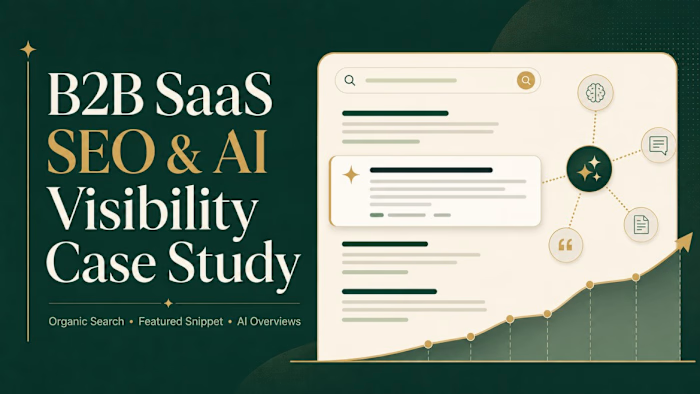
This self-led AI visibility teardown reviews Custify’s customer success metrics blog page and looks at how the content supports SEO, AEO, GEO, AI answer extraction, buyer clarity, entity structure, and SaaS content strategy.
The goal is not to judge the page as good or bad. The goal is to show how a strong SaaS article could become easier for Google, ChatGPT, Perplexity, and Gemini to understand, summarize, and connect to buyer intent.
Project details
ItemDetailContent typeAI visibility teardownPage reviewedCustify customer success metrics blog pageFocusSEO, AEO, GEO, AI visibility, buyer clarity, entity structure, SaaS content strategySectionStrategy & AuditsMain opportunityImproving extractability, answer structure, and buyer-stage clarityStatusSelf-led public teardown
Note:
This is a self-led public teardown based on a publicly available SaaS page and AI/search testing. Custify is not a client, and this analysis is intended to show strategic content thinking in a constructive way.
Strategy Note
I reviewed Custify’s customer success metrics article to understand how well it supports search visibility, AI answer extraction, and buyer clarity.
The goal was not to judge the content as good or bad. The goal was to identify where a strong SaaS article could become easier for Google, ChatGPT, Perplexity, and Gemini to understand, summarize, and connect to buyer intent.
The main opportunity was not content quality. It was extractability: making the page easier for AI tools and buyers to pull clear answers, compare options, and understand Custify’s relevance in the customer success software category.
Teardown
For this teardown, I looked at Custify’s blog page on customer success metrics and compared it against the types of answers buyers are getting from AI and search tools for SaaS customer success queries.
I focused on:
Search intent match
Buyer-stage clarity
Answer-first structure
Heading structure
Entity clarity
FAQ opportunities
Internal linking opportunities
Comparison and decision-support gaps
AI visibility weaknesses
Custify’s article is already useful. It covers many important customer success metrics, including churn, retention, NRR, GRR, MRR, ARR, product adoption, CLV, NPS, CSAT, CES, CAC, CRC, time to value, engagement score, sentiment score, upsell rate, and customer growth rate.
That gives the page strong topical coverage.
The issue is not relevance. The issue is how clearly the page helps AI tools and buyers understand which metrics matter most, when they matter, and how they connect to Custify’s product category.
That gives the page strong topical coverage.
What Showed Up in AI and Search Results
In the tested AI and search results, Custify appeared more clearly when the query directly included the brand, such as “Custify vs Gainsight vs ChurnZero.”
But for broader category questions like “What customer success metrics should B2B SaaS teams track?” or “How do you create a customer health score for SaaS?”, competitors and alternatives appeared more often.
Repeated names included Gainsight, ChurnZero, Vitally, Planhat, Totango, HubSpot Service Hub, Salesforce Service Cloud, Pylon, ClientSuccess, Catalyst, and CustomerSuccessBox.
That suggests a visibility gap.
Custify has relevant content, but AI tools may not be strongly associating the brand with the broader category questions buyers ask before they compare vendors.
The page matches the broad search intent for customer success metrics. It explains what the metrics mean and how to calculate them.
But it could better answer the more specific buyer question:
“Which customer success metrics should a B2B SaaS team track first?”
The article also has strong entity coverage, but the entities are mostly presented as a long list of metrics.
For AI visibility, the page would be stronger if those concepts were grouped by purpose.
GroupExample metricsRetention metricsChurn rate, retention rate, renewal rateRevenue metricsNRR, GRR, MRR, ARR, expansion revenueProduct adoption metricsProduct usage, feature adoption, time to valueSatisfaction metricsNPS, CSAT, CES, sentiment scoreSupport metricsSupport tickets, time to resolution, customer effortExpansion metricsUpsell rate, customer growth rate, CLV
This structure would make the content easier for AI tools to extract and easier for SaaS buyers to use.
1. Add an Answer-First Block Near the Top
I would add a short direct answer before the deeper breakdown.
Example:
For most B2B SaaS teams, the most important customer success metrics are churn rate, retention rate, NRR, GRR, MRR, product adoption, time to value, customer health score, NPS, CSAT, and expansion revenue.
This gives buyers and AI tools the main answer immediately.
2. Add a Metrics-by-Goal Decision Table
The page would be stronger with a table that helps readers prioritize metrics based on business goals.
GoalMetrics to prioritizeReduce churnChurn rate, customer health score, product adoption, time to valueImprove retentionGRR, NRR, renewal rate, CSATGrow accountsExpansion revenue, upsell rate, CLVImprove onboardingActivation rate, time to value, onboarding completionImprove supportTTR, CSAT, CES
This turns the article from a list of definitions into a decision-support asset.
3. Strengthen the Bridge Between Education and Product Category
The article could also connect key metric sections more clearly to Custify’s product category.
Content conceptProduct-category bridgeCustomer health scoreCustomer health trackingDashboardsCustomer success reportingCalculated metricsAutomated customer success measurementUpsell rateExpansion and growth workflowsAutomation triggersCustomer success playbooks
This would help buyers understand not just what the metrics mean, but how customer success software helps track and act on them.
AI visibility is not only about publishing detailed content.
It is about making a page easy to understand, quote, compare, and recommend.
Custify’s metrics guide has strong raw material. With clearer answer-first formatting, stronger buyer-stage guidance, better entity grouping, and more product-category bridges, it could become a stronger source for both search engines and AI-generated answers.
For SaaS brands, this matters because buyers are no longer only searching through Google results. They are asking AI tools direct questions, comparing vendors faster, and expecting clear answers before they visit a website.
Strong SaaS content now has to do more than rank. It needs to explain, structure, and position the brand clearly enough to show up in AI-assisted discovery.
FAQ
An AI visibility teardown reviews how well a SaaS page can be understood, summarized, and surfaced by tools like Google AI Overviews, ChatGPT, Perplexity, and Gemini. It looks at answer structure, entity clarity, buyer intent, internal links, and content extractability.
AI visibility matters because SaaS buyers now use AI tools to research problems, compare vendors, and shortlist software. If a page is hard to extract, unclear, or weakly connected to buyer questions, AI tools may overlook it even when the content is useful.
SaaS content becomes easier for AI tools to understand when it uses direct answers, clear headings, grouped entities, comparison tables, FAQs, product-category language, and internal links. These elements help AI systems connect the page to buyer questions and relevant SaaS topics.
Content extractability means how easily search engines, AI tools, and readers can pull a clear answer or useful section from a page. Strong extractability comes from short answer blocks, structured sections, tables, definitions, and clear topic relationships.
SaaS brands can improve AI search visibility by answering buyer questions early, grouping related concepts clearly, adding decision-support tables, strengthening product-category connections, and keeping content useful for human readers. AI visibility cannot be guaranteed, but clearer structure improves the page’s chances of being understood.
Like this project
Posted Jul 20, 2026
Analyzed a public Custify article to identify gaps in search intent, answer structure, product clarity, SEO, and AI discoverability.
Likes
0
Views
1
Timeline
May 11, 2026 - Ongoing