Wavelengths — Senior Design Project

Taylor Fournier


Wavelengths was my senior design project at the University of Connecticut. It was completely self-directed and lasted an entire semester, and was probably the most involved project I've ever completed (and one of my favorites in terms of subject matter).
Throughout my career, I've been continually interested in design systems, and how specific rules are applied to inputs to produce a desired output. I was (and still am) really drawn to studying sound & music and how it could be represented by visual design. Combining these two interests of mine, I was driven to capture the organic nature of sound & music and see how those sound vibrations could be translated into visual displays.This led me to discover & explore cymatics, which is the study of sound wave phenomena & their visual representations.
For my project, I created a crude "machine" (if you can call it that) out of a solo cup, balloon, mirror piece, speaker, & laser. When the speaker played music, the vibrations would move the laser, creating visual projections on the wall.
This allowed me to produce organic visuals from the vibrations of the sound with no human interpretation.
The only issue was that even though I had all this rich, visual data, I had no idea how to create a design project from it. No matter what I did, nothing felt truly complete. I ended up using my homemade cymatics machine to record & project different people's voices on the wall saying the same prompts, showcasing the difference in visual displays from person to person, regardless of them saying the exact same things.
See examples below of different people saying the same letters of the alphabet:
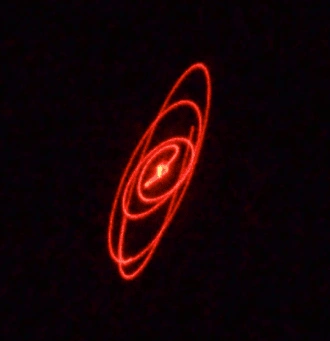
A visual representation of my mom saying the letter "A."
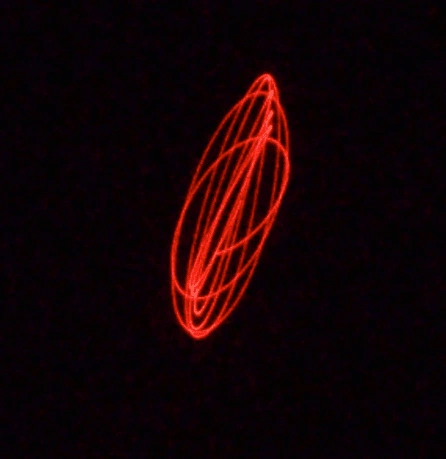
A visual representation of my father saying the letter "A."
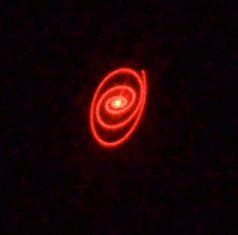
A visual representation of my sister saying the letter "A."
I used my findings to create a unique visual alphabet for each person's voice. I recorded videos of each person speaking, and used the audio to record video of these projections in a dark room. Once I had both, I juxtaposed them into a video in order to match each person with their alphabet.
See below examples of "letters" in one visual alphabet:
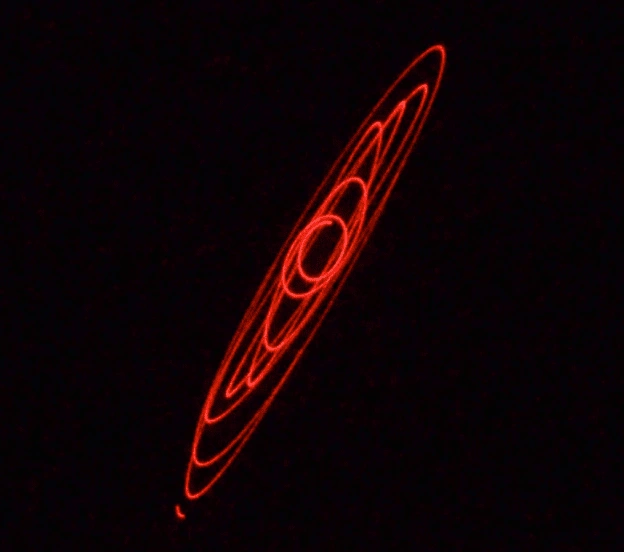
A visual representation of my father saying the word "P."
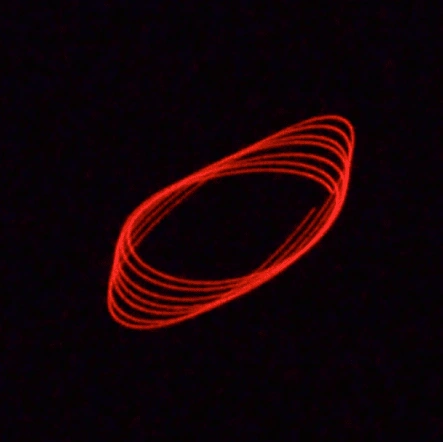
A visual representation of my father saying the word "M."
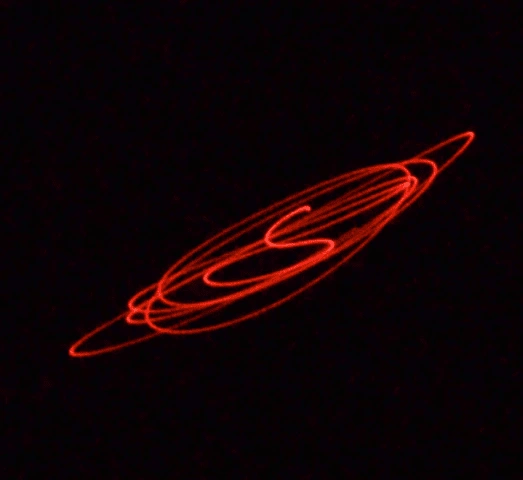
A visual representation of my father saying the word "J."
My dream for this project would have been to present my cymatics machine at our gallery exhibition, making it interactive & encouraging people to speak into a mic & view their own visual alphabet, in real time.
Unfortunately, we couldn't get the necessary audio // video equipment setup, so I had to settle for a presentation of the work I had already done.
At the culmination of the project, I found myself with more inspiration (and questions) than I started with. It felt a little like I had opened Pandora's Box.
How fascinating is it, that each of our voices is as unique as our fingerprints? What other applications could their be for this study? The project also makes a greater commentary on humanity, perspectives, & language—we may say the same things, but our vibrations are all different & unique in their own way.
As a result, my project was left a bit open-ended. Maybe when the time is right, I'll be able to revisit it & explore this field more.
Like this project
Posted Jan 16, 2022
Using the study of cymatics, I created visual manifestations of music & sound in order to create a visual alphabet for my senior design project.
Likes
2
Views
54
Timeline
Jan 22, 2018 - Apr 30, 2018