Eicher Anthem: Building a Six-World AI Cinematic Universe

Mahesh Bheemaraj


Eicher Anthem: Building a Six-World AI Cinematic Universe
Role: AI Filmmaker & Creative Director
Tools: Higgsfield, Seedance, Kling, Suno, DaVinci Resolve
Category: Corporate anthem film / AI-driven cinematic production
The Brief
Eicher Tractors needed a 3.5-minute Hollywood-scale anthem film for a company-wide Sales & Marketing meet — built around their "1% better every day" philosophy and featuring over 90 named leaders and team members across the organization, from the President down to regional field teams. The brief was explicit: more dramatic and energetic than the previous year's film, with zero repeats of its signature set-pieces, and every one of those 90+ people needed a moment that felt earned, not just a name checked off a list.
The real problem underneath the brief: how do you keep a cast that size visually coherent, individually distinct, and dramatically escalating across a single continuous story — using AI generation tools that, by default, forget who anyone is the moment you turn the camera or change the shot.
The Concept
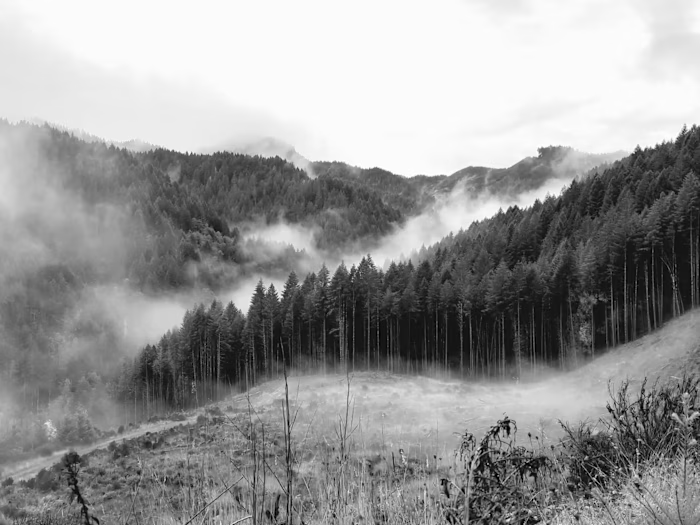
Rather than a montage of disconnected hero shots, I built the film around a single idea: every region of the company is its own world. Each of the five sales zones became a distinct planet — its own terrain, light, and architecture, styled in a restrained, monumental sci-fi register (closer to Dune than to neon-cyberpunk) rather than generic corporate futurism. A desert world of engineered canyon settlements, a river-delta world of glowing temple-towers, a highland world of terraced valleys and glass spires, a hill-country world wrapped in mist and jungle canopy, a grain world of monumental silo towers under an endless golden horizon — each grounded in the real geography and produce of that sales region, so the "advanced civilization" always traces back to something Eicher actually makes.
The story arc follows naturally: each world's team rallies alone, a shared signal calls them to converge, and the film builds to a united front breaking through together — with an abstract advancing darkness standing in for complacency and "yesterday," never a literal enemy. It's a structure that turns 90+ individual credits into one story about daily improvement compounding across an entire organization, rather than 90 separate hero moments stitched together.
The Production System
At this scale, the actual craft isn't prompting — it's engineering consistency. Over the course of the project I built and refined a full identity-and-continuity pipeline to keep every character, costume, vehicle, and location stable across hundreds of separately generated shots:
Locked reference plates over prose. Every recurring asset — the command tower, the aircraft fleet, five zone-specific vehicle fleets, uniform tiers for each rank — was generated once as a multi-panel reference sheet and then reused as an image reference, never redescribed in words. Text-only descriptions reliably drift toward familiar real-world designs; a locked visual reference doesn't.
Character cards for multi-person scenes. Combining five leaders' faces and costumes in a single generation caused identity bleed — faces swapping, duplicating, or vanishing. The fix was building a single resolved "face + costume" card per person first, so a group shot only has to place five already-correct people into a scene instead of assembling ten identity decisions live.
A storyboard → still → video pipeline. Every shot starts as a low-fidelity storyboard for blocking and pacing, gets locked as a finished hero-quality still once approved, and only then goes to image-to-video generation — so identity and environment fidelity are locked before motion is ever introduced.
A living project rulebook. Dozens of specific failure patterns — real-world vehicle silhouettes creeping in, repeated gestures across unrelated shots, costume trim bleeding between rank tiers, camera moves that accidentally hide the thing they're meant to reveal — were diagnosed, fixed, and written down as standing rules, so each new shot started from what the last one had already learned rather than repeating the same mistake.
The Score
The anthem itself — music and vocals — was composed with Suno, written around the "1% better every day" lyric structure the entire visual story is built to follow line by line. Scoring it this way kept the film's music as bespoke as everything else in it: no stock track retrofitted to the edit, but a piece written to hit the same verse-by-verse cascade and chorus returns the visuals were designed around from the start.
The Outcome
The film premiered live at Eicher's annual sales conference, opening to whistles and applause from the floor — the reaction that matters most for a film built to rally an entire sales organization behind one idea. Beyond the room, it stands as proof that AI filmmaking can hold up under genuine production scale and discipline: a single coherent visual universe spanning six distinct worlds, a hierarchy of costume and character design that reads at a glance, and a production process that carried 90+ named individuals through one continuous cinematic story rather than a string of disconnected hero shots.
Like this project
Posted Sep 9, 2026
Premiered live at Eicher's annual sales conference to whistles and applause — an AI-built anthem film that rallied the sales force around one shared mission.