


Discover more from Politically Pastoral
Where Faith Confronts Power—Progressive, Prophetic, Politically Pastoral.
Subscribe
Thirty Years with This Shunt
What My Body Knows About Grace and Justice

Sep 19, 2026
1
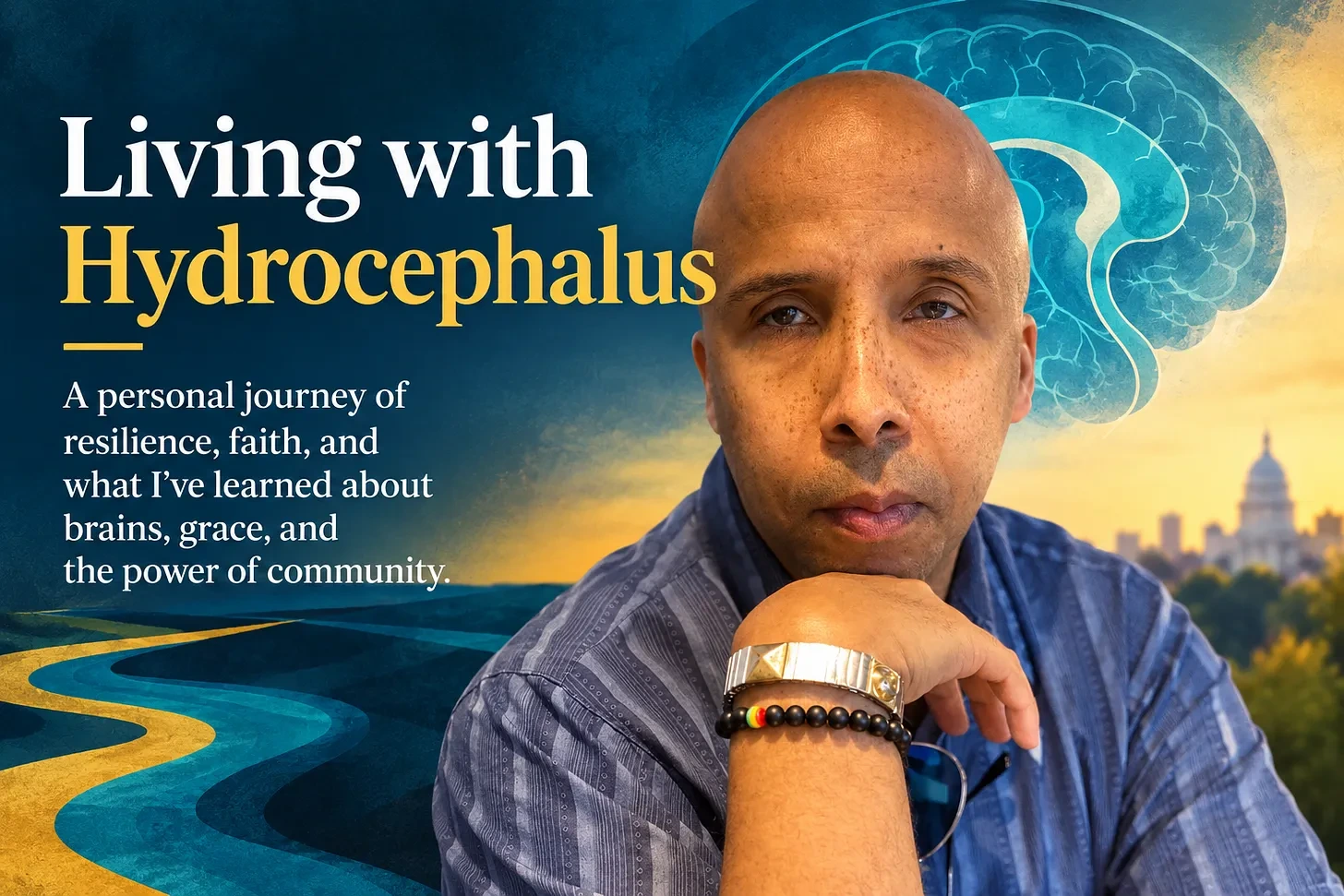
A surgeon opened me up 30 years ago, rerouting a piece of tubing from my abdomen to a chamber of my heart, and closed me back up. I went into that operating room with a shunt draining into my belly (ventriculoperitoneal shunt).
The August 1996 surgery was the fourth procedure in my life. I fully acknowledge how lucky I’ve been. Other people living with hydrocephalus have had surgeries in the double digits. Not many people can celebrate a 30-year-old shunt.
I left with one draining into my heart (ventriculoatrial shunt) — the same shunt, as far as anyone can tell, still doing its quiet, faithful work in my body right now.
Today, I’m marking that anniversary. And because I believe testimony is a spiritual discipline, I’m marking it out loud.
For those new here: in 1978, as a toddler, I was diagnosed with hydrocephalus. In plain English, that means the cerebrospinal fluid meant to cushion and nourish my brain was building up faster than my body could drain it, putting dangerous pressure on brain tissue that hadn’t finished developing.
National Institute of Neurological Disorders and Stroke describes it more clinically, but for 18-month-old me it meant something concrete: left untreated, I was looking at developmental delays, trouble walking, relentless headaches, and cognitive struggles that could have followed me my whole life.
The fix, then and now, is a shunt — a thin tube a surgeon threads in to drain that excess fluid somewhere the body can safely absorb it. It remains the standard treatment, and more than a million Americans are currently living with some version of my story.
My shunt originally drained into my abdominal cavity — a ventriculoperitoneal, or VP, shunt, still the most commonly placed configuration. My surgeon rerouted that drainage into the right atrium of my heart instead — a ventriculoatrial, or VA, shunt, the option doctors reach for when the abdomen isn’t a reliable site anymore.
Same job. Different plumbing.
I want to sit with that phrase for a second, because it’s basically a psalm. My body has adapted, more than once, to keep doing the essential work of protecting my brain — and it has done that against real odds.
Shunt hardware has one of the highest failure rates of any implanted medical device, and pediatric shunts fail at roughly 40 percent in their first year alone , with ongoing risk every year after.
Mine has held. Not perfectly, and not without one deliberate, carefully executed redesign — but it has held for three decades.
That’s not luck, and it’s not just good surgery, though I’m endlessly grateful for the surgeons and nurses who have kept me breathing since before I could talk. That’s grace — the kind that shows up not in a burning bush but in polymer tubing and a cardiologist’s steady hands.
Politically Pastoral is a reader-supported publication. To receive new posts and support my work, consider becoming a free or paid subscriber.
Subscribe
My great-grandmother fought for me when I was too young to fight for myself. A team of doctors solved a problem inside my skull most people never have to think about.
Thirty years later, I’m still here — still preaching, still writing, still organizing — carrying a piece of medical hardware that has outlasted most of my relationships, several jobs, and every apartment I’ve ever lived in.
I don’t tell you this for sympathy. I tell you because disability and chronic illness are still treated, especially in ministry and public life, like secrets to be managed rather than truths to be integrated.
We build pulpits with steps and no ramps, literal and otherwise. We praise leaders for “pushing through” instead of asking what they’re pushing through, or why they ever felt they had to hide it.
The late theologian Nancy Eiesland named this rot decades ago in her work on what she called the disabled God — insisting that the risen Christ still carried his wounds , that survival and disability aren’t obstacles to the sacred but evidence of it.
Scholars working in disability theology today, like Erin Raffety, push further still: the real obstacle isn’t a lack of ramps or accessible worship — it’s an ableist theology baked into how we define ministry and leadership in the first place , one that treats disabled people as a ministry project instead of ministers in their own right.
I am a Black, gay, disabled priest who has spent thirty years with a tube running from my brain to my heart, doing work no one sees. That is not a caveat to my ministry. That is my ministry, or at least one long, patient chapter of it.
My body has been telling the truth about interdependence, mortality, and the limits of self-sufficiency since before I had language for any of it. Every institution I serve — church, nonprofit, newsroom — could stand to learn what my shunt has known all along: the systems that keep us alive are rarely glamorous, and they deserve maintenance, not shame.
September is Hydrocephalus Awareness Month , so if this piece put a name to something you or someone you love has been carrying quietly, the Hydrocephalus Association is a genuinely good place to start — for information, for community, for the reminder that you are not the only one walking around with a small miracle in your skull.
If you want the longer version of this story, I’ve given it room to breathe in my book, Against the Current .
Thirty years on this shunt. Grateful for the surgeons, the nurses, the family who advocated for me before I could advocate for myself, and the God who has held it all together, valve by valve, atrium by atrium. Here’s to the next thirty.
In solidarity, in faith, and in the struggle,Rev. Dr. Jason Carson Wilson
#DisabilityJustice #ChronicIllness #Hydrocephalus #PoliticallyPastoral
My lived experience inspired me to write a book meant to help people living with hydrocephalus and those who love them navigate an interesting journey. Get
Politically Pastoral is a reader-supported publication. To receive new posts and support my work, consider becoming a free or paid subscriber.
Subscribe
1
Share
Discussion about this post
CommentsRestacks

Oct 24, 2025 • Rev. Dr. Jason Carson Wilson
2

Feb 3 • Rev. Dr. Jason Carson Wilson
4
1

Sep 28 • Rev. Dr. Jason Carson Wilson
3
2

See all
Ready for more?
Subscribe
0 likes · 0 views · Nov 11, 2026
A blog about living with hydrocephalus
