The Amana Score

Timileyin Abioye

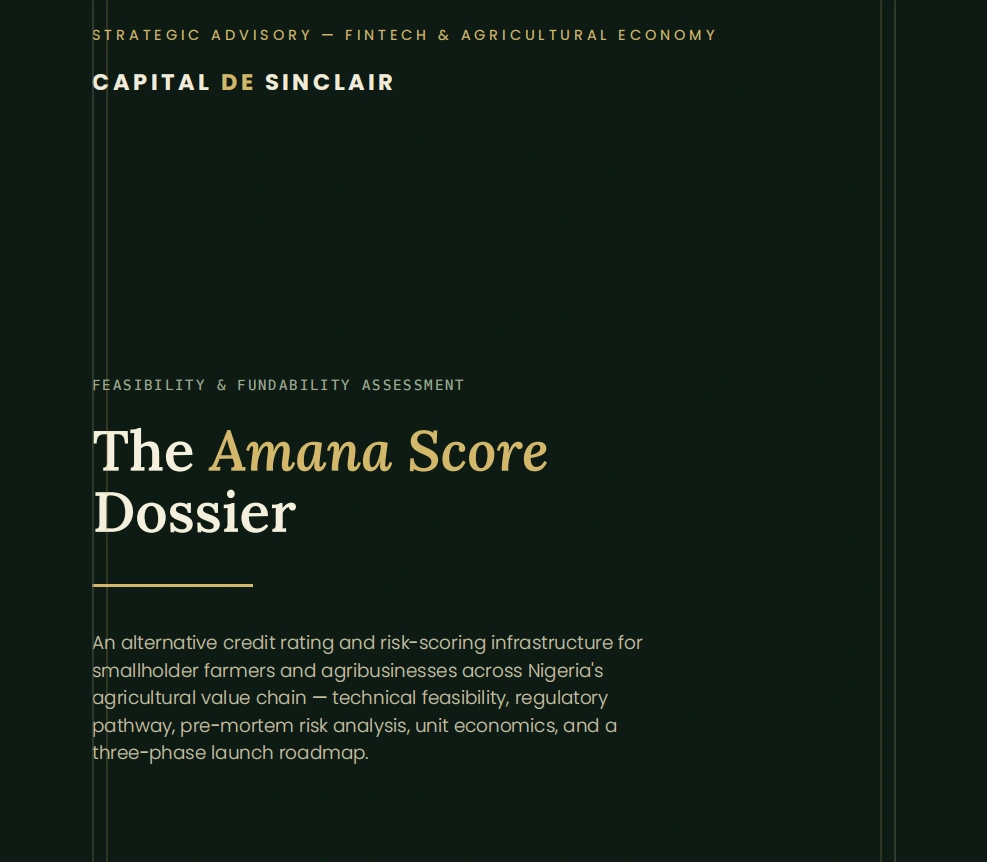
Advisory brief · Fintech · Agricultural economy
The Amana Score
An alternative credit rating and risk-scoring framework developed by Capital de Sinclair to evaluate smallholder creditworthiness.
Executive summary
The verdict
Bottom line
The business is fundable as a B2B alternative-scoring risk-SaaS provider, selling decision support to licensed microfinance banks, commercial agric desks, and DFIs. A full CBN Credit Bureau license under the Credit Reporting Act 2017 is a capital-heavy regulatory delay that isn't necessary for this scope.
Nigeria's agricultural sector employs roughly a third of the working population and contributes close to a quarter of GDP, yet receives less than 4% of formal bank credit. The shortfall is a legibility problem: most of Nigeria's 40 million smallholder farmers have no BVN-linked credit file, no formal land title to pledge, and no digitized transaction history.
Amana Score addresses this by building a composite risk score from satellite agronomy, local weather records, mobile money behavior, cooperative repayment ledgers, and off-taker delivery data. The framework delivers credit scores as infrastructure to institutions that already hold the balance-sheet risk, rather than competing as a new lender.
Alternative data architecture
Geospatial & remote sensing
Source feedSentinel-2 / Landsat NDVI & NDMI time series
Proxy metricsActual farm size vs. declared, crop health, flood/drought exposure.
Climate & agromet
Source feedNiMet station records, gridded rainfall reanalysis (CHIRPS)
Proxy metricsRain-fed yield probability, dry-spell frequency, exposure to climate shocks.
Soil & agronomic
Source feedNational soil atlas (IITA/FMARD), suitability maps
Proxy metricsRealistic yield ceilings per crop type, fertilizer-response profiles.
Transactional / mobile money
Source feedConsented wallet inflows/outflows (OPay, Moniepoint, Paga)
Proxy metricsCash-flow rhythm, income stability, airtime purchase regularity.
Off-taker & value-chain
Source feedForward-purchase contracts, AFEX warehouse receipts
Proxy metricsSales-side reliability, prior input-credit repayment record.
Cooperative & identity
Source feedCooperative tenure, group repayment files, BVN/NIN checks
Proxy metricsSocial collateral, group payment discipline, identity certainty.
Go-to-market pathway
Licensing choices
Evaluating the regulatory pathways under the Credit Reporting Act 2017:
Regulatory safeguard
To operate as risk-SaaS without a CBN Bureau license, the licensed lender must make the final underwriting decision, and the product can never be marketed as a formal "credit report."
Pathway A: CBN Credit Bureau
· ₦500 million capital deposit required
· 18–24 months to license
· Compelled to serve all lenders (no data moat)
· Direct competition with 3 incumbents
Pathway B: Agtech risk-SaaS
· Standard company registration
· 6–9 months to market
· Capital goes into product, not deposit lock-ups
· Retains full model IP and pricing freedom
NDPA 2023 compliance & automated decisions
Under the Nigeria Data Protection Act 2023, processing farmer profiles at scale triggers classification as a data controller "of major importance." That requires a dedicated Data Protection Officer, a Data Protection Impact Assessment (DPIA), and a working right-to-object mechanism so farmers can appeal automated score decisions to a human reviewer.
Like this project
Posted Sep 24, 2026
Advisory brief describing The Amana Score: an alternative credit rating and risk-scoring framework for smallholder creditworthiness.
Likes
1
Views
0