Development of AI Receptionist Platform

Sagar M


Product Metadata
Attribute
Details
Product Stage
Concept Validation & Active Development
Product Name
AI Receptionist
Core Value Proposition
AI-Powered Virtual Receptionist for Modern Businesses
Executive Summary
AI Receptionist is an AI-powered digital front desk that answers customer questions, captures and qualifies leads, schedules appointments, and escalates complex cases to human staff—across channels such as website chat, WhatsApp, and email.
The product is designed to reduce missed inquiries, speed up response times, standardize follow-ups, and help businesses convert more leads without adding headcount.
Why I Built This
Many businesses still rely on manual reception processes that create delays, missed opportunities, and inconsistent customer experiences. I wanted to explore how AI could act as a scalable front desk that combines customer support, lead qualification, scheduling, and human handoff into a single workflow.
The Problem & Business Impact
The Problem
Many modern service businesses (clinics, salons, agencies, home services, professional services, real estate, etc.) rely on phone calls, website forms, and messages for inbound demand. Common pain points include:
Missed calls and inquiries outside business hours
Slow response times to customer questions
Manual lead qualification and note-taking
Repetitive customer support tasks
Inconsistent follow-up workflows
Dependence on human staff for routine interactions
Impact on the Business
Lost revenue from missed/abandoned inquiries
Lower conversion rates from slow follow-up
High operational cost for repetitive interactions
Uneven customer experience across channels
The Solution
AI Receptionist acts as a 24/7 virtual receptionist that can:
Answer customer questions instantly
Capture and qualify leads automatically
Schedule appointments and consultations
Provide business-specific information (services, pricing, policies, FAQs)
Escalate complex requests to human staff
Preserve conversation context and maintain consistent communication
Target Users & Use Cases
Primary Users (Business Side)
Operations managers / owners
Front-desk staff / reception team
Sales teams handling inbound leads
Customer support teams
Primary Customer Scenarios (End-Customer Side)
“How much does X cost?” / “Do you offer Y?”
“Book an appointment for next week”
“What are your working hours / location?”
“I need help choosing a plan/service”
“Talk to a human” (handoff)
Product Goals & Success Criteria
Product Goals
Provide instant, accurate answers aligned with business policies
Increase lead capture rate and reduce drop-off
Reduce front-desk workload and repetitive support burden
Make appointment scheduling frictionless
Create a consistent experience across channels
Success Criteria (Example KPIs)
Response time: seconds (P50/P90)
Lead capture completion rate
Lead qualification rate (high-intent vs low-intent)
Appointment booking conversion rate
Human handoff rate (and reasons)
Customer satisfaction (CSAT) / conversation rating
Admin hours saved per week
Core Features
1) AI-powered conversations
Natural language interaction
Context-aware responses
Personalized customer engagement (based on business rules + prior conversation)
Key design considerations: Tone and brand voice controls, safe, policy-compliant responses (guardrails), and clarifying questions when information is incomplete.
2) Lead qualification
Collects customer requirements
Identifies high-intent prospects
Structures lead information automatically
Typical captured fields: Name, phone/email, preferred contact channel, service requested, urgency, budget (when relevant), preferred time window / availability, notes and constraints.
3) Appointment scheduling
Automated booking workflows
Calendar integration support
Confirmation and reminder handling
Scheduling behaviors: Offer available slots based on rules (business hours, staff availability), handle rescheduling and cancellation, confirm via WhatsApp/email and send reminders.
4) Knowledge base integration
Approach: RAG over a curated knowledge base
Source-of-truth governance: Owners, review cadence
Scope: Company information, service details, pricing details, frequently asked questions, and business-specific policies (refunds, cancellations, SLAs).
5) Human handoff
Handoff triggers: User explicitly asks for a human, sensitive topics or complaints, low confidence or missing data, high-value lead requiring sales specialist.
Typical Workflow
Customer inquiry (web chat / WhatsApp / email)
AI Receptionist responds instantly and gathers context
Lead qualification captures structured information
Appointment scheduling or human handoff
CRM entry (create/update lead + attach transcript)
Follow-up workflow (confirmation, reminders, next steps)
Product Architecture (High Level)
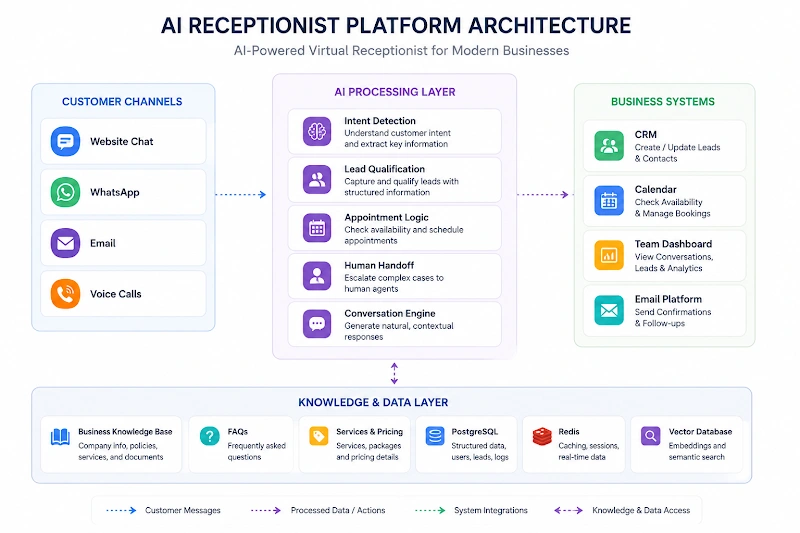
The system architecture is detailed below, structured around customer interaction points, the processing layer, and integration points with core business tools.
Refer to the architecture diagram for the full visual schematic components including:
Customer Channels: Website Chat, WhatsApp, Email, Voice Calls
AI Processing Layer: Intent Detection, Lead Qualification, Appointment Logic, Human Handoff, Conversation Engine
Business Systems: CRM (Create/Update Leads), Calendar (Check Availability), Team Dashboard, Email Platform
Knowledge & Data Layer: Business Knowledge Base, FAQs, Services & Pricing, PostgreSQL, Redis, Vector Database
Layer
Technologies & Systems
Frontend
Next.js, React, TypeScript
Backend
Python, FastAPI
AI Layer
Large Language Models (LLMs), Retrieval-Augmented Generation (RAG), Prompt engineering, Vector search
Data Layer
PostgreSQL, Redis, Secure data storage
Integrations
Website chat, WhatsApp, Email, CRM systems, Calendar systems
Key Technical Design Decisions
Multi-channel conversation normalization: Normalize messages from different channels into a single conversation model (threads, participants, message types). Maintain a unified state machine for qualification/scheduling flows.
Structured outputs + validation: Extract qualification details into a consistent schema (JSON) and validate before writing to CRM. Use deterministic fallbacks when extraction fails (ask follow-up questions).
RAG + business rules: Use RAG to answer from business knowledge. Apply business rules/guardrails for policy-sensitive responses (pricing, guarantees, compliance).
Safety & privacy: PII handling: minimize, encrypt at rest, redact in logs, role-based access. Auditability: store decision traces (what info used, what action taken).
Potential Outcomes
24/7 lead capture without additional staffing
Faster first-response times
Reduced front-desk workload
Improved appointment booking efficiency
Consistent customer experience across channels
Better visibility into lead and inquiry pipelines
My Role
Founder, Product Architect & Full Stack AI Developer
Responsibilities: Product strategy, System architecture, UX design, AI workflow design, Backend development, Frontend development, Integrations, and Deployment planning.
Future Roadmap
Voice AI receptionist
Multi-location business support
Advanced CRM integrations
Industry-specific AI agents
Automated follow-up campaigns
Analytics and performance dashboards
About AI Receptionist
AI Receptionist is an AI-first business automation platform focused on helping organizations streamline operations, automate workflows, improve customer engagement, and unlock growth through practical AI solutions.
Like this project
Posted Jun 9, 2026
Developed AI Receptionist to automate customer engagement for businesses.