We4U Task Management Redesign: Improving Efficiency

Isuru Ranaweera


Empowering admins and team leaders with real-time task updates through We4U.
The current manual processes are unstructured, fragmented, and time-consuming, leading to staff and volunteer overload, and an underutilized pool of
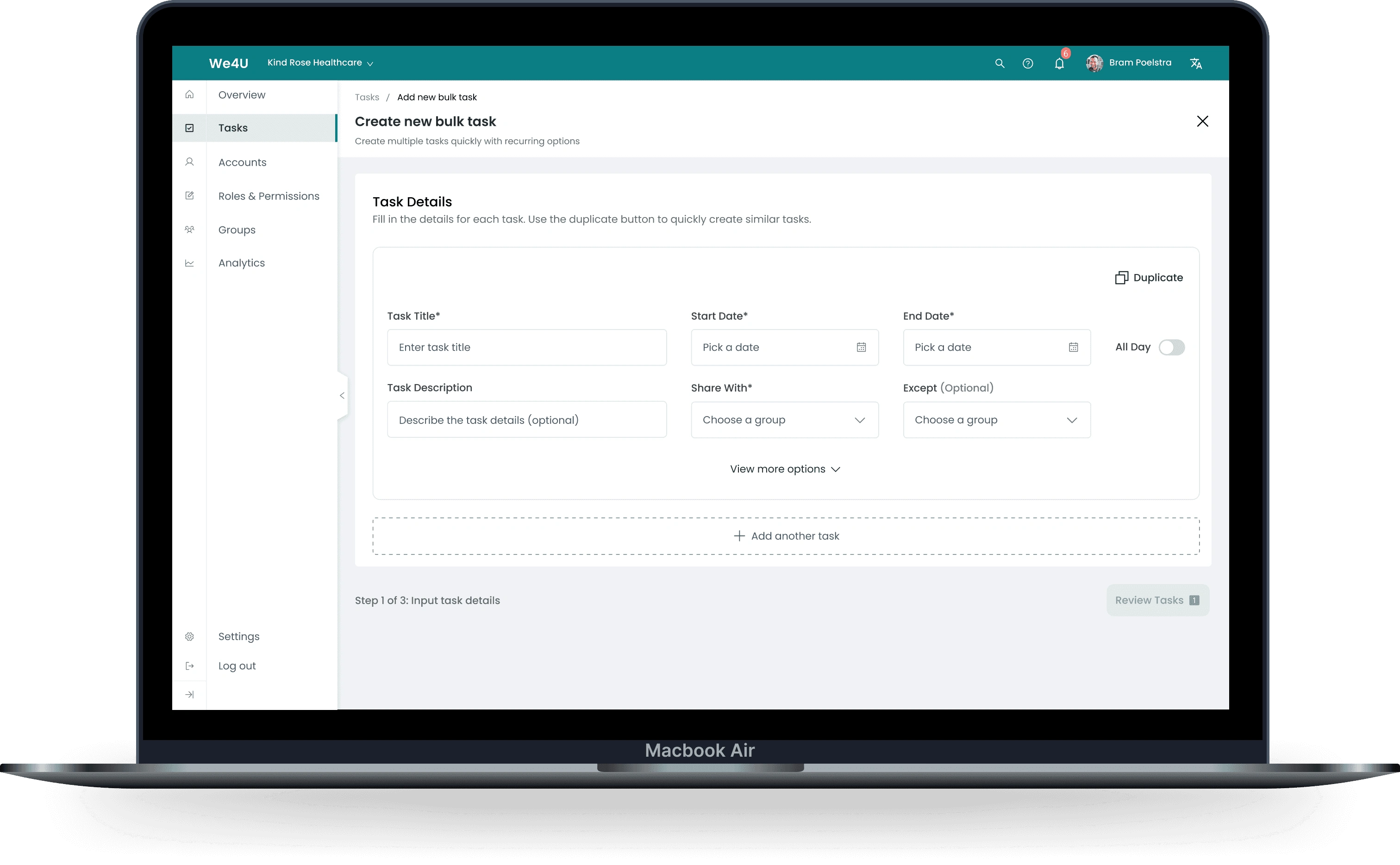
A streamlined task management interface that makes the task and staff management process clearer, more engaging, and easier to navigate.
Led research efforts to understand the pain points, needs and goals of our target users
Conducted 10+ user research sessions with admins, team leaders and support staff at care homes, sports centers and healthcare centers
Pioneered AI integration in our design process using V0 by Vercel, Lovable and UX Pilot
Collaborated closely with PM and engineering to navigate technical constraints and business priorities
Established design review processes to ensure quality delivery despite handoff challenges
Fragmented and Manual Task Management
Task coordination is the operational backbone for community organizations and care facilities, connecting thousands of residents, volunteers, and coordinators. However, two core aspects of the workflow were limiting efficiency and scalability for admins, team leaders and support staff in informal care settings at health, sports, aged-care centers and more.
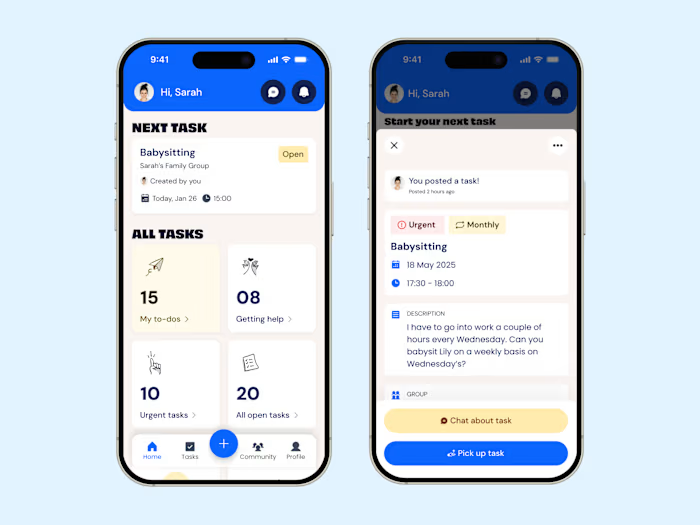
Creating tasks from scratch is one of the most commonly used features, but the experience was clunky and cognitively heavy with the current We4U app. Inconsistent UI, unintuitive grouping, no task status, and lack of insights for helpers made this vital experience inefficient.
In the current We4U mobile app, helpers get little insight into what tasks they can help with and how they can contribute - leading 71% of helpers to spend 3x longer in completing tasks, admins to spend 3x longer in managing different groups, finding helpers and following up with no shows.
"Current methods are unstructured and fragmented. WhatsApp groups, email, handwritten sign-up sheets on location, and fixed agreements are used. Some organizations do not plan at all or only rely on established routines. "
Through 10+ user interviews with administrators and team leaders at various organizations, I uncovered the following key insights:
Admins and team leaders need the flexibility to create tasks in bulk for different groups and people, especially when they need to manage common tasks across organizations.
According to the user research, admins and team leaders are currently using a multitude of apps and manual processes for task coordination, which is often fragmented.
The current manual processes are leading to more time consumption and under-utilization of the help pool for tasks. This is mainly due to the lack of clear task information and helper availability data at a glance.
We created the bulk task creation feature first. At the time, we experimented with using AI tools like v0 to generate initial inspiration - it felt efficient since it was faster and we weren't using an official Figma design system.
But the result didn’t match our vision. I ended up recreating the design in Figma with the aid of Ant Design System for several components, making multiple update cosmetic update tickets, which slowed down development more than expected.
So for the bulk task creation, we shifted gears: I delivered a polished Figma prototype instead. It made collaboration easier, ensured visual consistency, and saved engineering time.
My final designs reflect what I learned from previous iterations and what I heard from users: they wanted clarity, control, and fewer steps. Here’s how I brought that to life.
87% of participants stated that the ability to add multiple tasks in one workflow saved them significant time compared to entering tasks individually, reducing total creation time by an average of 60% per task set.
Task entry completion times shortened by an average of 27%, since most users only interacted with the main required fields, and advanced options did not interfere with the core workflow.
Usability tests showed a 54% reduction in post-creation task errors when users completed the review step before submission compared to flows lacking this safeguard.
Reduced time to create multiple tasks by 60%, enabling users to set up recurring or similar tasks in one streamlined workflow
Improved user satisfaction scores by 23% for group task management, with users citing the clarity of progressive disclosure and the ease of duplicating tasks and confirming details as major contributors.
Introduced AI-driven process that accelerated project delivery.
This project pushed me to navigate multiple constraints while maintaining design quality and user experience.
Striving for high-quality designs with efficient AI use, managing output variability, and resolving development handoff challenges.
Leveraged AI tools for initial brainstorming and exploration of diverse concepts
Relied on human judgment for final design choices
Crafted polished handoff assets in Figma to ensure accuracy and fidelity
Prioritized user testing to confirm and refine AI-generated ideas
There was no official design system for We4U. The new company-wide design system wasn't implementable yet, creating handoff challenges and limiting design deliverables. The final design system was a combined effort of 3 designers.
💡Key Learnings
This experience reshaped my approach to design problems, showing that while AI can speed up idea generation, human expertise is critical for ensuring solutions remain user-centric.
That’s it. Thank you for reading. 😇
Like this project
Posted Feb 24, 2026
Redesigned bulk task creation for We4U to enhance efficiency and user satisfaction.
Likes
0
Views
1
Timeline
Jan 25, 2025 - Feb 12, 2026