CSV cleanup handoff SOP — original documentation sample

Stephen Tumblin

Cleanup handoff SOP — original documentation sample
A worked procedure based on the original synthetic Python demo in this portfolio. This is documentation practice, not a client engagement or a production CSV importer. Created with AI assistance and checked against the code and result.
1. Agree the rules
Confirm the record key, required fields, whitespace treatment and acceptance checks. The demonstration uses a nonblank string ID. It does not perform fuzzy matching, date normalization or type conversion.
2. Preserve the source
Work from a copy and number records from one. Demo row references are record positions, not physical CSV line numbers. A real importer must define headers and multiline-field handling.
3. Classify conservatively
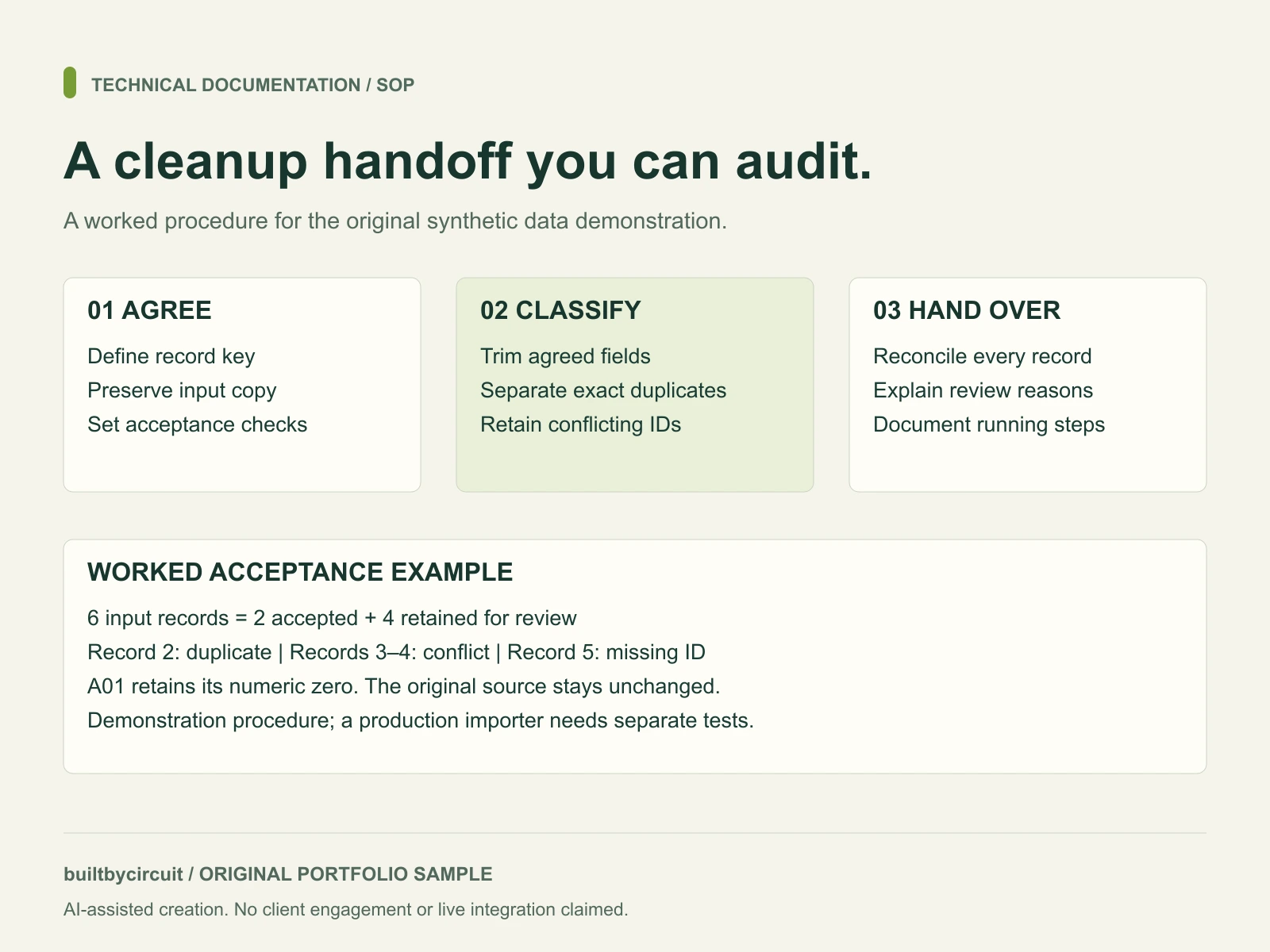
Trim surrounding spaces in string fields. Preserve zero and null. For identical normalized rows, accept one and retain later copies as exact duplicates. If any values conflict within an ID group, retain the entire group for review. Put blank IDs in review. Do not silently choose the correct value.
4. Reconcile every record
The worked example has six input records: two accepted plus four for review. A01 retains zero; C03 retains 30. Record 2 is a duplicate, records 3 and 4 conflict, and record 5 is missing its ID. Use source-row references because review output order can differ.
5. Resolve and hand over
Ask the buyer to resolve conflicts. Keep the agreed decision with the project notes. Deliver the agreed output, review reasons, source-row references and running instructions. The demonstration produces JSON; production CSV delivery requires separate implementation and tests.
Acceptance checks
Unchanged source; input count equals accepted plus review; zero and null preserved; unresolved conflicts excluded from accepted output; every review item has a reason and record reference.
The original automated checks pass for duplicates, conflicts, missing IDs, zero preservation, reconciliation, input preservation, idempotence and empty input. No customer-file or live-integration testing is claimed.
Like this project
Posted Oct 7, 2026
Worked cleanup procedure with input rules, conflict review, row reconciliation and acceptance checks, verified against an original synthetic demo.
Likes
0
Views
2