Jinx Cleaner

Justus Dieckman


Evidence before cleanup
Jinx Cleaner is a Windows desktop utility for inspecting processes, startup entries, scheduled tasks, and files without pretending a heuristic score is an antivirus verdict.
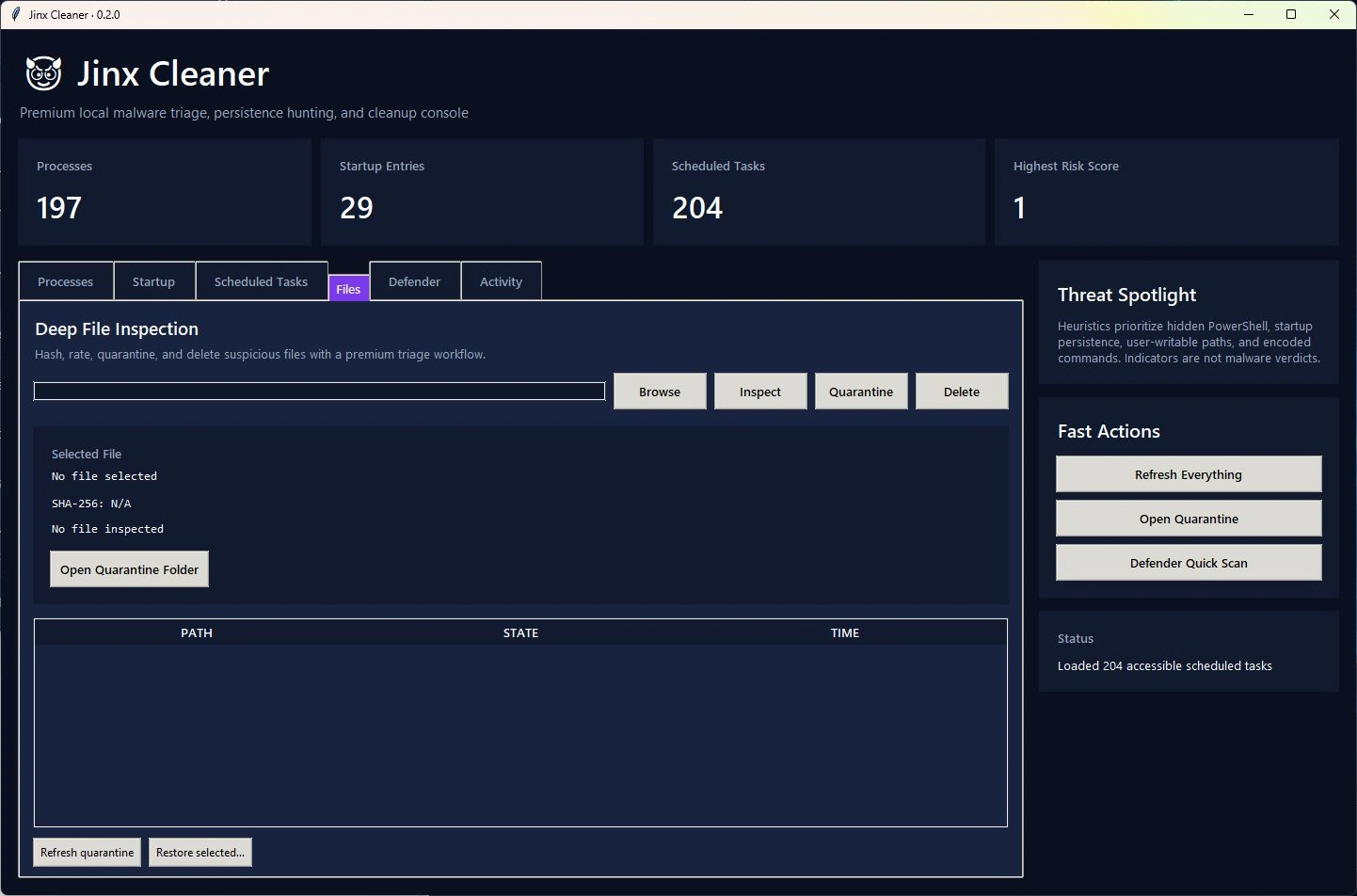
Jinx Cleaner 0.2.0 Files panel
The problem
Windows cleanup tools can make risky decisions feel deceptively simple. I wanted the opposite: useful system visibility, explicit limits, and a recovery path before anything destructive happens.
What I built
Process inspection with paths, command lines, SHA-256 hashes, Authenticode status, and publisher details.
Startup inspection across Run and RunOnce registry locations.
Scheduled-task inspection with executable-action visibility.
Persistent file quarantine with manifests, checksums, timestamps, and restore controls.
Registry and scheduled-task backups before removal.
Activity reporting, bounded timeouts, and refusal rules for protected or ambiguous targets.
Safety by design
Quarantined files are stored outside the application bundle. Restore verifies archive structure, size, and SHA-256, refuses to overwrite existing files, and keeps interrupted transactions visible for recovery. Windows-directory changes, links, incomplete process identities, and protected process IDs are refused.
Verification
Validated on Windows 11 x64 with Python 3.12. The project passed 18 tests, Ruff checks, formatting checks, compile checks, Bandit analysis, a PyInstaller onedir build, and an offline packaged smoke test. Read-only process, registry, task, and Authenticode checks were also exercised.
Current scope
This is a focused inspection and recovery utility—not comprehensive malware detection. It does not cover services, WMI persistence, startup folders, other users' registry hives, or automatic permanent deletion.
Like this project
Posted Sep 5, 2026
Evidence-first Windows system triage with persistent quarantine, verified restore paths, and explicit safety limits.