Exploring Shinrin-Yoku: A Journey Through Forest Bathing

Olivier Guiberteau

Our articles are crafted by humans (not generative AI). Support Team Human with a contribution!
I stood on the crest of a small, open ridge, with the forest spilling away in all directions — tumbling, dipping, and then rising steeply as it reached the curves of distant hills and mountains.
A rogue patch of dark clouds passed in front of the sun, and the world dimmed softly. Skimming the forest canopy, the shadow dashed toward an immense form lying opposite: a regal monster that I had waited years to see with my eyes. This day, of all days, it was almost entirely clothed by clouds wrapped tightly around its iconic cone.
“Here,” my guide said, holding out his hand and dropping tiny flakes of black rock into mine. I stared down at my palm. “Lava from Mount Fuji.”
Lifting my gaze to the obscured peak, I considered the volcano from which this blackened earth had emerged — perhaps over 300 years ago, perhaps much longer. My mind, flickering hopelessly, couldn’t bridge the gap.
What I couldn’t yet put my finger on was that time and distance were only the start of the chasm between us.
An hour earlier, as we gathered at an immaculate picnic area on the same ridge, I placed a small, plastic medical tube, about half the size of a pencil, under my tongue. After holding it there for a minute, I inserted it into a blue-and-white machine that looked remarkably like a children’s toy.
The machine revved silently to life and prepared to evaluate my mental well-being. The test would spit out my salivary amylase level — a number between 10 and 200 kilo units per liter — which would provide a rudimentary indication of stress levels within my body.
My guide, a short Japanese man in his 50s wearing a red flannel shirt and blue cap, told us that, in his experience, working people tend to score between 60 and 80.
I had taken a train to the small provincial town of Yamakita with my friend Kazoue, who lives outside Tokyo, to participate in a session of shinrin-yoku — or “forest bathing,” as this practice translates literally.
In Japan, nature has long been revered. Shinto remains a principal faith; it holds that spirits known as Kodama inhabit trees once they reach 100 years old. But four decades ago, access to nature among the Japanese population had reached unprecedented lows, with its urban population having soared from 18% in 1920 to 76% in 1980. This newly citified citizenry struggled with skyrocketing levels of depression and suicide. As part of the government’s response, in 1982 the Japanese Ministry of Agriculture, Forestry and Fisheries introduced an officially sanctioned form of stress management, coined shinrin-yoku.
The message was clear: Let the forest wash away your woes.
As we waited for results, the guide recited an array of health benefits credited to shinrin-yoku — from decreased anxiety to increased immune response. One early Japanese study on shinrin-yoku’s physiological effects, published in 1995, demonstrated that twice-daily, 40-minute sessions walking in a cedar forest were enough to lower stress levels, heart rate, and blood pressure.
When I first heard about shinrin-yoku, its catalog of benefits had seemed too good to be true. I had felt compelled to experience this wonder drug for myself, to see if it could possibly live up to the hype. Back home in East London, I rarely made time in my daily schedule to get immersed in nature, even though I had easy access to woods nearby.
Kazoue — slender and tall, with sunglasses perched atop her head — had gone first with the stress test and scored 73. Then my results flashed on the screen — 31. She and our guide chuckled. It appeared I was twice as relaxed as a typical Japanese person. Especially compared to the frenetic lifestyles I had observed in Tokyo, working from home as a freelance writer and photographer afforded me a relatively relaxed life.
Finally, we shouldered our backpacks to begin our session in earnest. But my mind had grabbed hold of that number — 31. Was shinrin-yoku a waste of my time?
I didn’t realize how dwelling on that niggling thought threatened to sabotage my whole experience.
We followed a trail down from the ridge and settled into a quiet rhythm, immersed in the bamboo forest. Our guide emphasized the importance of clearing the mind and focusing on life around us.
It took me a few minutes to get accustomed to our slow pace, which felt unnaturally lethargic — borderline lazy. I had envisioned shinrin-yoku as a sort of direct pathway to Zen, one in which a wave of relaxation would wash over me. Instead, I kept bumping into the back of Kazoue.
“This is much more than just a walk,” the guide said, his face jovial and his gentle voice a counterpoint to my impatience. “It’s about connecting with nature, about taking in the forest through our senses.” When we do that, he insisted, our body begins to heal and tap into our primal beings.
As I scanned both sides of the path, much of the flora appeared alien, my eyes more accustomed to the angular shapes of a built environment than the organic curves of nature.
At home, buildings dominate my surroundings and often pass by in a blur of detachment as I navigate from point A to B. Here, my focus felt different — as if searching for some connection that might help me get my bearings.
Whenever the cerebral chatter began to whirl, I tried to force my attention on what I passed: the thick bamboo and the ghostly creaking of stalks bending in the wind, signs with exquisite calligraphy I couldn’t decipher, a large, red-and-black spider suspended across the trail.
At one point, our guide paused, looked up, and raised a finger to the sky. Above us, leaves circled in a spiral wind, dancing playfully between the trees.
Then, the path descended into a series of steps carved into a hillside flanked by tall pine trees. A grisly scar of rocks and fallen trees lay to our right, carving through the forest, damage caused by Typhoon Hagibis just a few weeks before. A low rumble filled the air and I glanced up at that muggy sky hanging over us. It looked too bright for thunder.
“Tanks,” my guide explained, reading my mind. Seeing my look of perplexity, he pointed to a distant area and grinned, acknowledging the irony of hearing artillery shells during a shinrin-yoku session. “The military is practicing.”
This jarring revelation snapped me out of any pretense of revery.
“Nature can be cruel and painful, too,” he murmured thoughtfully. “It’s about accepting both the good and the bad, the beautiful and the ugly.”
Three hours later, a second amylase test revealed that my walk in the woods had shaved 6 points off my stress score — not bad for an already mellow guy like me, but not exactly life-changing, either. As we slowly made our way back to Tokyo on a local train, the snowcapped cone of Mount Fuji slipping farther away, I filed away the experience as a pleasant enough way to pass a few hours.
I couldn’t help but wonder what I had missed.
Six months on and I found myself inhabiting a quite different world — one of isolation and loss, one dictated by air flow and social distancing.
An avenue of ancient oak trees, their trunks gnarled grotesquely, lined what had become my regular route through a scrap of woodland in East London. Their thick branches stood defiantly — like sturdy arms held aloft, rising into the glistening, green canopy above.
Grasping for perspective, I lingered longer than necessary, imagining the thousands of human feet that had passed through before me. It’s not as if I had somewhere else to be.
The path dropped away to my right and I followed it down, pausing briefly as I picked my way around an expansive puddle that had appeared with the spring rain. I emerged next to a small lake and looked to my right — west — toward the dipping sun. Warm light flooded across the water, casting dramatic shadows of the geese feeding on acorns in the shallows.
Despite the sumptuous spring evening, the forest lacked human activity. A drone of traffic hummed in the distance.
Then, suddenly, the howl of an ambulance punctured the serenity — a reminder that all was not well in the city.
I followed the waterline and ascended a small mound of earth next to the shore. A pair of swans glided gently past, a group of mallards in riotous discussion the only sound for a moment.
Another ambulance shrieked to life. I turned away from the lake, taking a path through the foliage and back into the forest.
The world blurred as I hurtled through a dim tunnel of undergrowth. As the pandemic lockdown dragged on, I had started to run here most mornings and had come to know the forest trail almost instinctively. I zigzagged rapidly, hurdling puddles and root systems that bulged through the earth, before accelerating as the path straightened.
A gray squirrel ahead got caught in two minds, barreling left before pirouetting and scampering right, launching itself into a tree moments before I arrived.
The forest had become my refuge, a place of relative normality away from the spectral streets, the grim nods, the pained smiles. Away from the doom of the news.
Clearing my head had become a ritual. The physical act of running while focused intently on the small trail ahead left little space for thought or worry.
The trail opened up and I raced into a meadow capped by a balmy, light-blue sky. After the denseness of the forest, I inhaled deeply and glanced over the tall wild grass flopped sideways under its own weight.
Here where the meadow felt like a savanna, I emerged a wild animal, tearing freely through the natural world, unbridled by human complications.
The sensation flickered, like a vague memory.
A delicate brush of fresh snow now blanketed the meadow. A brisk wind blew the sleet sideways, and I dug my hands deeper into my pockets as I passed one of the smaller lakes. I couldn’t resist hurling a small rock into the air, relishing the childlike rush as it pierced the ice with a satisfyingly smooth thump.
Eight months had passed since my primal summer runs, bringing winter. Life, too, had frozen into a state of tension and blunted weariness.
Fears over an airborne killer had brought me to this forest, day after day, and I always felt better upon return. Growing inside me was an awareness — something was starting to take root.
I came to the battered trunk of an old oak and looked up into its skeletal form, enjoying the frosty feel of each inhalation.
With those breaths, I welcomed in more than fresh air. I would later discover that plants emit volatile organic compounds known as phytoncides, which act as a natural defense against bacteria, fungi, and insects. Humans, it turns out, may reap benefits, too. Recent studies have suggested that phytoncides can boost a person’s natural killer cell count as well as key cancer-fighting proteins. The effect can persist for at least 30 days.
Standing below the oak, the healing potential of phytoncides swirled through my mind — the implausibility of it all as well as something deeper, nudging me not to dismiss it so quickly.
Learning about phytoncides was akin to finding a jigsaw piece to a puzzle I hadn’t realized I was trying to solve. It was then that I remembered shinrin-yoku.
Back in my small London apartment, in moments between tramping in the forest and tracking the roadmap out of lockdown, I started reading more about phytoncides and other forest-bathing research.
Surrounded on all sides by concrete dwellings, I was struck by a thought-provoking fact raised by one academic paper, titled “Physiological effects of Nature Therapy: A Review of the Research in Japan” — Homo sapiens have spent less than 0.01% of our species’ history in modern, artificial surroundings.
“The gap between the natural setting, for which our physiological functions are adapted, and the highly urbanized and artificial setting that we inhabit is a contributing cause of the ‘stress state’ in modern people,” asserts the paper.
Put another way: Bodies are meant to be in nature, same as they always have been.
Perhaps the disconnect I had felt in Japan had less to do with what I was doing in the forest — and everything to do with the incongruity of the modern cues of my mind and the ancient instincts of my body. My urban existence had oriented me in that way, a divide that couldn’t be overcome in one outing.
My new forest ritual had begun to nurture a link I hadn’t even realized needed repair.
The man before me looked like a man who spends plenty of time outdoors. He had a tough face, covered in a week’s worth of stubble, and talked about the forest like it was a secret — one he might be willing to share if you came along for the walk.
I had emerged from the U.K. lockdown to do just that, having journeyed to southwestern England to the edge of the brooding, bleak beauty of Dartmoor National Park. If the pandemic had taught me anything, it was patience. And so I had joined a three-day shinrin-yoku course, determined to try again.
Our guide, Stefan Batorijs, paused, his gaze momentarily lost in the canopy as our group of four gathered around him.
Then he glanced at each of us. Still he didn’t speak, holding the silence a few seconds longer. I remembered that his website mentioned his training as an integrative psychotherapist.
Finally, Stefan offered a directive: “I’d like to invite you to go and say hello to the forest.”
We dispersed, and I left the path to begin nudging through the tangled web of scrub, pondering how on earth to say hello to a forest.
Out of sight, I stopped beside a small redwood that twisted elegantly skywards. With the smell of wild garlic hovering in the distance, I placed a hand on the scarred bark and self-consciously whispered, “Hello.”
Nothing happened, but that was probably to be expected.
Shortly before lunch, we were each handed a tiny magnifying glass and encouraged to use it to explore the forest.
Peering down at the layers of leaves below me, I initially struggled to see anything in focus. I shifted positions, and suddenly a bright green leaf sharpened into life. I could trace the rivers of arteries lying just below the surface.
A small black beetle creeping through twigs caught my eye, and I placed the magnifying glass as close as I dared while it stared up at me. Its body loomed into focus — the small ridges that ran down its shell, the two tiny tarsal claws at the end of each leg, its antennas twitching ever so slightly.
A call from Stefan pulled me out of my micro world. I stood up, a little unsteadily, as my mind readjusted to the scale of my surroundings. All around me, great natural pillars rose, trees powering skywards, dwarfing me and everything around them, all the while sustained by the tiniest of veins on the smallest of leaves. I returned to the group with a broad grin.
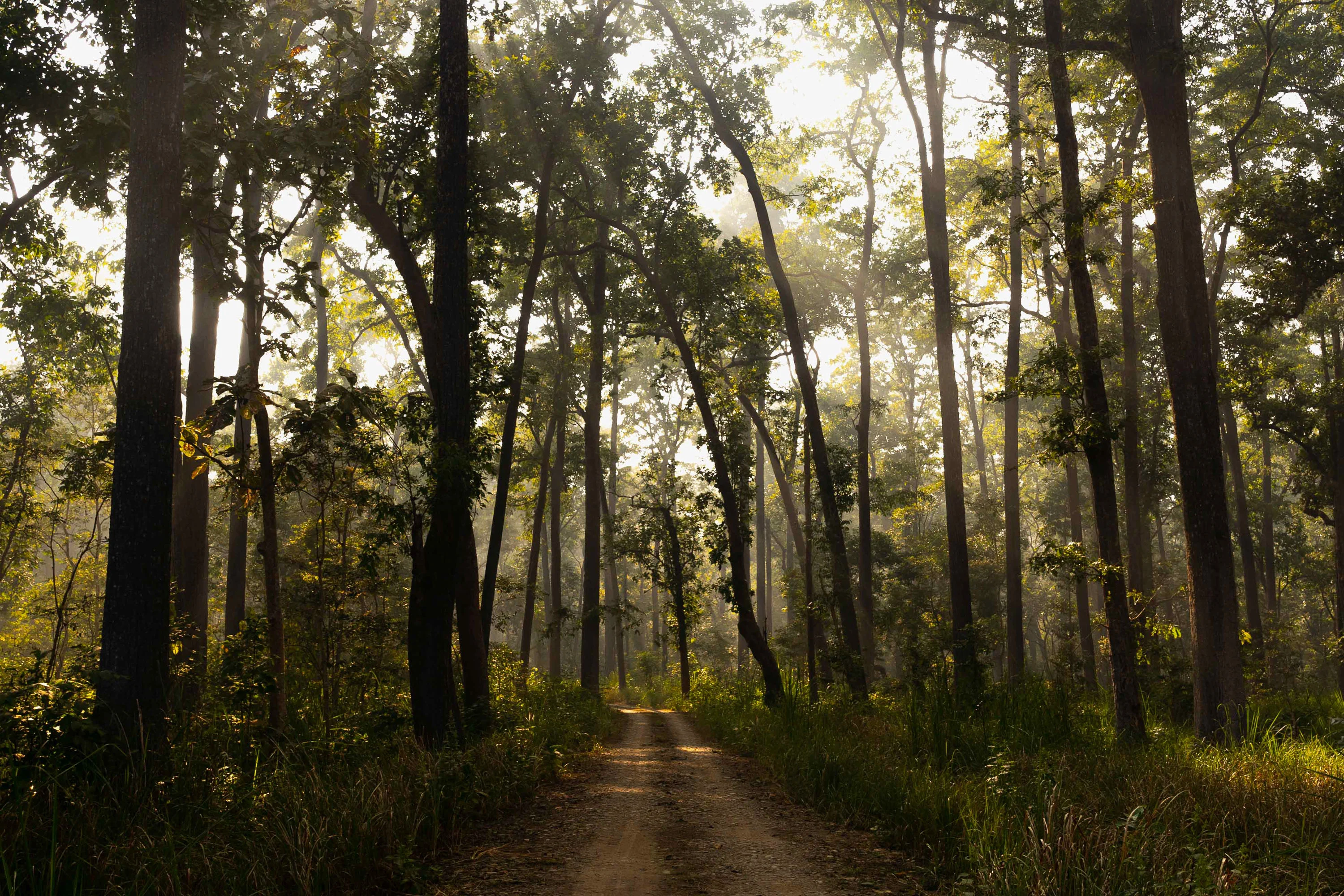
The green hummed — the moss coating every rock, and trees brimming with life. Spears of sunlight darted through the canopy, creating intense spotlights on the soggy forest floor.
Moments earlier, Stefan had directed us to find an area in the forest to focus on sounds. I was immediately drawn to this small, strangely beaming hideaway.
I perched on a fallen tree trunk and allowed my attention to explore the area with a meandering curiosity. I ran my hand through a thick patch of moss, soaked through but velvety — compulsive to touch.
Stefan’s words from earlier in the day came back to me: “Be childlike in the forest.” I stroked the moss again.
The babbling between birds and the rhythmic drumming of a single woodpecker combined with a thousand drips as rain steadily fell from the trees. Taken together, the sound was quietly immense. The pace of existence felt slower, more peaceful in this ethereal snuggery.
Stefan told me later that he “can see a beaming contentment when people have re-experienced a sense of awe in the natural world that has sometimes been missing since their childhood.”
“Every time I go out with a group,” he added, “it gets deeper.”
For the final exercise of the day, our group fanned out and I was left alone, surrounded by sparsely populated pine trees, close to where an Iron Age fort once stood.
I lay down, chest to earth, and burrowed a small hole for my nose to rest in. Immediately, I started squirming. But I stuck with the discomfort, making a concerted effort to focus on my breath and the smells around me.
Gradually, my breathing slowed and I became acutely immersed in a deep, rusty scent I’ve always known, yet rarely given a second thought.
Later, after my nose was no longer pressed into the earth, I could recognize how, in this state of elevated awareness, the physiological impacts of shinrin-yoku had taken hold inside me, acting as a powerful trigger of my parasympathetic nervous system — the yin to the body’s fight-or-flight yang.
As the earthy aroma tickled my nostrils, though, my inner workings couldn’t have been further from my mind. In fact, my brain was quiet. Each deep inhale gave me the peculiar sensation of drawing closer to the ground beneath me.
The following day, with the rain still falling steadily, I slip my boots and socks off sullenly and gingerly place my naked feet on the sodden forest floor. I straighten up as a burning cold races across my soles, rushing upward and gripping my ankles. The muscles in my shoulders and neck tighten; my pulse quickens. I’m wobbling, inside and out.
Still, I put one foot in front of the other and follow a trail as it weaves through tall, boisterously green grass. The growling of a nearby river merges with the cacophony of the birds above. The forest sparkles in the way English woodland does after heavy rainfall — colors smoldering; an intense, earthy aroma.
I couldn’t have chosen a more delightful spot to risk frostbite.
Stefan has explained to us that barefoot walking is also known as grounding, and it may recharge our extracellular matrix — basically, the scaffolding protecting our immune system — by way of the Earth’s electrons. In practice, my frigid stroll could reduce inflammation and calm my body.
Suddenly, the pain shifts from searing discomfort to a dull, distant ache. My breathing and pace have slowed, and I’m no longer barreling toward the group’s meeting point.
Small details of the forest emerge, and I lean down to examine a wonderfully concentric fern — running a finger in a large circle around it, grazing the leaves slightly, and sending streams of rainwater tumbling to the ground.
I pause next to a tree, momentarily lost in the rhythmic pattern of its bark. Ordered lines higher on the trunk eventually give way to chaotic whirls closer to the ground. As my eyes continue down, I spot a snail embarking on an epic quest, inching defiantly along.
I crouch down to examine the dark brown spiral on its shell, which all of a sudden looks remarkably similar to one of the patterns in the tree bark. I laugh to myself, feeling as if I’ve just discovered one of life’s wonderful secrets.
A tepid warmth has begun creeping across my feet, and with it a compelling sense of ease. Neither elation nor happiness, this deeply rooted harmony takes me by surprise. My accumulated frustration and worries remain part of me, of course, but they have receded at this moment.
This glowing patch of forest hasn’t delivered instantaneous ecstasy nor grand epiphanies. That’s not how shinrin-yoku works.
My path had started long before I arrived in Dartmoor, having been cultivated, unknowingly, over many previous forest visits. Perhaps the previous year’s nature immersion had prepared me for this necessary patience. Then again, maybe my foray in Japan had been the first step all along. It’s a thought I consider for a few seconds, then put aside.
The trail merges with a larger path. The meeting point is just ahead. I stop, caught between a need to press on and a desire to do the opposite.
I step off the path and into the tall grass, noting how the ground below my feet has a hint of warmth to it now. I imagine the exchange of electrons between us — two beings, separate, but fused.
Unseen and enigmatic, our link to nature is difficult to fathom — like trying to reconcile specks of lava in my hand with its mystifying source. The full expression of that bond can’t be measured.
With patience and curiosity, though, it can lead us beyond the forest.
Like this project
Posted Jul 30, 2025
Explored shinrin-yoku in Japan and Dartmoor, enhancing connection with nature and reducing stress.
Likes
0
Views
9
Timeline
Jan 30, 2023 - Nov 30, 2023
Clients
Hidden Compass