How I Grew a Healthcare Pricing Platform from 0 to 219K Clicks

Nicholas Cheung


How I Grew a Healthcare Pricing Platform from 0 to 219K Organic Clicks in Under 12 Months (Without Writing a Single Blog Post)
Results
In short, the results we achieved during the 12 months of working with this SaaS client:
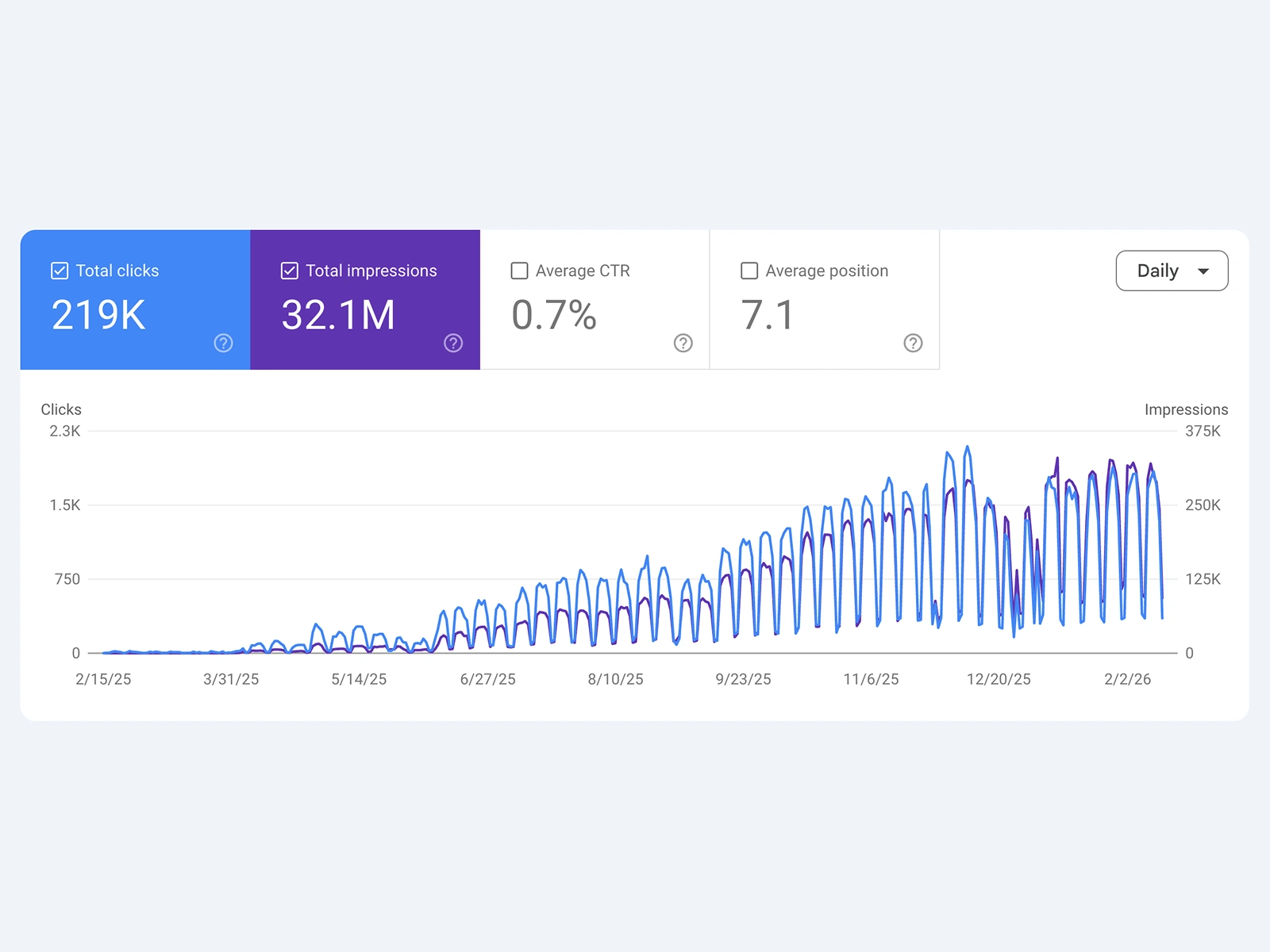
219K+ Organic Clicks (Cumulative)
19K+ Keywords Ranking on Page 1
$27K+ Monthly Traffic Value
71K+ Monthly Organic Visits
Client
This particular client is a healthcare pricing platform that was pushing a new product to market.
The problem? Most of their target audience didn't even know a solution like theirs existed.
Their ICP spans hospitals, healthcare consultants, and billing providers: organizations that rely on accurate pricing data to make critical financial decisions every day.
As a new entrant, they were going up against legacy government data sources that had decades of domain authority and institutional trust behind them.
Challenges
From the beginning, the client had near-zero organic presence and no structured approach to SEO.
They were facing some serious challenges in a niche dominated by government incumbents:
Near-zero organic presence : The site had barely any ranking keywords and virtually no organic traffic.
An undefined software category : Their target users weren't searching for this type of tool because they didn't know it existed. There was no established search demand for the product itself.
Competition from high-authority government domains : The SERPs were dominated by .gov sites and long-standing institutional resources with massive backlink profiles.
No content strategy or technical SEO foundation : The site had no structured approach to search visibility, and existing pages weren't built for search engine discovery.
Existing pages weren't structured for search : The information existed on the site, but search engines couldn't effectively crawl, index, or rank it.
In short, they had a superior product with zero organic visibility, competing in a space where the established players weren't even trying to rank (they didn't have to).
The client had two core goals:
Build organic visibility that drives qualified leads to their platform
Establish dominance in search results within their data niche
They brought us on board because we have a proven track record of building organic growth for SaaS products in competitive niches.
Our Solution
Our solution was focused on 3 segments that helped this client build sustainable organic growth in under 12 months:
Audience research and search gap analysis to find the opportunity
Programmatic SEO to fill information gaps at scale
Technical SEO and indexation management to make sure search engines could find it all
Audience Research & Search Gap Analysis
During our initial audience research, we discovered a common search behavior pattern among the client's ICP.
These users were actively searching for specific data points related to healthcare pricing. But the existing search results were failing them.
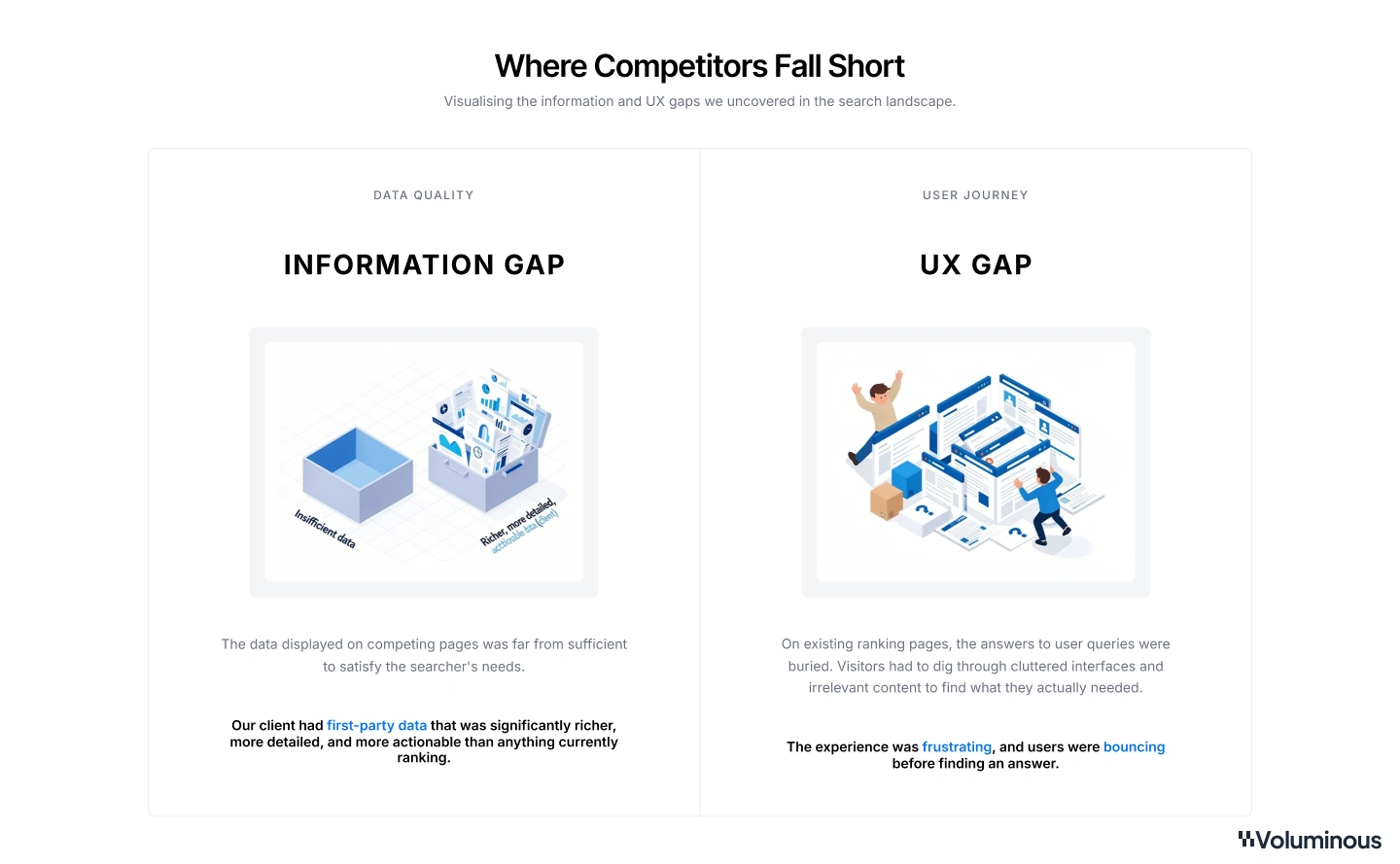
We analyzed the SERPs for these queries and found two critical gaps:
Information gap: The data on competing pages was far from enough to satisfy the searcher. Our client had first-party data that was significantly richer and more actionable than anything currently ranking.
UX gap: On existing ranking pages, the answers to user queries were buried. Visitors had to dig through cluttered interfaces to find what they needed. Users were bouncing.
These two gaps formed the foundation for our entire strategy.
We didn't need to create demand. Demand already existed. We just needed to serve it better than anyone else.
Programmatic SEO Strategy
With the gaps identified, we developed a programmatic SEO approach to fill both of them at scale.
Instead of writing blog content, we created thousands of data-driven pages powered by the client's first-party data.
Each page was designed around a single principle: surface the answer immediately. No digging, no friction, no wasted clicks.
How did we prioritize what to build first?
We analyzed keyword patterns where the modifier had the highest search potential. We calculated this by looking at search volume data and how common the underlying practices were across the industry.
This allowed us to focus engineering resources on the pages most likely to drive traffic first.
What did this look like in practice?
Zero blog posts written. Every page served real, actionable data that users needed.
Thousands of pages generated programmatically from the client's proprietary dataset.
Every page designed to answer the query on arrival, giving users exactly what they searched for within seconds of landing.
This wasn't thin content. Each page delivered genuinely unique data that couldn't be found anywhere else, sourced directly from the client's platform.
Google rewarded that.
Technical SEO & Indexation Management
Creating thousands of pages means nothing if search engines can't find them.
Technical SEO was the engine that made the entire strategy work.
Crawl budget management was critical. With over 10,000 pages, every crawl had to count. We needed to make sure search engines spent their budget on the pages that mattered most.
How did we manage this?
We took a phased rollout approach. For each sub-category of programmatic pages, we published a pilot subset first to test which modifier groups brought the highest return in traffic.
This let us validate demand before scaling. It also informed which page types deserved full rollout versus which ones should stay noindexed.
Over time, we gradually configured noindex on low-value pages that weren't earning traffic. This concentrated crawl budget on the pages that actually performed.
On the sitemap side, we configured priority properties and tags to signal which pages mattered most and when content had been updated. This gave crawlers clear guidance on where to spend their time, rather than treating all 10,000+ URLs equally.
We also tackled several foundational technical issues:
Rendering issues that prevented search engines from reading dynamically generated page content
Programmatic sitemaps structured to guide crawler discovery efficiently across thousands of URLs
Redirect issues that were silently blocking bot access to large sections of the site
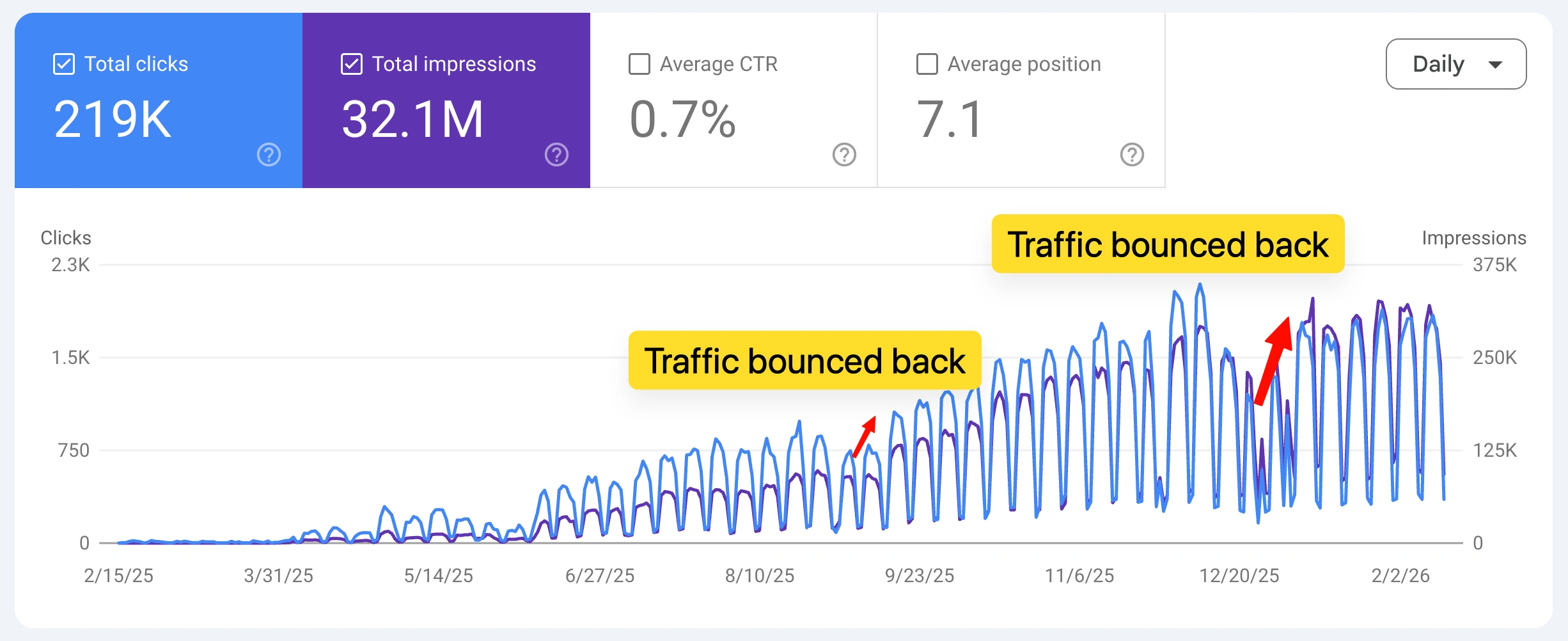
Then, a Google algorithm update de-indexed a significant portion of pages mid-campaign.
We didn't panic. We executed a systematic recovery: identified the root causes, fixed the underlying issues, and re-submitted affected pages for indexing.
Traffic recovered and continued its upward trajectory.
But that's not all.
Throughout the engagement, we monitored indexation health continuously, catching issues before they could impact traffic. With a site this large, you can't afford to be reactive.
Results
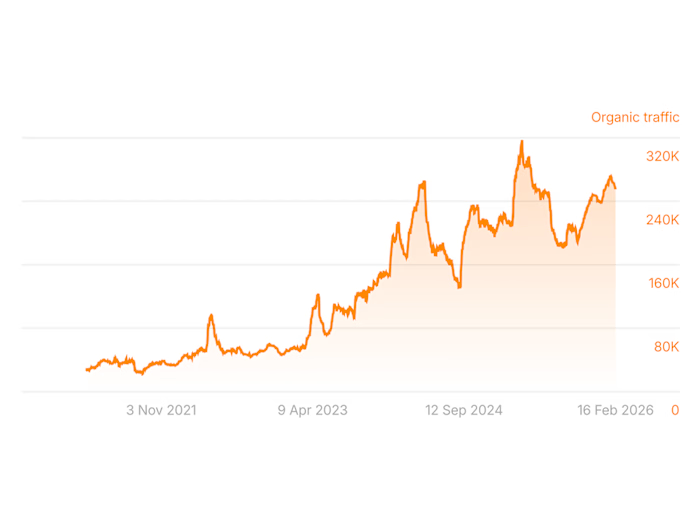
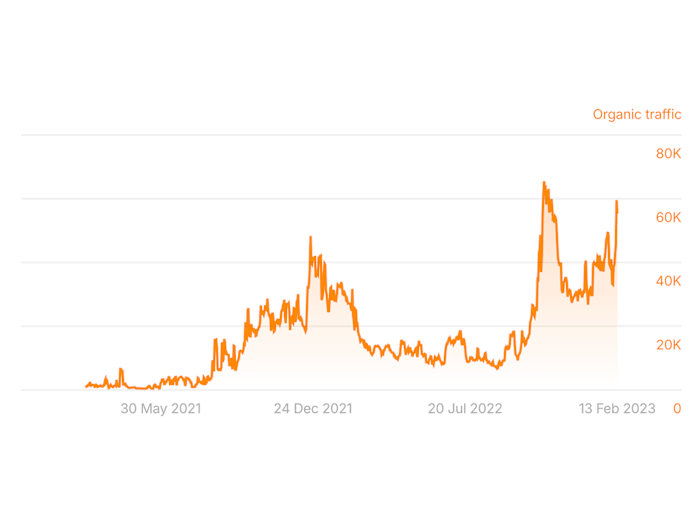
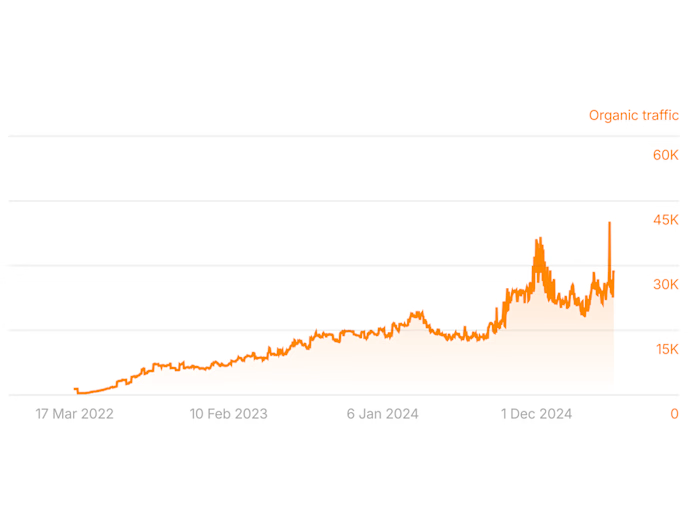
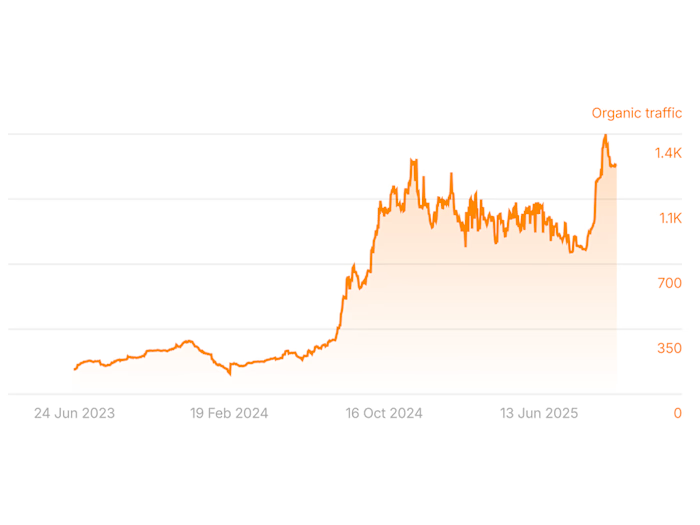
We saw massive organic growth directly attributed to our programmatic SEO efforts.
Results: 219K+ cumulative organic clicks in under 12 months, with zero blog content.
Here's what the numbers look like:
Traffic growth: The site went from roughly 1,000 monthly organic visits to over 35,000 monthly organic visits. That's a 35x increase, and the trajectory continues to climb.

Keyword rankings: From barely ranking for any terms, the site now has 19,400+ keywords on page 1 of Google, with over 4,400 in the top 3 positions. The total keyword footprint spans over 25,000 ranking keywords.
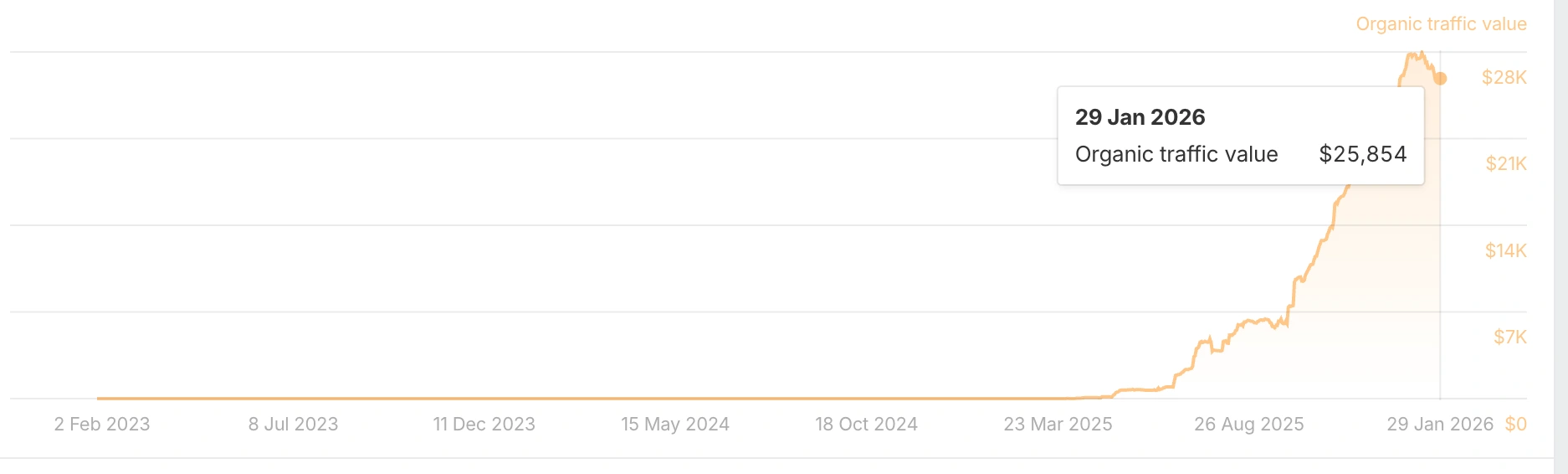
Traffic value: We were able to build up $27,000+ worth of monthly organic traffic value, which represents the equivalent ad spend needed to generate the same visibility.
Domain authority: Domain Rating increased from 12 to 28 (a 133% increase).
Competitive wins: The site now outranks established, high-authority government domains for thousands of queries in their niche. We were able to do this even at a relatively low DR, thanks to our structured approach to programmatic SEO.
Like this project
Posted Feb 16, 2026
219K Organic Clicks (Cumulative) 19K+ Keywords Ranking on Page 1 $27K+ Monthly Traffic Value
Likes
1
Views
34
Timeline
Feb 1, 2025 - Ongoing