Fieldwork Case Study

Venkatesh L


UxRep
(formerly fieldwork)
A case study
The Problem
Background & Challenge:
As enterprise teams scaled, the demand for user research rapidly outpaced the capacity of solo designers & PMs. Without dedicated UXR budgets, product managers were forced to conduct their own research, leading to a severe lack of standardization.
Problem Statement:
This manual bottleneck resulted in two major issues: "convenience bias" (teams only interviewed English-speaking users in their own time zones) and poor data quality due to biased questioning or worse, skip research entirely.
Solution:
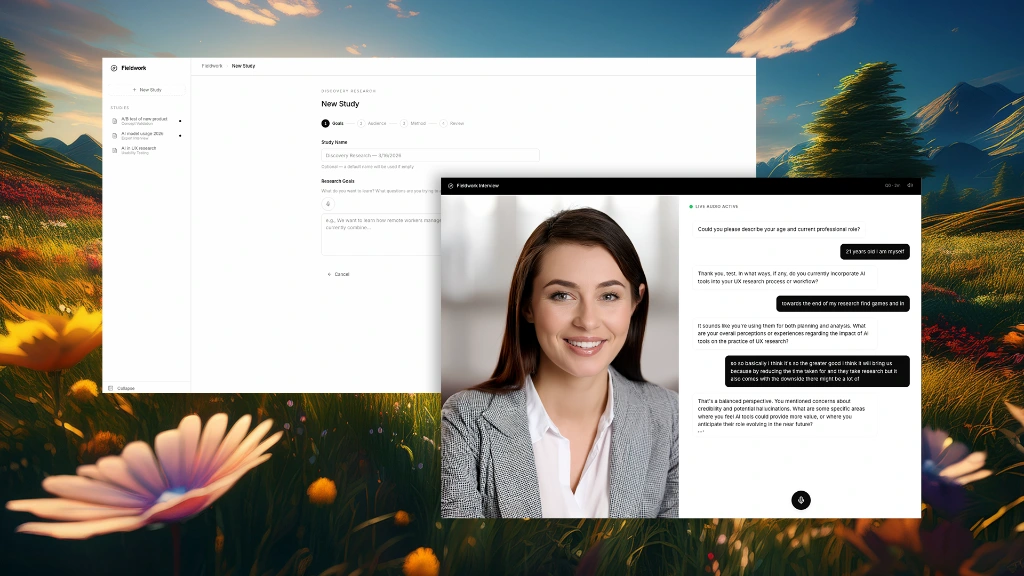
Fieldwork was conceptualized to solve this scaling problem by deploying a 24/7 multilingual AI research agent, standardizing the interview process and capturing global insights asynchronously.
Journey (Before & After)
The introduction of the AI agent fundamentally rewired the enterprise research lifecycle, shifting it from a massive synchronous burden to a lightweight asynchronous workflow.
The 4-Week Bottleneck
Before Fieldwork
Draft discussion guide
Recruit participants manually
Timezone scheduling conflicts
Conduct synchronous interviews
Manually transcribe
Synthesize data
The 1-Day Cycle
With Fieldwork
Define study goals via Guided Creation
Deploy Agent
AI conducts interviews 24/7
Quote-backed insights instantly
Designing for Control at Scale
To balance the autonomy of an AI agent with the rigorous control required by enterprise researchers, the design was anchored in three core principles:
Asynchronous by Default
The system must do the heavy lifting in the background, allowing the user to be entirely hands-off during the interview phase.
Grounded Transparency
To combat the fear of AI hallucinations, every synthesized insight must be structurally tied to a direct human quote.
Progressive Disclosure
Setting up an AI agent is complex; the UI must hide technical parameters until the user explicitly needs them.
Evolution of Study Creation
The initial challenge was designing an interface that allowed users to easily program the AI agent's behavior without feeling like they were writing a complex prompt.
Idea 1: The Mega-Form:
The traditional UI approach relied on a massive, structured form asking for audience types, tone, and goals. Result: High cognitive load; users felt like it was a chore.
Idea 2: The Chatbot:
Most AI-native platform follow this approach, a purely conversational UI where users told the AI what they wanted to study. Result: Users lacked a holistic overview of the study and felt they had no structural control.
Idea 3: Guided Context Panel (The Champion):
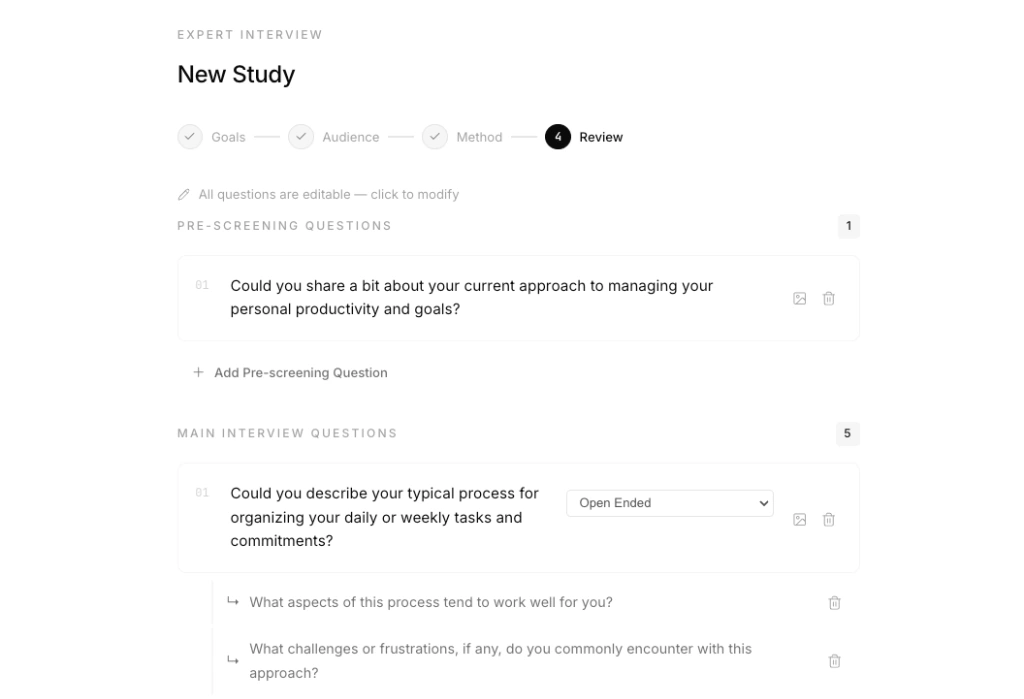
The design utilized a hybrid approach. Users answer simple onboarding questions, and the system instantly generates a visual "Study Outline." Users can then click into specific sections of the outline to inline-edit the AI’s follow-up logic, giving them both speed and granular control.
Explorations & Iterations: Active States
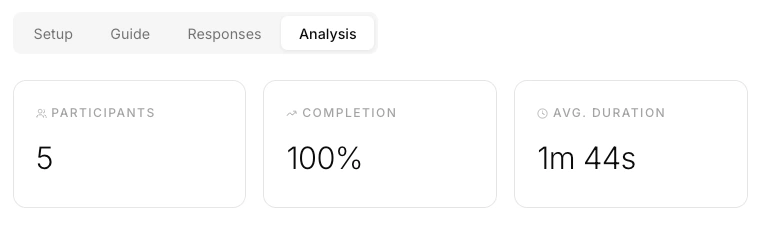
Once a study was deployed, users faced an anxiety-inducing "Empty State" while waiting for participants to complete the interviews.
Exploration:
A static "Waiting for Data" screen caused users to repeatedly refresh the page or unsure if the agent was actually working.
Solution:
I designed the analysis tab to indicate active status. As the agent interacts with participants, the UI displays real-time status indicators: number of participants, completion rate & avg. session duration. This visual feedback built immediate trust in the system's asynchronous capabilities.
Evidence-Based Insights
The most critical UI challenge was synthesizing the data. Early tests showed that users fundamentally did not trust AI to do their research synthesis, primarily due to fear of hallucination.
Iteration 1: Only Transcripts:
Initially, I displayed only the transcripts in english. Result: Overwhelming to read at scale.
Iteration 2: AI Summaries:
I introduced a feature that auto-generated bulleted themes. Result: Users ignored them, fearing the AI was hallucinating or missing nuance.
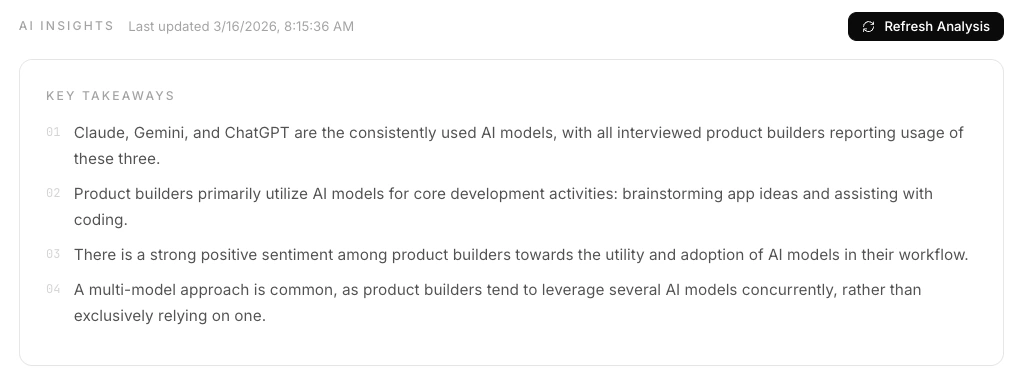
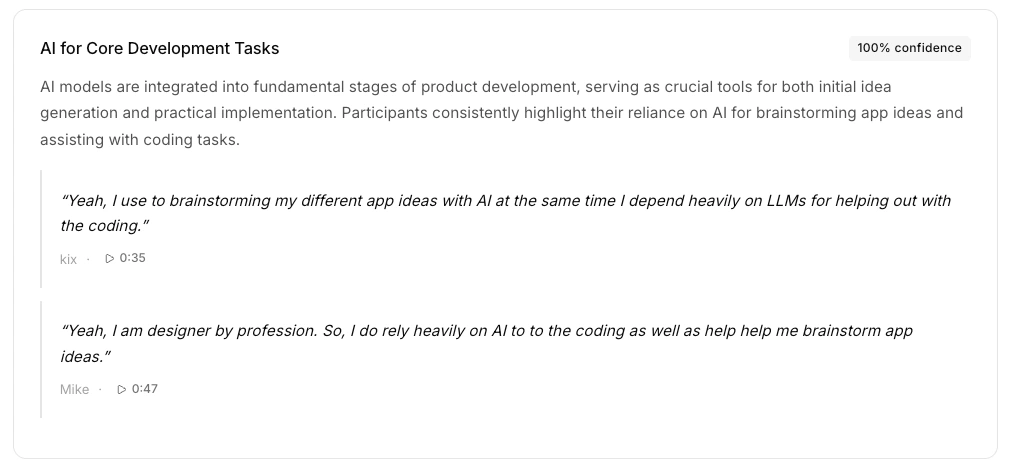
Iteration 3: Quote-Anchored Insights:
The final UI seamlessly merged both ideas. The translated transcripts with original language available response tab. Analysis showing key takeaways based on AI analysis, each theme in a separate section with the exact, unedited participant quotes that the AI used to generate that conclusion. Trust was immediately established.
Impact
The deployment of Fieldwork's bi-directional agent drastically altered how internal teams approached discovery:
Time-to-Insight:
Weeks → 1 Day
Shrinking the average research cycle from weeks to just a single day.
Global Reach:
Multilingual
Teams can naturally launch studies in multiple languages simultaneously, eliminating "convenience bias."
High Adoption:
100%
With 100% buy intent in all user demos, proving the tool's value to non-researchers.
Conclusion
Fieldwork successfully evolved from a fragmented idea about survey generation into an active, autonomous research system. By carefully designing for trust, transparency, and seamless integration, the platform didn't just speed up research—it transformed qualitative discovery from a manual, localized bottleneck into a continuous, global feedback loop for enterprise growth.
Demo of Fieldwork - YouTube
Demo of Fieldwork
Future work: Evolution of Actions
Insights are useless if they stay trapped in the research tool. The next piece of the puzzle is ensuring Fieldwork can natively export findings into presentations.
Proposed Transition:
Instead of requiring users to manually copy and paste transcripts, the goal is to introduce a seamless 'export as presentation' feature. When reviewing the analysis tab, users will be able to export individual sections as presentation cards with quotes for quick sharing.
Like this project
Posted May 28, 2026
A case study on revolutionizing user research with an AI agent.
Likes
0
Views
4