Portfolio

Aini R



Portfolio
I'm Aini, and I write emails people actually want to read.
Most brands don't have an attention problem. They have a copy problem, emails that are polished but forgettable, words that look good in a template and vanish in an inbox.
I write direct-response emails built around one thing: the reader. Their
hesitation, their language, their specific reason for almost buying and almost staying.
I also work fluidly with AI tools, which means faster turnarounds and sharper research without ever losing the human voice your audience actually responds to.
If it looks like what your brand needs, you know where to find me.
Aini
aini.copy@gmail.com
Piece 1: Before/After Email Rewrite | Business Setup
Client type: Business setup consultancy (Dubai) | Email type:
Nurture/conversion
The problem: GenZone's email read like a company newsletter, award
announcements, nineteen bullet points, three competing CTAs, and zero emotional connection to the reader's actual situation. It was written about GenZone, not for the prospect. The copy reads like an AI output, structured but emotionally flat, written for an algorithm's idea of a customer rather than a real one.
My approach: Stripped everything back to the one real obstacle stopping prospects from booking, not lack of information, but lack of clarity about their specific situation. Built the entire email around a single named mechanism, "the gap" that made procrastination feel concrete and made the consultation feel like the logical solution rather than a sales ask.
BEFORE
This is the second email from their welcome sequence after they delivered the guide.
AFTER
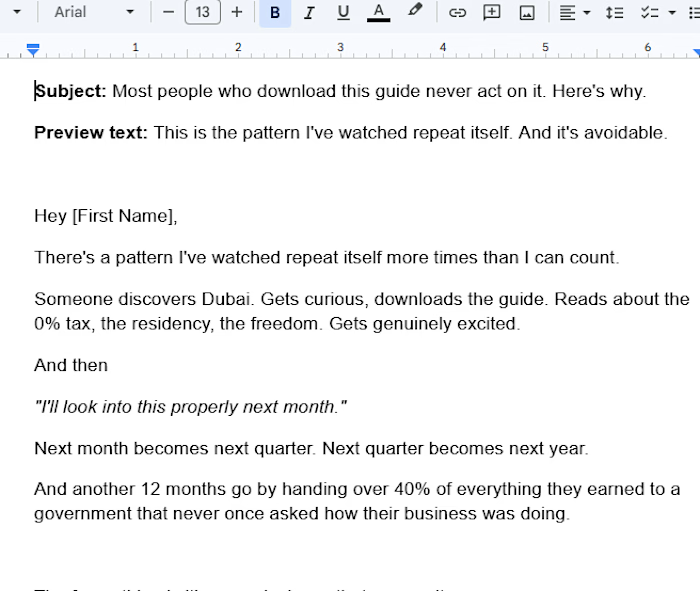
Subject Line: Most people who download this guide never act on it. Here's why.
Preview text: This is the pattern I've watched repeat itself. And it's avoidable. Hey [First Name],
There's a pattern I've watched repeat itself more times than I can count.
Someone discovers Dubai. Gets curious, downloads the guide. Reads about the 0% tax, the residency, the freedom. Gets genuinely excited.
And then
"I'll look into this properly next month."
Next month becomes next quarter. Next quarter becomes next year.
And another 12 months go by handing over 40% of everything they earned to a government that never once asked how their business was doing.
The funny thing is it's never laziness that causes it.
It's the gap.
The gap between "this sounds genuinely possible" and "but I don't know exactly what this looks like for me specifically."
That gap is where good intentions go to die. Not because people don't want to move forward.
But because moving forward feels like it requires certainty they don't have yet. So they wait. For more information. More clarity. More confidence.
But information doesn't create clarity. And clarity doesn't arrive on its own. The conversation does.
That's the only thing separating the people who actually make the move from the ones who are still thinking about it two years from now.
Not another guide. Not more research.
One honest conversation with someone who has done this a thousand times, who will look at your specific situation and tell you plainly whether this works for you right now, or exactly what needs to happen first.
Thirty minutes. That's the gap closed.
[Book Your Free Consultation Here]
Talk soon,
Shayan Co-Founder, GenZone
P.S. Tomorrow I'll tell you the story of how GenZone actually started. It begins with a moment that changed how I thought about money entirely, and it's probably closer to your situation than you'd expect.
What Changed and Why
Replaced award announcement opener with the reader's own
procrastination pattern, they see themselves in line one
Eliminated all nineteen bullets in favor of a single named concept ("the
gap") that does more persuasion work than any feature list
Reduced three competing CTAs to one, placed at the moment of highest emotional investment
Reframed the consultation from a "sales call" to the literal solution to the problem the email just made real
P.S. opens a curiosity loop pulling the reader into the next email rather than ending cold
A second piece for the same client, different email type, different framework, showing range within one niche.
Piece 2: Story-Driven Nurture Email | Business Setup
Client type: Business setup consultancy (Dubai) | Email type: Lead nurture / conversion
The problem: Most business setup companies sell with statistics; tax
percentages, setup timelines, free zone comparisons. The prospect already has all of that information. More data wasn't moving them to book.
My approach: Replaced information entirely with one specific person's story, told from the inside of their experience, not the outside. The goal was to make the reader recognize themselves in Adam before they recognized the pitch coming. No bullet points, no statistics, just a story that arrives at the
consultation as a natural conclusion rather than a sales ask.
THE EMAIL
Subject: He almost didn't make the call. Three weeks later he was set up in Dubai.
Preview: He'd been researching for eight months. The call took 28 minutes. Hey [First Name],
Adam had been researching Dubai for eight months.
Spreadsheets with cost comparisons.
Reddit threads at midnight. YouTube videos that answered one question and opened three more.
He knew the free zone structures.
He knew the rough visa timeline.
He'd read the same three blog posts so many times he could have written them himself.
And still, every time he got close to actually doing something, the same thought stopped him.
"I just need a bit more information before I'm ready."
He was 31. Freelance UX designer.
Built his client base from nothing over four years, no agency, no safety net, just good work and word of mouth.
By most measures, doing well.
But every month, the same thing happened.
An invoice cleared. His brain did the maths before he could feel anything about it.
Government takes this, national insurance takes that, and the number that's actually his feels like a consolation prize for a month he gave everything to.
He'd known about the Dubai option for nearly a year.
He just never felt quite ready enough to find out if it was right for him.
Then one Tuesday evening, no particular reason, no dramatic moment, he opened the GenZone website and booked the call.
Not because he'd finally done enough research.
Because he realized more research was never going to answer the one
question that actually mattered:
Does this work for my situation, right now, as I actually am?
The call was 28 minutes.
By the end of it, Adam knew exactly which free zone suited his business, what the total cost would be, how long the visa process would take, and what the first step was.
No vague estimates. Just clear answers built around his situation.
Three weeks later his company was registered.
Five weeks after that, his residency visa was done.
He's been in Dubai Marina for four months. Same work. Same clients. Same rates.
The only thing that changed is what happens when an invoice clears.
He does the maths. And the number that's actually his is the number on the invoice.
If you've been in the research loop, reading, comparing, almost deciding, Adam's story isn't unusual.
It's the most common one we hear.
The information was never the problem.
It was the absence of one conversation that actually looked at his situation instead of the general case.
That conversation is free. Thirty minutes.
[Book your free strategy call]
Shayan Co-Founder, GenZone
P.S. Adam spent eight months researching. The call took 28 minutes. By the end of it he knew exactly what his setup would cost, how long it would take, and what the first step was. That's what thirty minutes costs you, versus another year of wondering.
What Made This Work
Opened inside the reader's exact experience, eight months of research, midnight Reddit threads, so they feel seen before they feel sold to
"A consolation prize for a month he gave everything to", reframes a tax bill as a personal injustice, which is what it actually feels like to the reader
Resolution is concrete and specific; free zone, total cost, visa timeline, first step, four exact outcomes the reader also wants answered
"Same work. Same clients. Same rates.", parallel structure makes the payoff land harder by contrast
P.S. compresses the entire story into three sentences and re-delivers the core contrast at the moment of highest intent
Piece 3 : Post-Purchase Upsell Email | E-commerce Client type: Travel e-commerce brand | Email type: Post-purchase upsell
The problem: Most post-purchase emails either ignore the customer entirely or hit them with a generic "you might also like" algorithm recommendation, giving the reader no real reason to care about the second product.
My approach: Built the entire email around one specific fear that owning a carry-on suitcase creates, the overweight baggage fee moment at the airport gate. The second product isn't positioned as an upsell but as the logical solution to a problem the first purchase introduced. The reader doesn't feel sold to, they feel looked after.
THE EMAIL
Subject: The $50 mistake most travelers make
Hey [Firstname],
Picture this: you're at the airport, excited, ready for your trip.
Then you get to the check-in counter and they tell you your bag is overweight.
Now you're stuck choosing between an expensive fee or repacking right there, while a line of strangers waits behind you.
Neither option feels good.
Since your [Bag Name] is already on its way to you, there's one more thing worth having before your next trip: a luggage scale.
It's small, light, and takes about 10 seconds to use, just hook it onto your bag, lift, and read the number.
No surprises at the counter, no repacking in public.
[Check it out →]
Here's the part that makes it a no-brainer: it costs a fraction of what most overweight fees run.
One trip without a surprise fee, and it's already paid for itself.
Keep it in your bag permanently, check your weight at home before every trip, and you'll never have that gate moment again.
Safe travels,
[Store Name]
P.S. It folds flat and takes almost no space, one more thing you won't have to think about while packing.
What Made This Work
Opened with a visceral airport gate scenario rather than a product
description; loss-aversion (fear of a bad outcome) consistently outperforms desire-based selling in post-purchase copy
"The number on the invoice" reframe, comparative value framing removes price resistance without discounting
Single CTA placed immediately after the fear scenario peaks, not buried at the bottom as an afterthought
P.S. handles the last micro-objection ("but it'll take up space") before the reader even raises it
Tone stays deliberately low-pressure throughout, critical because the
reader just spent money and is subconsciously watching for signs of being exploited
Piece 4 : Churn-Prevention Email | SaaS
Client type: Indie SaaS ; habit tracking app | Email type: Retention / churn prevention
The problem: Most churn-prevention emails make one of two mistakes ; they either pretend the user's inactivity didn't happen, or they name it so clinically it reads like a system alert. Both approaches trigger the exact behavior they're trying to prevent. The first through irrelevance, the second through reactance, the instinct to push back when you feel pressured.
My approach: Wrote from a founder's voice that acknowledges the silence directly but without surveillance language. Built the value reminder around one specific result the user had already experienced. And included a deliberate release valve ("if this isn't for you right now, that's okay too") counterintuitive but critical, because removing pressure to stay consistently reduces the urge to leave.
Subject: Before your renewal…
Hey [Firstname],
Noticed you haven't been on in a bit, and your renewal's coming up, so I wanted to reach out myself before that happens.
Look, I get it.
Tracking habits is one of those things that's easy to drop the second life gets busy, and then a week turns into three without you even noticing.
Honestly, it happens.
Remember when you were on a roll a few weeks back, knocking out your tasks daily?
That streak you had wasn't luck, it's literally what the tracker's built for.
It's still there, waiting for you to pick it back up.
[Get back on track →]
Takes about 30 seconds to log back in and tick off where you left off.
If something about it felt clunky or confusing, just tell me. I'll fix it myself.
And hey, if this just isn't clicking for you anymore, that's fine too.
I'd rather know than have you quietly disappear.
Talk soon,
[Founder's Name]
P.S. Reply "remind me" and I'll personally nudge you tomorrow morning to log your first task back in. Sometimes that's all it takes to restart.
Key decisions:
Subject line ("Before your renewal…") gives a natural, low-pressure reason for the email without triggering defensive reading
Specific proof point ("that streak you had") tied to something the user actually did, not a generic benefit claim
P.S. offered the smallest possible re-entry action ("reply 'remind me'"), lower friction than any button click, and a reply improves deliverability metrics simultaneously
Piece 5 : Before/After Sales Email Rewrite | High Ticket Coaching
Client type: High-ticket business coach / public figure | Email type: Live event promotion
The problem: Strong emotional hook and a genuinely excellent P.S. bookending a structurally broken middle. The pivot from empathy to pitch was unearned, a broken sentence created a trust gap at the critical moment of highest
persuasion, and two competing CTAs split conversion rather than reinforcing each other.
My approach: Preserved everything working; the chaos opener, the systems insight, the P.S. and fixed the three structural problems. Earned the product pivot through a logical bridge, gave the offer enough context to remove friction, and unified both CTAs into a single consistent action phrase so both reinforce rather than compete.
BEFORE
AFTER
Subject: What I do when the world feels completely out of control
Every week seems to be getting worse.
Trade wars. Real wars. AI replacing jobs overnight. Layoffs hitting companies that looked untouchable six months ago.
And if you run a business, there's an extra layer on top of all that: your team is watching you. Waiting for you to have answers you don't have yet.
Here's the only thing I know for certain right now:
I can't control the world. Neither can you.
But I can control my systems.
When chaos hits from the outside, the businesses that survive aren't the ones with the biggest teams or the highest ad budgets.
They're the ones with predictable revenue systems that keep working
regardless of what's happening in the news.
That's what I've spent the last decade building. And I've never needed it more than right now, which is exactly why I'm sharing it.
Revenue Engine LIVE is where I show you how.
Most business events leave you motivated for a week and confused for a month. This isn't that.
It's one day, a small group, and by the time you leave you'll know exactly what's broken in your revenue system and exactly how to fix it.
If your business needs to get more predictable, not someday, right now — this is where you start.
[Reserve your seat at Revenue Engine LIVE →]
To certainty,
Dan Lok
P.S. If your business would fall apart the moment you stopped checking in, that's not a discipline problem. That's an architecture problem. One afternoon is all it takes to fix it. [Reserve your seat →]
What Made This Work
Subject line rewritten to be personal and specific to business owners rather than a generic news hook, does independent work without relying purely on Dan's sender name recognition
"Most business events leave you motivated for a week and confused for a month" , handles the implicit "is this just another seminar?" objection by attacking the category rather than defending the product
Fixed the broken sentence that was creating a trust gap at the moment of highest persuasion
Kept the original P.S. intact, it was the strongest element in the email and needed no fixing
Like this project
Posted Jul 16, 2026
Revamped GenZone's email sequence to increase clarity and reader engagement.