Critical System Legibility Review

Paul LaPosta
Client details are withheld under NDA. This portfolio item describes my review method and a representative engagement pattern. It does not identify a client, system, date, confidential evidence set, or undisclosed outcome.
When a critical system becomes illegible
A critical system can be available, monitored, documented, and apparently well controlled while the people accountable for it are losing the ability to explain how it actually works. The failure is not necessarily missing documentation or weak observability. It is the separation of responsibility from understanding, authority from practical control, and consequential decisions from the evidence needed to reconstruct them. You see it when a system can be operated but not readily explained, when a material change makes sense only to its original author, when formal ownership does not match the people who can actually intervene, or when a vendor, model, platform, or individual has quietly become the place where critical understanding lives.
Responsibility has outrun understanding.
The Critical System Legibility Review is a fixed-scope diagnostic for that condition. I review one bounded socio-technical system against one consequential operating risk, using a small evidence set rather than an open-ended discovery process. A representative engagement uses no more than five supplied evidence items, begins with roughly thirty minutes of structured intake, keeps expected client meeting time under an hour, and produces a leadership readout within two weeks of completed intake. The narrowness is deliberate. This is not enterprise discovery wearing a smaller hat.
What I test
The review begins with three questions. Explain asks whether someone accountable for the system can explain why it behaves as it does, including the assumptions and dependencies that matter when normal operation breaks down. Reverse asks whether someone other than the original author can safely alter or reverse a consequential change. Own asks whether the organization can identify who possesses the authority, responsibility, and practical ability to intervene when the system creates risk. None of those questions is answered by the existence of a diagram, ticket, approval record, or runbook alone. Those artifacts are evidence; they are not proof of comprehension.
I look for signals that knowledge, authority, and consequence have begun to separate. Recent material changes may be difficult to reconstruct without their authors. Approval records may show that a decision happened without preserving enough reasoning to explain why it was acceptable. Rollback procedures may exist while few people can explain why the rollback is safe. Escalation, override, stop, or freeze authority may be formally documented but operationally ambiguous. Repeated reversals, reopened decisions, incidents, or emergency escalations may show that the organization remains capable of recovering the system while becoming less capable of understanding it. The review does not treat those conditions as automatic failures. It treats them as places where operating claims need evidence.
One particularly useful pressure test is the last-five-changes test. I take the last five material changes to the system and ask who can explain each one, why it was acceptable, what assumptions it depended on, and who could safely reverse it without relying on the person who produced it. Conventional reliability metrics can remain healthy while that distributed comprehension decays. Recovery is useful evidence of resilience, but it is not evidence that the organization still understands what it is recovering.
How the review works
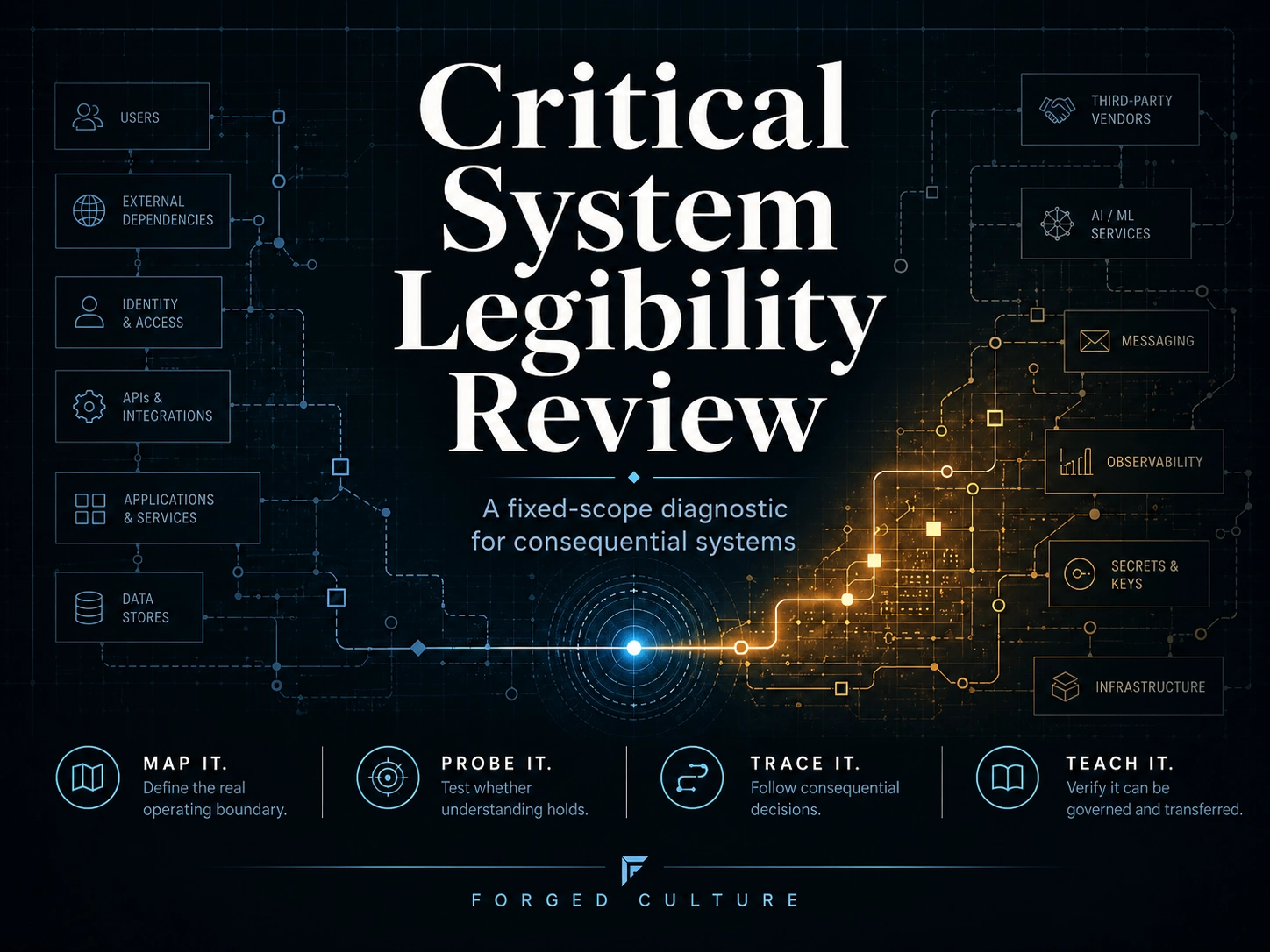
The method follows four movements. Map it establishes the actual operating boundary, including consequential dependencies, where knowledge resides, who can change system behavior, and who bears the cost when that behavior is wrong. Probe it tests whether claimed understanding survives specific questions about behavior, assumptions, dependencies, exceptions, and recent change. Trace it follows a consequential decision backward through authorization, evidence, reasoning, overrides, and the surviving record. Teach it tests whether understanding survives handoff by asking whether another accountable person can operate, challenge, alter, escalate, or recover the system without depending on tribal knowledge or the original author.
The evidence request stays correspondingly small. Depending on the system, useful artifacts can include recent change history, operating instructions, architecture or dependency documentation, decision records, escalation paths, incident evidence, rollback procedures, vendor responsibility boundaries, or operational telemetry. I do not need unrestricted access to the client's environment or a dump of every document the organization has accumulated since the Bronze Age. I need enough evidence to test the operating claims that matter.
The method is deliberately evidence-first. A polished process description may tell me how the system is supposed to work; a recent material change, actual escalation, rollback path, or consequential decision can show how responsibility and control work when somebody has to act. The gap between those two is often more useful than either artifact by itself.
What the client receives
The primary deliverable is a concise leadership readout rather than a large consulting report. Findings are examined through five dimensions of operational legibility. System legibility asks whether consequential behavior and dependencies can be reconstructed well enough to support responsible operation. Knowledge legibility asks where genuine understanding resides and where it has become concentrated or externalized. Decision legibility tests whether consequential choices can be reconstructed from evidence and reasoning. Authority legibility examines whether responsibility, formal authority, and practical ability to intervene actually correspond. Consequence legibility identifies who or what bears the cost when the system behaves incorrectly.
Those dimensions are lenses, not a promise to manufacture one defect in each category. A material finding has to connect evidence to an actual legibility gap or concentration, explain the consequence created by that condition, and identify the smallest credible intervention that would improve responsible control. If the evidence does not support a finding, the answer is not to invent symmetry. The answer is that the evidence does not support the claim.
Where corrective action is warranted, I use OTW-E to keep the recommendation operable. Owner identifies who carries the obligation. Time establishes when it must be addressed. Witness identifies who can verify that the change actually occurred. Evidence defines what will demonstrate completion. The point is not to produce a giant remediation backlog or an ornamental maturity score. It is to identify the first move that materially improves the organization's ability to understand, govern, or intervene in the system.
What the review does not claim
A Critical System Legibility Review is not a penetration test, security assessment, compliance audit, architecture certification, AI model validation, legal opinion, clinical review, regulatory certification, source-code review, or implementation engagement. It does not certify that a system is safe, compliant, secure, or correct. It tests a narrower and more operational question: whether the people carrying responsibility for a consequential system possess enough knowledge, decision traceability, authority, and intervention capability to exercise informed judgement over it.
Not every system warrants the same level of legibility. Trying to make every dependency, workflow, and internal tool equally inspectable would be expensive, slow, and mostly performative. Consequential systems are different because the price of misunderstanding them is borne somewhere real. For systems that can materially affect money, care, safety, access, trust, or legal standing, the governing principle is simple. Know who understands the system, know who can change it, know who can be harmed, and make sure those lines cross on purpose.
Like this project
Posted Sep 26, 2026
A fixed-scope diagnostic for testing whether accountable teams can explain, govern, and safely intervene in consequential systems.