
Nikolai Pavlov
Senior Low-Code Architect | Supabase, WeWeb & FlutterFlow
New to Contra
Nikolai is ready for their next project!


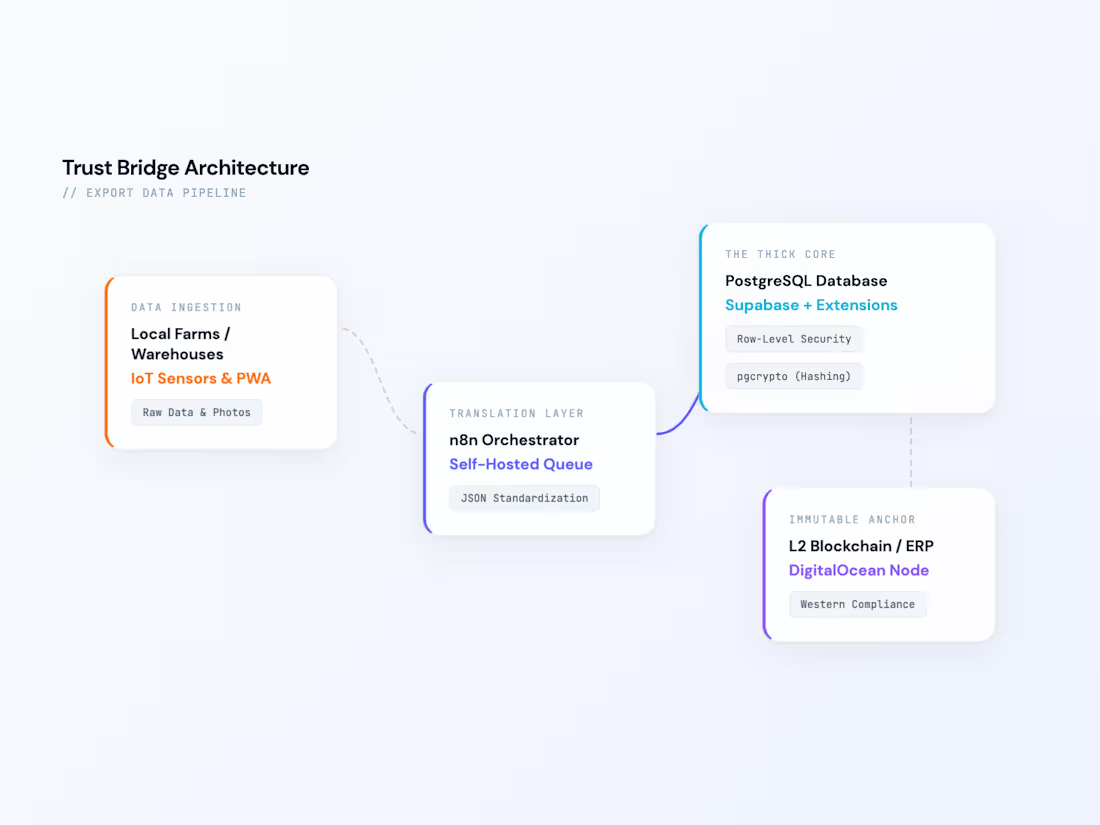
Beautiful UI cannot pass a Compliance Audit. Resilient Architecture does.
In the rush to build fast MVPs, many founders and agencies focus entirely on the frontend, gluing the backend together with fragile No-Code automation tools.
But when you are building B2B platforms in Logistics, FinTech, or HealthTech, a "silent failure" in an API webhook isn't just a bug—it’s a lost contract or a compliance fine.
I just published an engineering deep-dive on Medium covering the "Thick Database" Strategy.
I explore how to encapsulate complex business logic natively inside PostgreSQL (using extensions like pgcrypto for hashing, earthdistance for logistics routing, and pg_partman for heavy IoT logs).
By keeping the compute inside the database and only using orchestration (n8n/Deno) for network I/O, we build systems that are mathematically secure and infinitely scalable.
If you're designing a beautiful product, make sure it has a titanium spine. Read the full blueprint on my Medium. (https://medium.com/the-system-blueprint/the-traceability-gap-architecting-data-pipelines-for-emerging-market-arbitrage-87f791967fad)
#SystemsArchitecture #Supabase #BackendEngineering #DatabaseDesign
1
3
192
Digital Concrete: Architecting a Structured SMTP Gateway for Equine Health
Equine health records are traditionally a black hole of lost paper and forgotten notes. In the field, data entry is a battle against the elements - mobile apps often fail here because they ignore the physical reality of a vet’s work. When I architected the ESQ Engine, I didn't build another complex interface for professionals to fight with. I built a Structured SMTP Gateway that turns the world’s most universal protocol - email -into a surgical data-entry tool.
My architectural philosophy for this project was "Zero-Friction Integrity." In a barn, a specialist won't tap through twenty screens to log a medical report. They want to type a quick email from their desktop or phone and be done. The ESQ Engine meets them exactly where they are, but it enforces a rigid, database-ready structure on the backend. It’s a passive hub that translates human intent into atomic records without the need for a UI.
At the core of the engine is Unique Horse Hashing. Every horse in the system is assigned a unique, private email address that acts as its personal data vault. But receiving mail is only the beginning; we needed a security layer that acts as a digital bouncer. To protect data privacy, I implemented SMTP-level Verification. The system performs a real-time handshake: if the sender’s email doesn't match a registered, verified professional in our database, the engine silently drops the connection. This ensures that every entry in a horse’s history is authenticated at the source.
Once authorized, the system transitions from security to precision. Using a high-performance parsing logic, the ESQ Engine scans the incoming text for specific patterns. It extracts the horse's name, the service performed, and the Soundness Score with surgical accuracy. This ensures that even though the input method is fluid and familiar (email), the output is absolute. The data is parsed, validated, and instantly mapped to the horse's unique identifier in the database—all without the professional ever seeing a spreadsheet or a login screen.
The lifecycle concludes with Automated Sync and Notification. The moment a record is committed, the engine triggers a cleanup routine: attachments like radiographs and CT scans are stripped, optimized, and filed into secure S3 storage. Simultaneously, a push notification is dispatched to the horse owner. This creates a real-time, verified medical history that is unhackable by human forgetfulness.
I specialize in taking fragmented, manual industries and building the underlying concrete that holds their data together. The ESQ Engine doesn't just store notes; it creates a trusted, chronological audit trail for the life of an animal. It’s a solution that proves the most sophisticated technology is often the one you can’t even see. If your infrastructure relies on users remembering to use a clunky app, you’re building on sand. I build on logic.
3
2
264
It’s Friday evening, the week is winding down, and I’m sipping tea, reflecting on a conversation I had with a founder earlier this week.
We were discussing security. Specifically, how to stop a disgruntled former employee from taking the entire customer database with them when they leave.
His solution? "We’re thinking about signing an Enterprise contract with Okta or Auth0."
I almost choked on my tea.
Don't get me wrong, Okta is a beautiful product. But it’s also the most effective legal extortion mechanism in the B2B world. They hook you with a $6/user sticker price, but the moment you need actual security—like Adaptive MFA, API access, or automated offboarding—you realize those features are locked behind "Enterprise" add-ons.
Suddenly, a mid-sized team is paying $25 per internal user, plus thousands more for their customer identities (CIAM) through Auth0. And worst of all? You’re now managing two separate, siloed systems.
The "Okta Tax" isn't just a monthly bill; it's a tax on your engineering team's time.
I told him to put the credit card away and let me build him an open-source fortress instead.
My approach: The Authentik Engine
I deployed authentik (an incredible open-source Identity Provider) on a secure, self-hosted AWS environment. Yes, configuring OIDC apps, mapping granular RBAC (Role-Based Access Control) policies, and setting up token expiration is complex. It’s not "click-and-play."
But here is the ROI:
Unified Identity: Workforce (employees) and CIAM (customers) live in the same system. One dashboard.
The Ultimate Kill Switch: I orchestrated the authentik API using n8n. If an employee is terminated, an automated webhook revokes their access across every single internal app (Appsmith, Retool, Supabase) in milliseconds.
Zero "SaaS Tax": The company now pays ~$25/month for the AWS instance, instead of bleeding $2,000+ monthly on licensing fees.
Sometimes, the most sophisticated architectural decision is knowing when to stop paying for shiny SaaS tools and start owning your infrastructure.
If your team is drowning in SaaS subscriptions just to keep your data secure, let's talk about building a real backbone. Have a great weekend!
2
2
235
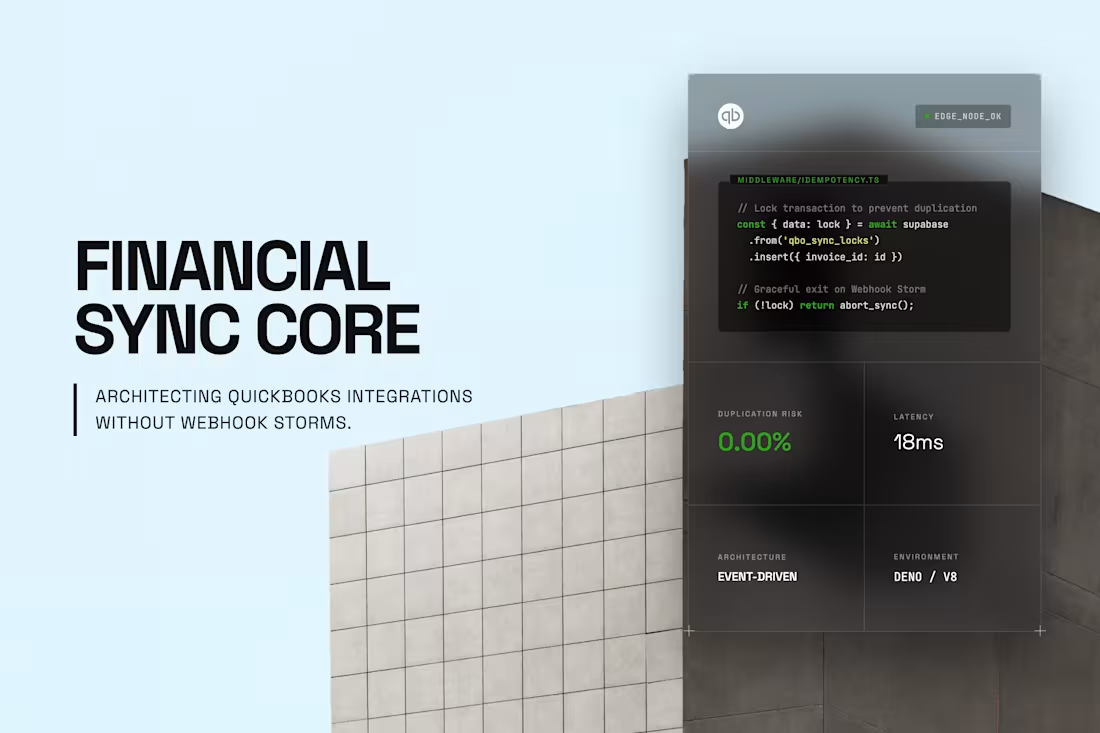
Taming the QuickBooks API: Architecting a Bulletproof Financial Sync
Grab a cup of coffee. Let’s talk about one of the most notoriously unforgiving tasks in software architecture: integrating a custom SaaS platform with enterprise accounting software like QuickBooks Online (QBO).
If you’ve ever integrated Stripe or PayPal, you know it’s relatively straightforward. Money moves, a webhook fires, the status changes. But accounting software is different. It’s not just about moving money; it’s about Audit Trails, Chart of Accounts, and Tax Compliance. One wrong API call, and you can ruin a company's annual tax return.
Recently, I led the architecture and integration of QuickBooks Online for Sound Equine Pro — a specialized CRM and financial management app for equine professionals (farriers, veterinarians).
Here are the critical architectural challenges I faced and the solutions that turned a potential data nightmare into a seamless, invisible assistant for our users.
Challenge 1: The "Source of Truth" Trap (Why Two-Way Sync is a Bad Idea)
When clients ask for a QuickBooks integration, they usually say: "I want everything to sync both ways instantly." As an architect, my first job was to push back against this.
If a bookkeeper changes an invoice amount inside QuickBooks to balance the books, should that change propagate back to the mobile app and overwrite the original invoice the farrier created in the barn? Absolutely not.
The Architectural Rule:
We established a strict boundary of responsibility.
Sound Equine Pro is the Source of Truth for Operations (Clients, Horses, Services, Invoice generation).
QuickBooks is the System of Record for Taxes.
Data flows strictly One-Way (App ➔ QBO) for all master data and invoices. The only exception is Payments. If a client pays an invoice via a QuickBooks payment link, QBO sends a webhook to our app to close the balance. This separation prevents data mutation loops and protects the operational integrity of the app.
Challenge 2: Domain Mapping (How do you put a Horse in QuickBooks?)
QuickBooks doesn't have a "Horse" category. It has Customers, Vendors, and Items. But for a veterinarian, tracking profitability per horse is a killer feature.
The Solution:
Instead of flat mapping, we utilized QuickBooks' Sub-customer (Jobs) architecture.
The human owner becomes the Customer.
The horse becomes the Sub-customer (e.g., Larissa Maslow : Gunner's Hotrod).
To make this work asynchronously, I designed a specialized SQL View (qbo_unified_horses_view) in PostgreSQL. This view intelligently combined both native application horses and "shadow" (offline) horses, retrieved their parent’s qbo_id, and fed a clean, flat data structure to our Edge Functions. The result? Flawless P&L reports for the CPA without the user doing any extra manual data entry.
Challenge 3: Surviving the "Webhook Storm" and Race Conditions
Modern apps use database triggers to keep data consistent. In our Supabase architecture, creating an invoice involves multiple steps: inserting the invoice, inserting items, calculating totals via triggers, and adding notes.
Initially, this caused a massive Webhook Storm. Saving one invoice in the app fired 4-5 simultaneous UPDATE webhooks to our Edge Function.
The Resulting Bug: Five parallel Serverless Functions raced to QuickBooks, trying to create the same invoice. QBO allowed it, creating duplicates. When we tried to update the invoice later, QBO threw a Stale Object Error (SyncToken collision).
The Engineering Fix (Idempotency & Debouncing):
I re-architected the qbo-sync-worker Edge Function into a robust Dispatcher.
Locking Mechanism: The first webhook to arrive instantly writes a processing status to the database. The subsequent webhooks see this lock and gracefully terminate.
Smart Filtering: The function compares old_record and new_record payloads from the Supabase webhook. If only technical fields changed, it aborts.
Retry Logic with Backoff: If QuickBooks still throws a Stale Object Error due to rapid user edits, the function catches the error, waits for 2 seconds, fetches the latest SyncToken from QBO, and retries the operation.
Challenge 4: The "Uncategorized" Grace
To create an Item or Expense in QBO via API, you must provide an Income/Expense Account ID. But asking a farrier to map Chart of Accounts in a mobile app is terrible UX.
The Automation:
During the initial OAuth 2.0 handshake, a background worker silently queries the user's QuickBooks account for default accounts like "Uncategorized Expense". It saves these IDs to our database. When the user logs a $50 expense for horseshoes in the app, the worker routes it to the Uncategorized bucket. The CPA can easily review and reassign these at the end of the month.
The Tech Stack
Backend & Database: Supabase, PostgreSQL (with heavy use of Views and Row Level Security).
Compute: Deno-based Edge Functions (Serverless).
Integration: QuickBooks Online API (OAuth 2.0, Batch API for performance, Webhooks).
***
Integrating with enterprise accounting software requires moving beyond basic CRUD operations. It demands defensive programming, strict data governance, and an understanding of how accountants actually work. By leveraging Event-Driven architecture and intelligent Edge Functions, we built a silent, powerful bridge that handles the financial heavy lifting, allowing equine professionals to do what they do best: care for the horses.
Are you looking to integrate complex third-party APIs (ERPs, Accounting, Payment Gateways) into your SaaS without compromising performance or data integrity? Let's connect and discuss your architecture.
2
191