

DEMONSTRATION 4 — Teaching Resource: Solids Balance in Blending
AI-assisted self-initiated educational sample. Hypothetical inputs; not a client project or a record of measured production.
Learning outcome: calculate the mass fraction of solids after blending, using conservation rather than an unweighted average.
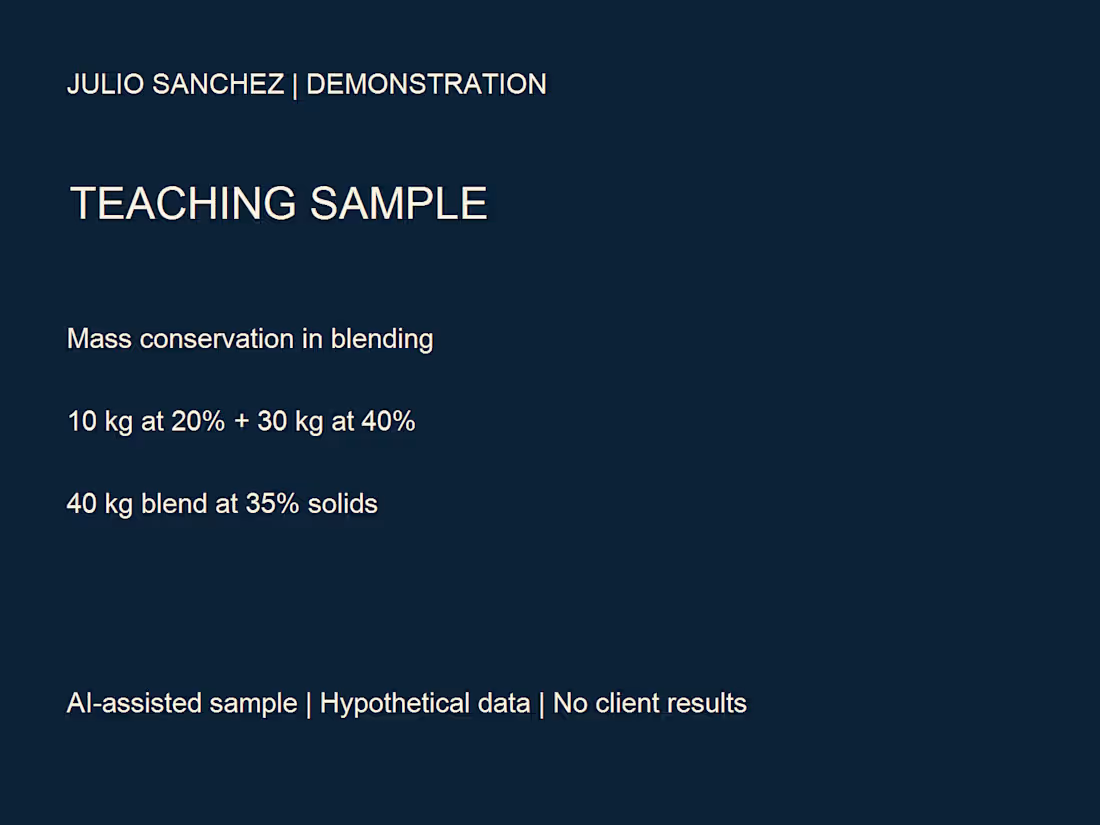
Problem: mix 10 kg of stream A at 20% solids with 30 kg of stream B at 40% solids. Assume no mass loss, reaction or evaporation.
Worked solution: total mass = 10 + 30 = 40 kg. Solids from A = 10 × 0.20 = 2 kg. Solids from B = 30 × 0.40 = 12 kg. Total solids = 14 kg. Final mass fraction = 14/40 = 0.35, or 35% solids by mass.
Board sequence: draw two input arrows and one output; label mass and composition; write total and solids balances; substitute values; check units. The answer lies between 20% and 40% and closer to 40% because B contributes more mass.
Common error: (20% + 40%)/2 = 30% ignores the unequal masses.
Practice: 15 kg at 12% plus 5 kg at 28%. Answer: (1.8 + 1.4)/20 = 16% solids.
Assessment: students must show both balances and explain why the simple average fails. This sample illustrates instructional structure and quantitative checking.
1
9
DEMONSTRATION 3 — Technical Review: Markup vs Margin
AI-assisted educational sample using hypothetical numbers. No client engagement claimed.
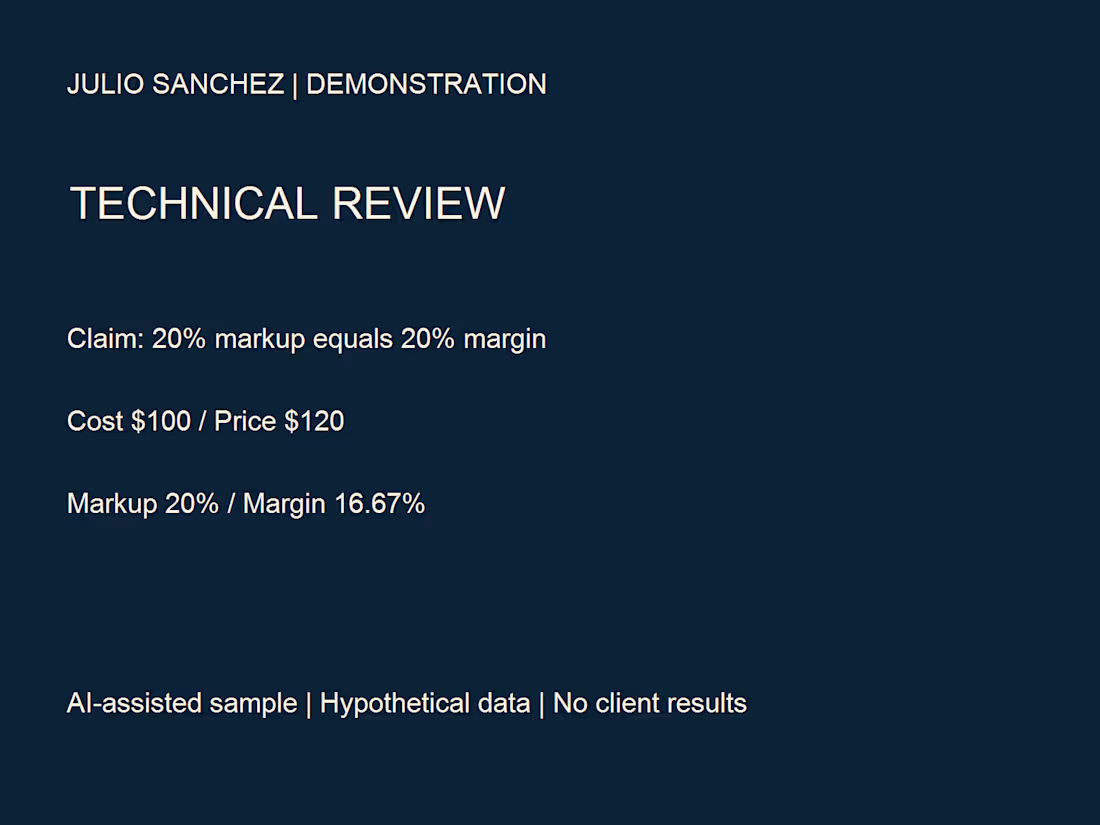
Claim to audit: “A product costing $100 and sold for $120 earns a 20% margin.”
Review: gross difference = $120 - $100 = $20. Markup uses cost as denominator: 20/100 = 20%. Margin uses sales as denominator: 20/120 = 16.67%. The claim confuses two different measures.
To target a 20% margin on the same cost boundary: price = 100/(1-0.20) = $125. Check: (125-100)/125 = 20%.
Technical reporting method: define the cost boundary, state whether price excludes taxes, keep periods and units consistent, recalculate the claim, and separate a numerical correction from a business recommendation. Actual net profit also depends on expenses outside the selected cost boundary.
1
13
DEMONSTRATION 2 — Formulation Scaling & Mass Balance
AI-assisted educational sample; hypothetical data, no client or validated product claimed.
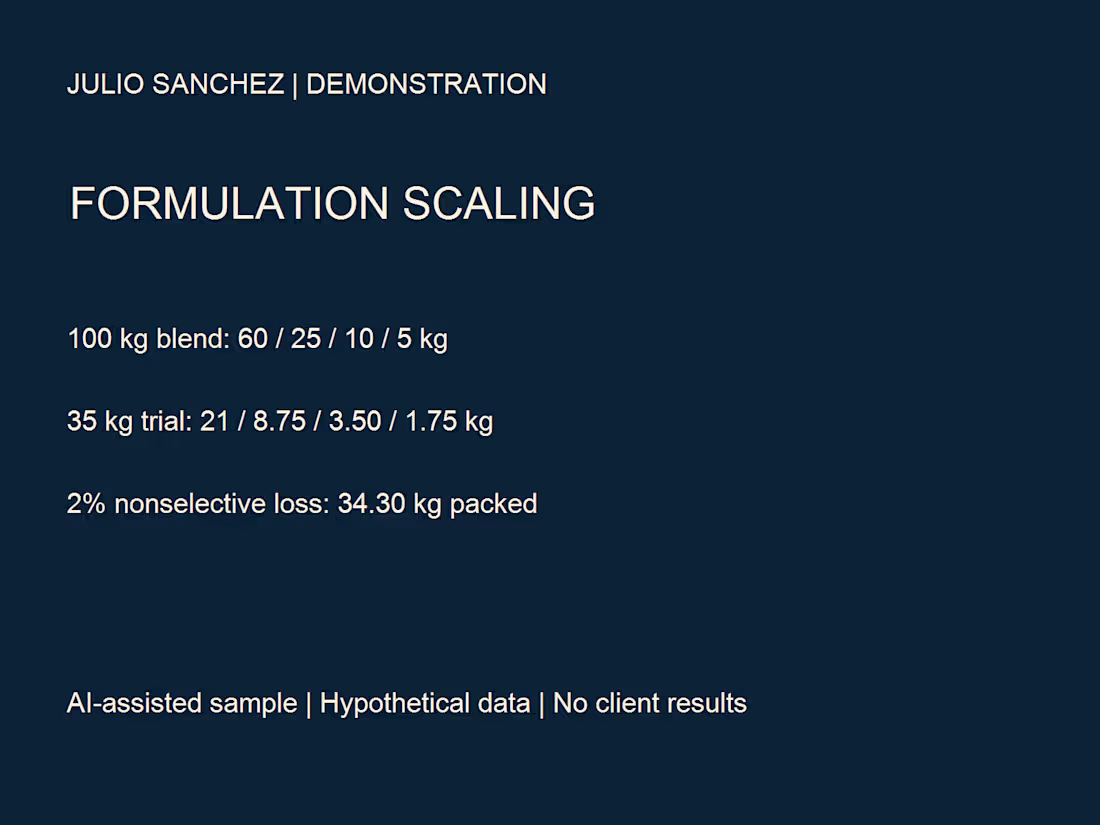
For a proposed 100 kg blend: ingredient A 60%, B 25%, C 10%, D 5%. Total = 100%; quantities = 60, 25, 10 and 5 kg. For a 35 kg trial, multiply each fraction by 35: 21, 8.75, 3.50 and 1.75 kg; sum = 35 kg.
If nonselective handling loss is assumed at 2%, packed output = 35 × 0.98 = 34.30 kg. At 0.5 kg per pack, that is 68 full packs plus 0.30 kg remainder. To target 100 kg packed, gross input = 100 / 0.98 = 102.0408 kg.
Checks: distinguish percentage from mass, gross input from packed output, and theoretical yield from measured yield. Selective losses require component balances rather than proportional scaling. This is a calculation demonstration, not a finished recipe, safety assessment or shelf-life validation.
0
2

Demonstration: Food Product Costing & Break-Even
0
1