
Jorge Stachoviack
Co-founder at Statro — AI Systems & B2B Strategy
New to Contra
Jorge is ready for their next project!
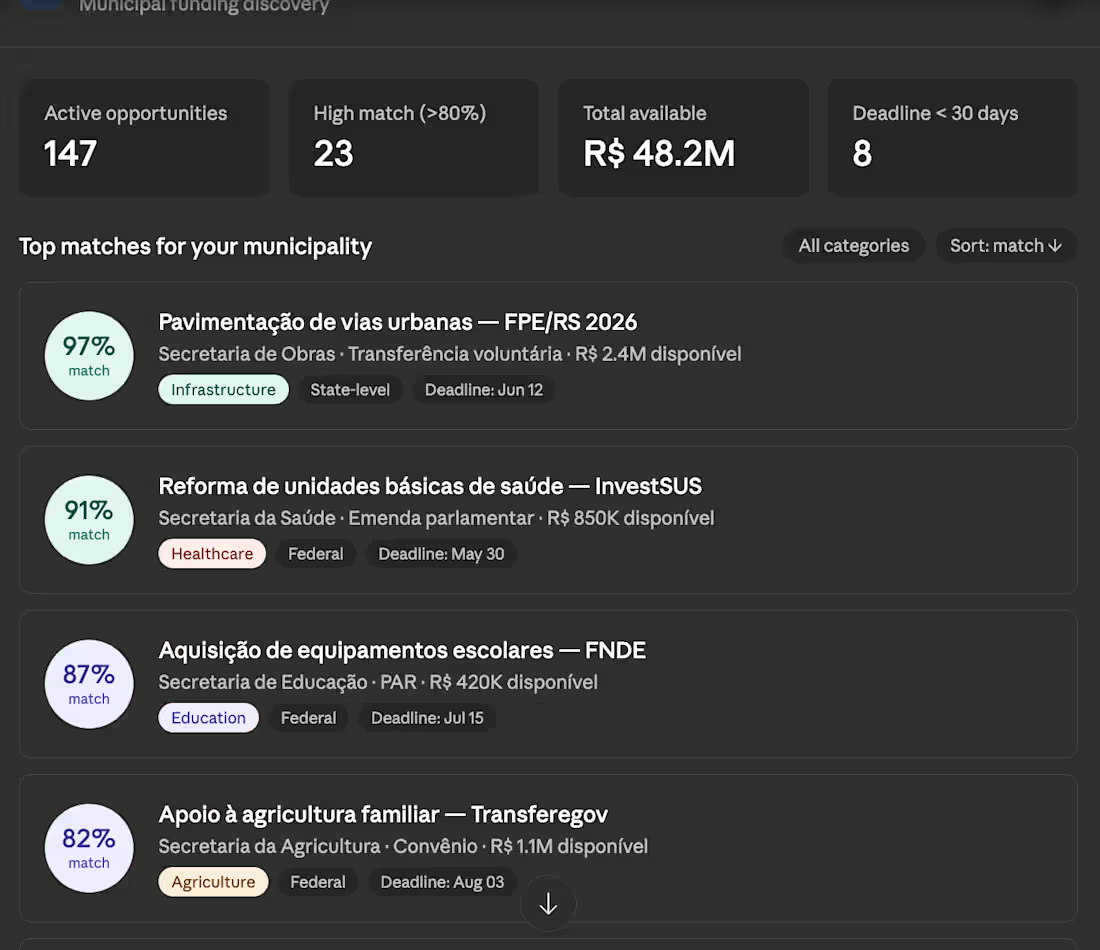
Editais.AI (http://Editais.AI) — AI-Matched Funding Discovery for Public Sector
Concept prototype: LLM-based matching engine that identifies federal funding opportunities for municipalities based on their strategic profile.
A research prototype I built to explore AI-driven matching in complex regulatory domains. The idea: municipalities miss millions in federal funding every year because grant discovery is manual, fragmented across government portals, and requires reading hundreds of pages of technical requirements.
The prototype
Ingests active funding programs from multiple government platforms (federal and state-level)
Builds a structured profile of each municipality (size, sector priorities, current projects, eligibility history)
Uses an LLM to score fit between each grant and each municipality — not just keyword matching, but semantic alignment with strategic goals
Generates a ranked list of opportunities with auto-drafted application outlines
Why it matters
This approach generalizes. Any domain where unstructured regulatory content meets structured eligibility criteria — grants, RFPs, tax incentives, compliance frameworks — can be approached the same way. The prototype validated the core architecture; the productization is ongoing through a sister project (DocLicit IA, which handles the downstream document generation step).
Status
Concept prototype and technical architecture. Used as the foundation for ongoing client conversations and as a reference implementation for similar matching problems in other verticals.
0
51
Business Process Automation with n8n, Make and Zapier
End-to-end automations connecting CRMs, databases, AI models and internal tools. Custom-built for operational bottlenecks.
I design and deploy automation workflows that eliminate repetitive operational work — connecting tools that weren't designed to talk to each other and inserting AI judgment where manual decisions used to happen.
Common use cases I've built:
Lead enrichment pipelines pulling data from multiple sources, scoring with an LLM, and pushing prioritized leads to CRM
Document intake workflows: incoming files trigger extraction, validation against business rules, and routing to the right human reviewer only when needed
Sales ops automation: proposal generation, contract routing, and post-sale handoff to operations
Internal reporting: scheduled data aggregation from SaaS tools → cleaned dataset → automated delivery to stakeholders
My approach
I don't just wire tools together. I map the actual business process first, identify the 20% of steps where automation pays off most, and build the smallest automation that removes the bottleneck. Most of my workflows include AI components (Claude or GPT) for the parts that used to require human interpretation — not just for show, but because they genuinely outperform rigid rule-based logic.
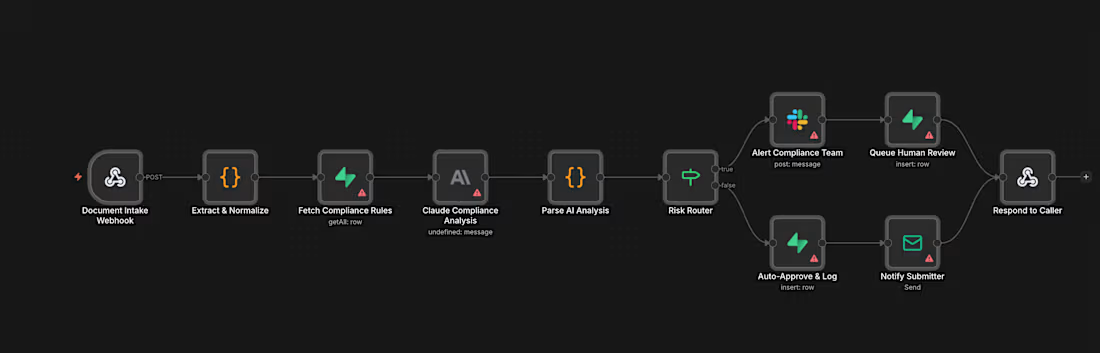
Example: I built a compliance document review pipeline that receives documents via webhook, fetches applicable rules from a database, analyzes the content with Claude against those rules, and then routes the result — auto-approving low-risk items, escalating high-risk items to human reviewers via Slack, and logging everything for audit. What used to be 30 minutes of manual review per document now takes 15 seconds.
Tools I work with daily: n8n (self-hosted), Make.com (http://Make.com), Zapier, plus custom Node.js/Python glue code when platforms hit their limits.
0
52
Production-ready AI agents that draft, review and route documents in regulated environments. Built on Claude and GPT with domain-specific guardrails.
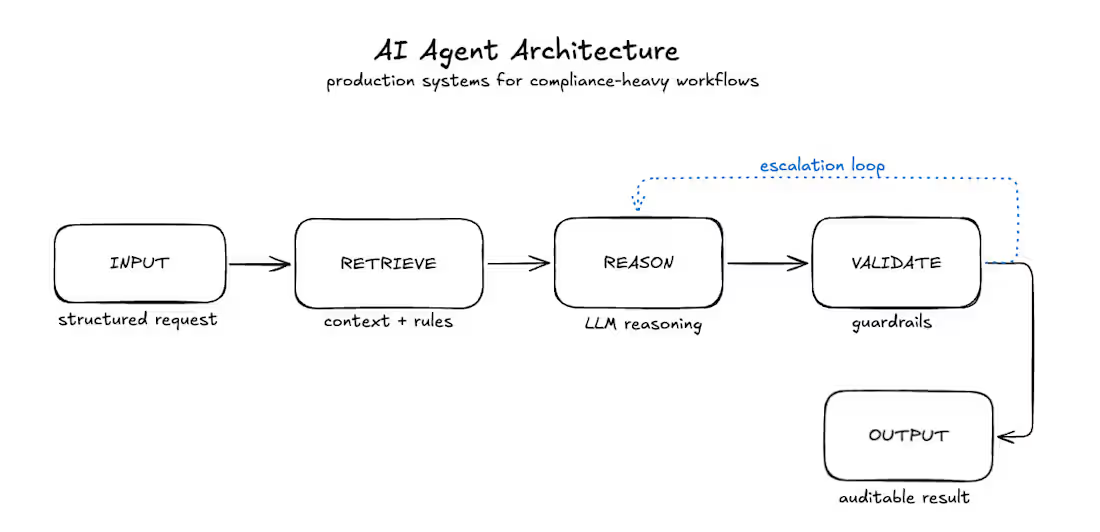
I build AI agents for operations where getting it wrong has real consequences — legal, financial, or regulatory. These aren't chatbots. They're production systems that execute multi-step workflows with the kind of guardrails that compliance-heavy teams actually need.
What "agent" means in my work
A focused, task-specific system that:
Takes structured or semi-structured input
Runs through a controlled multi-step reasoning process
Executes actions (write, retrieve, validate, route)
Includes escalation paths for edge cases
Produces auditable output with traceable reasoning
Typical engagements
Contract and document review agents: extract obligations, flag risks, compare against playbooks
Procurement and RFP drafting agents (my specialty — see DocLicit case study)
Internal policy Q&A agents with strict grounding in source documents
Intake and triage agents for operations teams drowning in unstructured requests
How I work
Typical engagement is a 2-4 week sprint. Week 1: deep workflow mapping, define success criteria, identify the critical failure modes. Weeks 2-3: build, test with real documents, iterate. Week 4: deploy, hand off, and document for the team. Most clients see the first meaningful output within 10 days.
Background: I built and shipped an LLM system for public procurement that reduced document creation time from 3 days to 30 minutes. That's not a thought experiment — it's running with paying municipal clients today.
0
57
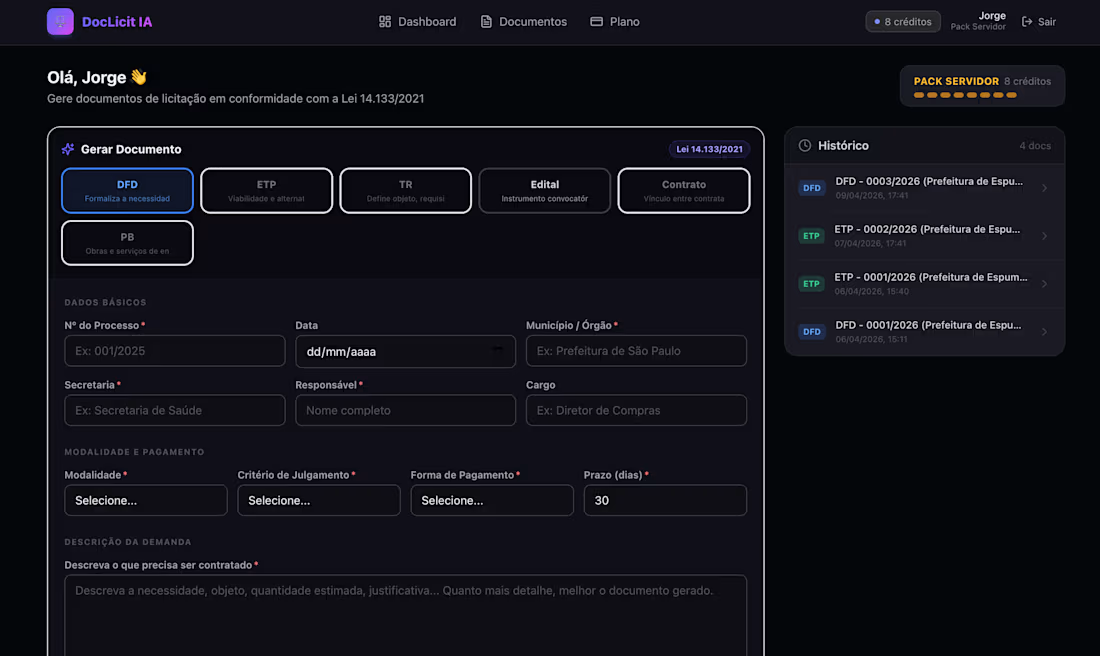
DocLicit IA — LLM-Powered Document Generation for Public Procurement
Cut procurement document creation from 3 days to 30 minutes. AI SaaS live in beta with municipal governments.
DocLicit IA is a vertical SaaS that automates the generation of public procurement documents under Brazil's Federal Procurement Law (Lei 14.133/2021). It's built for small municipalities that lack specialized legal staff — a segment of roughly 4,000 cities in Brazil alone.
The Problem
Before DocLicit, a single procurement process (edital, termo de referência, estudo técnico preliminar, etc.) required 3 full days of manual drafting by a municipal legal specialist. Small cities rarely have one — they outsource at premium rates or delay procurement entirely, blocking critical public works and purchases.
The Solution
I designed and built an LLM-powered system where the user answers a short guided questionnaire, and the platform generates a complete, legally compliant procurement package in minutes. The AI is tuned specifically to the legal requirements of Lei 14.133/2021, producing documents ready for public audit.
Impact
Time-to-document: 3 days → 30 minutes (≈99% reduction)
Currently in beta with active municipal clients
Pricing structured to fit within direct-purchase exemption thresholds — removing the biggest adoption barrier for small public entities
What I Built
Full product architecture and technical leadership
Prompt engineering and RAG pipeline tuned to Brazilian procurement law
Next.js 14 frontend with Supabase backend
Stripe integration with pricing tiers designed around public-sector purchasing constraints
Anthropic Claude API as the core generation engine
This project is the proof that LLMs can replace specialist labor in compliance-heavy, jurisdiction-specific workflows — not with toy chatbots, but with production systems that ship real legal documents.
0
72